Myra Maybelle Shirley Reed Starr
Case Summary
Two days before her forty-first birthday, Myra Maybelle Shirley Reed Starr was riding home alone along a dirt road near Briartown in Indian Territory when someone shot her in the back. Twice. She fell from her horse, and the shooter approached and fired again, leaving wounds across her neck, shoulder, and face. It was February 3, 1889, and the woman the New York Times would soon call 'a most desperate woman' never saw forty-one. Her murder has never been solved.
History remembers her as Belle Starr, the 'Bandit Queen' of the Old West: pistol-carrying, sidesaddle-riding, a known associate of Jesse James who harbored outlaws at her ranch on the Canadian River. But the truth is both stranger and more human than the dime novel legend that was already being written before her body was cold. She had a classical education. She could play the piano. She had two children, a series of husbands who kept dying violently, and exactly one criminal conviction on her record: horse theft.
This is the story of how a Missouri innkeeper's daughter became America's most famous female outlaw, and who might have been waiting in ambush on that winter road outside Briartown.
February 5, 1848, Washington County (near Carthage), Missouri, USA(Age: 40)
February 3, 1889, Near Briartown, Indian Territory (present-day Oklahoma), USA (Gunshot wounds — ambushed with two shotgun blasts to the back, neck, shoulder, and face while riding home; murder officially unsolved)
Related Cases

Convicted
Connection tags:
Convicted
Connection tags:

Accused
Connection tags:

Accused
Connection tags:

Accused
Connection tags:

Convicted
Connection tags:
Case Details
The afternoon of February 3, 1889 was unremarkable in Indian Territory. Winter light, frozen mud, the kind of quiet that settles over river bottomland between seasons. Belle Starr had been visiting a neighbor and was riding home alone near Briartown, following a path she knew as well as the lines of her own hands. She was two days shy of her forty-first birthday.
She never made it home.
Someone waiting in ambush fired two shotgun blasts into her back. The force knocked her from her horse. Whoever it was then walked up and shot her again, peppering her neck, shoulder, and face with additional pellets. When her horse arrived at Younger's Bend riderless, her common-law husband Jim July Starr went looking. He found her body in the road.
The New York Times ran the story on February 6, three days after her death, describing her as "a most desperate woman." It was the kind of epitaph that told you everything about the legend and almost nothing about the life.
She was born Myra Maybelle Shirley on February 5, 1848, near Carthage in Washington County, Missouri, into comfort and stability rather than hardship. Her father, John R. Shirley, was a prosperous farmer and innkeeper who helped found the Carthage Female Academy, where his daughter received a classical education. She studied literature, excelled in her coursework, and became a competent pianist, her fingers moving across keys in a frontier parlor while the country outside slowly tore itself apart at its seams.
Her mother, Elizabeth Hatfield Shirley, was connected by blood to the Hatfield family, the same family that would become synonymous with one of American history's most savage and protracted feuds. Whether that lineage tells us anything about Belle's temperament is speculation. What it tells us is that she came from people who understood grievance.
The Civil War did not spare the Shirleys. Her older brother, John "Bud" Shirley, rode with bushwhacker guerrilla forces aligned with the Confederacy, and in June 1864 he was killed in Sarcoxie, Missouri. He was young. So was Belle, sixteen years old, watching her family's world crack apart. John Shirley sold his holdings and moved the family south, to a farm near Scyene, Texas, southeast of Dallas, where Confederate sympathizers and restless veterans were trying to build something new from the wreckage of a lost cause.
Texas in the post-war years was a combustible place. The men who drifted through Scyene included former soldiers with nowhere to go and young men whose moral education had been conducted on horseback with a gun in their hands. It was in this world that the piano-playing innkeeper's daughter found her footing.
In 1866, she married James C. Reed, a man already well acquainted with the wrong side of the law. Through Reed, Belle stepped into a social world that included the James-Younger Gang. Cole Younger's name would later circulate as a rumored father for her first child, a daughter born around 1866 and named Rosie Lee, though everyone called her Pearl. The paternity was disputed then and remains so; Jim Reed was the more likely father. A son followed, James Edwin, called Eddie by everyone who knew him. Whatever romantic ideas Belle may have held about outlaw life, they were tested early and often.
Reed was killed in August 1874 in Texas. A former gang member shot him to collect a reward. Belle was twenty-six, widowed, with two small children and no obvious path forward. She chose the one she knew.
She drifted into Indian Territory, the vast and only nominally governed land that would eventually become Oklahoma. It was outlaw country in the most literal sense: a jurisdictional tangle where the federal court at Fort Smith, Arkansas, under Judge Isaac C. Parker, was supposed to maintain order across an enormous expanse of territory with a limited number of deputy marshals. Criminals understood the geography better than the law did, and they used it accordingly.
Belle used it too. She assembled a loose network of cattle and horse thieves, operated from various locations in the Territory, and eventually found her way to Sam Starr, a Cherokee outlaw with land on the north side of the Canadian River. They married in June 1880 and she named their 62-acre property Younger's Bend, a nod either to the outlaws she had known or to the curve of the river itself, possibly both. The ranch became a known refuge for men on the run. Jesse James was among its guests.
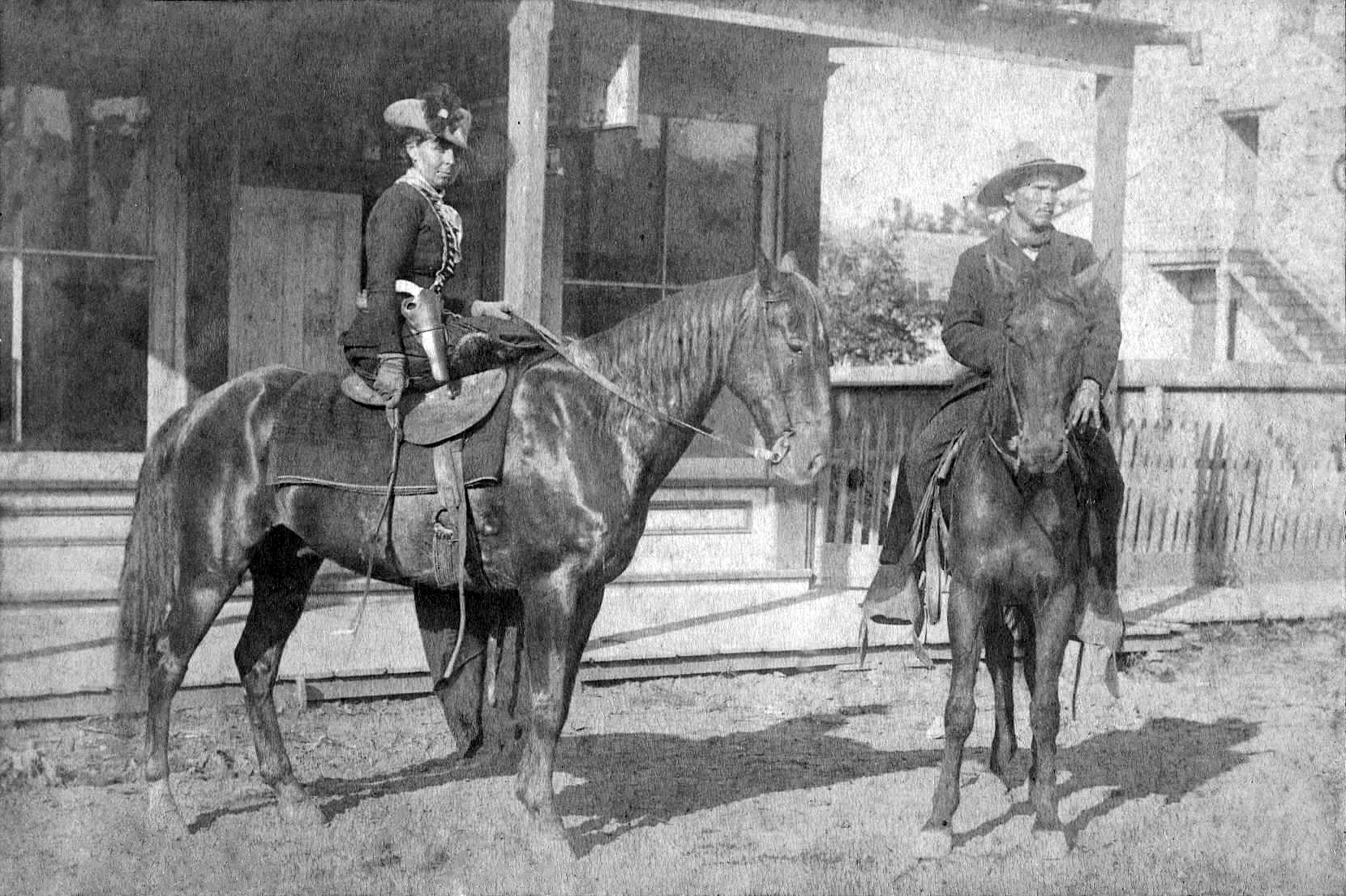
By this point, Belle Starr was something of a figure. She rode sidesaddle, famously, wearing black velvet riding habits and plumed hats, pearl-handled revolvers strapped across her hips on cartridge belts. She looked theatrical because she was. Belle understood that a woman in her position needed to be more than competent; she needed to be unforgettable. She succeeded on both counts. During her lifetime, newspapers dubbed her the "Petticoat Terror of the Plains."
Law enforcement eventually caught up with her. In November 1882, she and Sam Starr were charged in U.S. Commissioner's Court at Fort Smith with the larceny of two horses. The deputy who brought the charges was Bass Reeves, a man whose own story was extraordinary: formerly enslaved, he had escaped into Indian Territory during the Civil War, learned the land and its languages, and gone on to become the first Black deputy U.S. Marshal west of the Mississippi. Reeves was methodical, fearless, and effective. He brought in thousands of fugitives over his long career. Belle Starr was one of them.
On March 8, 1883, after a jury returned a guilty verdict, Judge Parker sentenced both Belle and Sam to one year in prison. Parker had earned his nickname, "The Hanging Judge," through genuine severity, and he ran his Fort Smith courtroom with iron consistency. Belle and Sam were transported to the federal penitentiary in Detroit, Michigan. They served nine months, released early for good behavior.
It was the only criminal conviction of Belle Starr's life. This fact deserves to sit with the reader for a moment, because it cuts directly against the legend. She was indicted three more times after her release, including once on a charge that she had participated in a post office robbery disguised as a man, but none of those charges produced a conviction. The woman history would remember as the most dangerous female outlaw of the American frontier had, in legal terms, a fairly thin record.
What she had instead was a life that kept accumulating loss. Sam Starr was killed in December 1886 in a gunfight with his cousin, a lawman named Frank West. Both men shot each other; both died of their wounds. By most accounts, the marriage to Sam had been the most stable relationship of Belle's adult life. His death left her widowed again and, more practically, at risk of losing her homestead. Property rights for non-native individuals in Indian Territory were complicated and contingent on specific legal arrangements.
She solved the problem practically. She entered into a common-law marriage with Jim July Starr, also known as Bill July, a Creek and Cherokee man roughly fourteen to fifteen years her junior and a relative of Sam by family connection. The arrangement gave her standing to remain at Younger's Bend. Whether there was genuine warmth in it is difficult to say; the relationship was reportedly stormy.
By early 1889, there were several people in Belle Starr's orbit with reason to wish her harm. Edgar Watson was a neighbor with whom she and Jim July had been feuding. Watson, it later emerged, had fled to Indian Territory from Florida, where he was wanted for murder. Her own son, Eddie Reed, was another suspect; Belle had recently beaten him for mistreating one of her horses, a punishment suggesting she may have valued her animals' welfare more than familial sentiment at that particular moment. Jim July Starr himself rounded out the list of suspects, his motive murky but his proximity to the crime undeniable.
None of them were ever charged. The investigation went nowhere. The murder of Myra Maybelle Shirley Reed Starr on February 3, 1889 remains officially unsolved.
The legend, meanwhile, was just getting started. That same year, dime novelist Richard K. Fox published "Bella Starr, the Bandit Queen, or the Female Jesse James," written by freelancer Alton B. Meyers. It was a bestseller. It was also largely fictional, a pulp confection that took a complicated woman and flattened her into an archetype: the pistol-twirling frontier queen, fearless and free. That book shaped how Americans would imagine Belle Starr for generations.
Her daughter Pearl had her mother buried at Younger's Bend and commissioned a white marble tombstone engraved with a bell, a star, and Belle's horse, along with an epitaph poem. The grave became a tourist attraction almost immediately. Pearl went on to operate a brothel in Fort Smith, reportedly to raise money for Eddie's release from prison after his own horse theft conviction. She secured a presidential pardon for him in 1893. The Starr children had complicated legacies to manage.
Belle Starr has been portrayed on screen by Gene Tierney in 1941, by Pamela Reed in "The Long Riders" in 1980, and by Elizabeth Montgomery in a television film that same year. Her story has been examined in books, documentaries, and museum exhibits at the Fort Smith National Historic Site. She has never entirely left the American imagination, which says something about the power of a well-constructed myth.
Strip the myth away, though, and what remains is something more interesting than the legend: a woman of genuine education and musical talent who survived the Civil War, two violent widowhoods, a federal prison sentence, and years of life in one of the most lawless regions of nineteenth-century America, only to be shot in the back on a dirt road two days before her birthday by someone who was never identified, never charged, and never held to account.
She was buried in the yard of her own home, on the land she had fought to keep. Whether she was a bandit queen or simply a woman who made the best of very difficult circumstances is a question the historical record, carefully examined, refuses to answer cleanly. Perhaps, as is so often true of lives lived at the American frontier's ragged edge, both things were true at once.
Timeline
Birth of Myra Maybelle Shirley
Myra Maybelle Shirley was born on February 5, 1848, near Carthage, Washington County, Missouri, to prosperous farmer and innkeeper John R. Shirley and Elizabeth Hatfield Shirley. Her mother was related to the Hatfield family of the infamous Hatfield-McCoy feud. The family called her 'May,' and she grew up in relative comfort, attending Carthage Female Academy where she received a classical education and became an accomplished pianist.
Her privileged upbringing and formal education stood in stark contrast to the outlaw life she would later lead, making her legend all the more compelling to the American public.
Civil War Devastates the Shirley Family
Belle's older brother John 'Bud' Shirley, who rode with bushwhacker guerrilla forces, was killed in Sarcoxie, Missouri, in June 1864. The loss shattered the family, and the Shirleys subsequently abandoned Missouri and relocated to a farm near Scyene, Texas, southeast of Dallas. This upheaval severed Belle from her comfortable childhood and placed the family in proximity to returning Confederate outlaws who would shape her future.
Bud Shirley's death and the family's forced relocation to Texas directly exposed Belle to the James-Younger Gang and other postwar outlaws, setting her on the path toward her criminal associations.
Marriage to Outlaw Jim Reed
Belle married James C. Reed, a Missouri-born outlaw, in 1866, and together they had two children: daughter Rosie Lee, nicknamed 'Pearl,' and son James Edwin, called 'Eddie.' Reed participated in stagecoach robberies and other criminal enterprises, keeping the family perpetually on the run from law enforcement. Their life together ended abruptly in August 1874 when Reed was shot and killed in Texas by a former gang member collecting a reward.
Marriage to Reed formally introduced Belle to the outlaw world and produced the two children who would figure prominently in the later chapters of her life, including Pearl's eventual career as a madam and Eddie's own criminal conviction.
Settlement at Younger's Bend with Sam Starr
Belle married Cherokee outlaw Sam Starr in June 1880 and settled on his 62-acre property on the north bank of the Canadian River in Indian Territory, which she defiantly named 'Younger's Bend.' The remote homestead quickly became a notorious sanctuary for wanted outlaws, reportedly including Jesse James himself, who could exploit the legal ambiguities of Indian Territory to evade federal pursuit. Belle reveled in her role as queen of this outlaw refuge, riding sidesaddle in black velvet habits and pearl-handled revolvers.
Younger's Bend became the physical and symbolic center of Belle's outlaw legend, cementing her reputation as a criminal matriarch and attracting the law enforcement attention that would lead directly to her only conviction.
Arrested by Deputy Marshal Bass Reeves
In November 1882, Deputy U.S. Marshal Bass Reeves — the first Black deputy U.S. Marshal west of the Mississippi River — charged Belle and Sam Starr in U.S. Commissioner's Court at Fort Smith, Arkansas, with the larceny of two horses. The arrest was a landmark moment, pitting one of the most celebrated lawmen of the frontier era against the woman who would become its most famous female outlaw. Belle was held to answer before the court of the formidable Judge Isaac C. Parker.
The arrest by Bass Reeves brought Belle before Judge Isaac Parker's feared court and set in motion the only criminal conviction of her life, transforming her from a regional nuisance into a nationally recognized figure.
Convicted of Horse Theft by Judge Isaac Parker
On March 8, 1883, a jury returned a guilty verdict against Belle and Sam Starr on the horse theft charges before Judge Isaac C. Parker — the infamous 'Hanging Judge' of Fort Smith. Parker sentenced both to one year in the federal penitentiary in Detroit, Michigan; they ultimately served nine months and were released early for good behavior. This conviction stands as the only formal criminal conviction of Belle Starr's entire life, a fact that historians note sharply contradicts her fearsome legend.
Her conviction before the legendary Hanging Judge, and her subsequent imprisonment, was the defining legal event of her life and the only time the justice system successfully prosecuted her despite multiple later indictments.
Sentencing and Federal Imprisonment in Detroit
Following Judge Parker's sentence, Belle and Sam Starr were transported to the federal penitentiary in Detroit, Michigan, to serve their one-year terms. Belle reportedly conducted herself with composure and even a degree of celebrity during her imprisonment, and both she and Sam were released after nine months for good behavior. Upon her return to Younger's Bend, rather than retreating from public life, Belle leaned further into her outlaw persona.
Her imprisonment, far from breaking her, arguably amplified her notoriety and hardened her identity as a defiant outlaw queen, while the early release demonstrated that even the federal system found her manageable when she chose compliance.
Death of Sam Starr in Gunfight
In December 1886, Sam Starr was killed in a gunfight with his cousin Frank West, a lawman; both men died of their wounds. Contemporaries noted this was reportedly the most loving and stable relationship of Belle's life, and his death left her both emotionally bereft and legally vulnerable, as her right to remain on the Indian Territory homestead depended on her status as the wife of a Cherokee citizen. She subsequently entered a common-law marriage with Jim July Starr, a Creek/Cherokee outlaw roughly 14–15 years her junior, primarily to preserve her legal claim to Younger's Bend.
Sam's death removed Belle's most important personal anchor and forced her into a pragmatic remarriage that kept her on the frontier but could not protect her from the ambush that would claim her life just over two years later.
Assassination Near Briartown, Indian Territory
On February 3, 1889 — just two days before her 41st birthday — Belle Starr was ambushed while riding home alone near Briartown, Indian Territory. She was struck by two shotgun blasts fired into her back; additional wounds were found on her neck, shoulder, and face, suggesting her attacker approached and fired again after she fell from her horse. She died from her wounds, and the murder was never officially solved, with primary suspects including neighbor Edgar Watson, her own son Eddie Reed, and her common-law husband Jim July Starr.
Her brutal and unsolved murder at the threshold of middle age transformed Belle Starr from a regional outlaw into an enduring American myth, and the unresolved question of who pulled the trigger has fueled speculation for more than 130 years.
Dime Novel Cements the Belle Starr Legend
In 1889, the year of her murder, New York publisher Richard K. Fox released 'Bella Starr, the Bandit Queen, or the Female Jesse James,' written by freelancer Alton B. Meyers. The book was a bestseller but was largely fictional, fabricating exploits and romanticizing Belle's life far beyond what the historical record supports. The New York Times had already reported her death on February 6, 1889, calling her 'a most desperate woman,' and the combination of sensational journalism and dime-novel mythology permanently enshrined her as the archetypal female outlaw of the American West.
The Fox publication was the single most consequential act in constructing the Belle Starr legend, divorcing her popular image from historical reality and ensuring that her name would endure in American culture long after more factually accurate accounts were available.
Crime Location
Photos
Belle Starr, Fort Smith, Arkansas, 1886

Belle Starr and Blue Duck

Belle Starr full

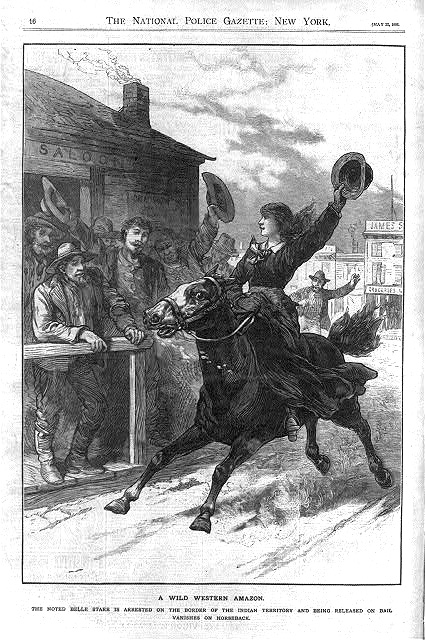
Belle Starr jumping bail, illustration from The National Police Gazette, May 22, 1886

Woolaroc - Belle Star 2

Myra Maybelle Shirley Reed Starr - Primary image
Myra Maybelle Shirley Reed Starr - Image 3
Sources
- Bella Starr, the Bandit Queen, or the Female Jesse James
- Belle Starr and Her Times: The Literature, the Facts, and the Legends
- Belle Starr
- A Most Desperate Woman (Death of Belle Starr)
- Fort Smith National Historic Site — Belle Starr and Judge Parker
- United States v. Belle Starr and Sam Starr — Horse Theft Conviction Records
- Bass Reeves: The Real Lone Ranger
- Fort Smith Museum of History
Frequently Asked Questions
Table of Contents
Case Summary
Two days before her forty-first birthday, Myra Maybelle Shirley Reed Starr was riding home alone along a dirt road near Briartown in Indian Territory when someone shot her in the back. Twice. She fell from her horse, and the shooter approached and fired again, leaving wounds across her neck, shoulder, and face. It was February 3, 1889, and the woman the New York Times would soon call 'a most desperate woman' never saw forty-one. Her murder has never been solved.
History remembers her as Belle Starr, the 'Bandit Queen' of the Old West: pistol-carrying, sidesaddle-riding, a known associate of Jesse James who harbored outlaws at her ranch on the Canadian River. But the truth is both stranger and more human than the dime novel legend that was already being written before her body was cold. She had a classical education. She could play the piano. She had two children, a series of husbands who kept dying violently, and exactly one criminal conviction on her record: horse theft.
This is the story of how a Missouri innkeeper's daughter became America's most famous female outlaw, and who might have been waiting in ambush on that winter road outside Briartown.
February 5, 1848, Washington County (near Carthage), Missouri, USA(Age: 40)
February 3, 1889, Near Briartown, Indian Territory (present-day Oklahoma), USA (Gunshot wounds — ambushed with two shotgun blasts to the back, neck, shoulder, and face while riding home; murder officially unsolved)
Case Details
The afternoon of February 3, 1889 was unremarkable in Indian Territory. Winter light, frozen mud, the kind of quiet that settles over river bottomland between seasons. Belle Starr had been visiting a neighbor and was riding home alone near Briartown, following a path she knew as well as the lines of her own hands. She was two days shy of her forty-first birthday.
She never made it home.
Someone waiting in ambush fired two shotgun blasts into her back. The force knocked her from her horse. Whoever it was then walked up and shot her again, peppering her neck, shoulder, and face with additional pellets. When her horse arrived at Younger's Bend riderless, her common-law husband Jim July Starr went looking. He found her body in the road.
The New York Times ran the story on February 6, three days after her death, describing her as "a most desperate woman." It was the kind of epitaph that told you everything about the legend and almost nothing about the life.
She was born Myra Maybelle Shirley on February 5, 1848, near Carthage in Washington County, Missouri, into comfort and stability rather than hardship. Her father, John R. Shirley, was a prosperous farmer and innkeeper who helped found the Carthage Female Academy, where his daughter received a classical education. She studied literature, excelled in her coursework, and became a competent pianist, her fingers moving across keys in a frontier parlor while the country outside slowly tore itself apart at its seams.
Her mother, Elizabeth Hatfield Shirley, was connected by blood to the Hatfield family, the same family that would become synonymous with one of American history's most savage and protracted feuds. Whether that lineage tells us anything about Belle's temperament is speculation. What it tells us is that she came from people who understood grievance.
The Civil War did not spare the Shirleys. Her older brother, John "Bud" Shirley, rode with bushwhacker guerrilla forces aligned with the Confederacy, and in June 1864 he was killed in Sarcoxie, Missouri. He was young. So was Belle, sixteen years old, watching her family's world crack apart. John Shirley sold his holdings and moved the family south, to a farm near Scyene, Texas, southeast of Dallas, where Confederate sympathizers and restless veterans were trying to build something new from the wreckage of a lost cause.
Texas in the post-war years was a combustible place. The men who drifted through Scyene included former soldiers with nowhere to go and young men whose moral education had been conducted on horseback with a gun in their hands. It was in this world that the piano-playing innkeeper's daughter found her footing.
In 1866, she married James C. Reed, a man already well acquainted with the wrong side of the law. Through Reed, Belle stepped into a social world that included the James-Younger Gang. Cole Younger's name would later circulate as a rumored father for her first child, a daughter born around 1866 and named Rosie Lee, though everyone called her Pearl. The paternity was disputed then and remains so; Jim Reed was the more likely father. A son followed, James Edwin, called Eddie by everyone who knew him. Whatever romantic ideas Belle may have held about outlaw life, they were tested early and often.
Reed was killed in August 1874 in Texas. A former gang member shot him to collect a reward. Belle was twenty-six, widowed, with two small children and no obvious path forward. She chose the one she knew.
She drifted into Indian Territory, the vast and only nominally governed land that would eventually become Oklahoma. It was outlaw country in the most literal sense: a jurisdictional tangle where the federal court at Fort Smith, Arkansas, under Judge Isaac C. Parker, was supposed to maintain order across an enormous expanse of territory with a limited number of deputy marshals. Criminals understood the geography better than the law did, and they used it accordingly.
Belle used it too. She assembled a loose network of cattle and horse thieves, operated from various locations in the Territory, and eventually found her way to Sam Starr, a Cherokee outlaw with land on the north side of the Canadian River. They married in June 1880 and she named their 62-acre property Younger's Bend, a nod either to the outlaws she had known or to the curve of the river itself, possibly both. The ranch became a known refuge for men on the run. Jesse James was among its guests.
By this point, Belle Starr was something of a figure. She rode sidesaddle, famously, wearing black velvet riding habits and plumed hats, pearl-handled revolvers strapped across her hips on cartridge belts. She looked theatrical because she was. Belle understood that a woman in her position needed to be more than competent; she needed to be unforgettable. She succeeded on both counts. During her lifetime, newspapers dubbed her the "Petticoat Terror of the Plains."
Law enforcement eventually caught up with her. In November 1882, she and Sam Starr were charged in U.S. Commissioner's Court at Fort Smith with the larceny of two horses. The deputy who brought the charges was Bass Reeves, a man whose own story was extraordinary: formerly enslaved, he had escaped into Indian Territory during the Civil War, learned the land and its languages, and gone on to become the first Black deputy U.S. Marshal west of the Mississippi. Reeves was methodical, fearless, and effective. He brought in thousands of fugitives over his long career. Belle Starr was one of them.
On March 8, 1883, after a jury returned a guilty verdict, Judge Parker sentenced both Belle and Sam to one year in prison. Parker had earned his nickname, "The Hanging Judge," through genuine severity, and he ran his Fort Smith courtroom with iron consistency. Belle and Sam were transported to the federal penitentiary in Detroit, Michigan. They served nine months, released early for good behavior.
It was the only criminal conviction of Belle Starr's life. This fact deserves to sit with the reader for a moment, because it cuts directly against the legend. She was indicted three more times after her release, including once on a charge that she had participated in a post office robbery disguised as a man, but none of those charges produced a conviction. The woman history would remember as the most dangerous female outlaw of the American frontier had, in legal terms, a fairly thin record.
What she had instead was a life that kept accumulating loss. Sam Starr was killed in December 1886 in a gunfight with his cousin, a lawman named Frank West. Both men shot each other; both died of their wounds. By most accounts, the marriage to Sam had been the most stable relationship of Belle's adult life. His death left her widowed again and, more practically, at risk of losing her homestead. Property rights for non-native individuals in Indian Territory were complicated and contingent on specific legal arrangements.
She solved the problem practically. She entered into a common-law marriage with Jim July Starr, also known as Bill July, a Creek and Cherokee man roughly fourteen to fifteen years her junior and a relative of Sam by family connection. The arrangement gave her standing to remain at Younger's Bend. Whether there was genuine warmth in it is difficult to say; the relationship was reportedly stormy.
By early 1889, there were several people in Belle Starr's orbit with reason to wish her harm. Edgar Watson was a neighbor with whom she and Jim July had been feuding. Watson, it later emerged, had fled to Indian Territory from Florida, where he was wanted for murder. Her own son, Eddie Reed, was another suspect; Belle had recently beaten him for mistreating one of her horses, a punishment suggesting she may have valued her animals' welfare more than familial sentiment at that particular moment. Jim July Starr himself rounded out the list of suspects, his motive murky but his proximity to the crime undeniable.
None of them were ever charged. The investigation went nowhere. The murder of Myra Maybelle Shirley Reed Starr on February 3, 1889 remains officially unsolved.
The legend, meanwhile, was just getting started. That same year, dime novelist Richard K. Fox published "Bella Starr, the Bandit Queen, or the Female Jesse James," written by freelancer Alton B. Meyers. It was a bestseller. It was also largely fictional, a pulp confection that took a complicated woman and flattened her into an archetype: the pistol-twirling frontier queen, fearless and free. That book shaped how Americans would imagine Belle Starr for generations.
Her daughter Pearl had her mother buried at Younger's Bend and commissioned a white marble tombstone engraved with a bell, a star, and Belle's horse, along with an epitaph poem. The grave became a tourist attraction almost immediately. Pearl went on to operate a brothel in Fort Smith, reportedly to raise money for Eddie's release from prison after his own horse theft conviction. She secured a presidential pardon for him in 1893. The Starr children had complicated legacies to manage.
Belle Starr has been portrayed on screen by Gene Tierney in 1941, by Pamela Reed in "The Long Riders" in 1980, and by Elizabeth Montgomery in a television film that same year. Her story has been examined in books, documentaries, and museum exhibits at the Fort Smith National Historic Site. She has never entirely left the American imagination, which says something about the power of a well-constructed myth.
Strip the myth away, though, and what remains is something more interesting than the legend: a woman of genuine education and musical talent who survived the Civil War, two violent widowhoods, a federal prison sentence, and years of life in one of the most lawless regions of nineteenth-century America, only to be shot in the back on a dirt road two days before her birthday by someone who was never identified, never charged, and never held to account.
She was buried in the yard of her own home, on the land she had fought to keep. Whether she was a bandit queen or simply a woman who made the best of very difficult circumstances is a question the historical record, carefully examined, refuses to answer cleanly. Perhaps, as is so often true of lives lived at the American frontier's ragged edge, both things were true at once.
Timeline
Birth of Myra Maybelle Shirley
Myra Maybelle Shirley was born on February 5, 1848, near Carthage, Washington County, Missouri, to prosperous farmer and innkeeper John R. Shirley and Elizabeth Hatfield Shirley. Her mother was related to the Hatfield family of the infamous Hatfield-McCoy feud. The family called her 'May,' and she grew up in relative comfort, attending Carthage Female Academy where she received a classical education and became an accomplished pianist.
Her privileged upbringing and formal education stood in stark contrast to the outlaw life she would later lead, making her legend all the more compelling to the American public.
Civil War Devastates the Shirley Family
Belle's older brother John 'Bud' Shirley, who rode with bushwhacker guerrilla forces, was killed in Sarcoxie, Missouri, in June 1864. The loss shattered the family, and the Shirleys subsequently abandoned Missouri and relocated to a farm near Scyene, Texas, southeast of Dallas. This upheaval severed Belle from her comfortable childhood and placed the family in proximity to returning Confederate outlaws who would shape her future.
Bud Shirley's death and the family's forced relocation to Texas directly exposed Belle to the James-Younger Gang and other postwar outlaws, setting her on the path toward her criminal associations.
Marriage to Outlaw Jim Reed
Belle married James C. Reed, a Missouri-born outlaw, in 1866, and together they had two children: daughter Rosie Lee, nicknamed 'Pearl,' and son James Edwin, called 'Eddie.' Reed participated in stagecoach robberies and other criminal enterprises, keeping the family perpetually on the run from law enforcement. Their life together ended abruptly in August 1874 when Reed was shot and killed in Texas by a former gang member collecting a reward.
Marriage to Reed formally introduced Belle to the outlaw world and produced the two children who would figure prominently in the later chapters of her life, including Pearl's eventual career as a madam and Eddie's own criminal conviction.
Settlement at Younger's Bend with Sam Starr
Belle married Cherokee outlaw Sam Starr in June 1880 and settled on his 62-acre property on the north bank of the Canadian River in Indian Territory, which she defiantly named 'Younger's Bend.' The remote homestead quickly became a notorious sanctuary for wanted outlaws, reportedly including Jesse James himself, who could exploit the legal ambiguities of Indian Territory to evade federal pursuit. Belle reveled in her role as queen of this outlaw refuge, riding sidesaddle in black velvet habits and pearl-handled revolvers.
Younger's Bend became the physical and symbolic center of Belle's outlaw legend, cementing her reputation as a criminal matriarch and attracting the law enforcement attention that would lead directly to her only conviction.
Arrested by Deputy Marshal Bass Reeves
In November 1882, Deputy U.S. Marshal Bass Reeves — the first Black deputy U.S. Marshal west of the Mississippi River — charged Belle and Sam Starr in U.S. Commissioner's Court at Fort Smith, Arkansas, with the larceny of two horses. The arrest was a landmark moment, pitting one of the most celebrated lawmen of the frontier era against the woman who would become its most famous female outlaw. Belle was held to answer before the court of the formidable Judge Isaac C. Parker.
The arrest by Bass Reeves brought Belle before Judge Isaac Parker's feared court and set in motion the only criminal conviction of her life, transforming her from a regional nuisance into a nationally recognized figure.
Convicted of Horse Theft by Judge Isaac Parker
On March 8, 1883, a jury returned a guilty verdict against Belle and Sam Starr on the horse theft charges before Judge Isaac C. Parker — the infamous 'Hanging Judge' of Fort Smith. Parker sentenced both to one year in the federal penitentiary in Detroit, Michigan; they ultimately served nine months and were released early for good behavior. This conviction stands as the only formal criminal conviction of Belle Starr's entire life, a fact that historians note sharply contradicts her fearsome legend.
Her conviction before the legendary Hanging Judge, and her subsequent imprisonment, was the defining legal event of her life and the only time the justice system successfully prosecuted her despite multiple later indictments.
Sentencing and Federal Imprisonment in Detroit
Following Judge Parker's sentence, Belle and Sam Starr were transported to the federal penitentiary in Detroit, Michigan, to serve their one-year terms. Belle reportedly conducted herself with composure and even a degree of celebrity during her imprisonment, and both she and Sam were released after nine months for good behavior. Upon her return to Younger's Bend, rather than retreating from public life, Belle leaned further into her outlaw persona.
Her imprisonment, far from breaking her, arguably amplified her notoriety and hardened her identity as a defiant outlaw queen, while the early release demonstrated that even the federal system found her manageable when she chose compliance.
Death of Sam Starr in Gunfight
In December 1886, Sam Starr was killed in a gunfight with his cousin Frank West, a lawman; both men died of their wounds. Contemporaries noted this was reportedly the most loving and stable relationship of Belle's life, and his death left her both emotionally bereft and legally vulnerable, as her right to remain on the Indian Territory homestead depended on her status as the wife of a Cherokee citizen. She subsequently entered a common-law marriage with Jim July Starr, a Creek/Cherokee outlaw roughly 14–15 years her junior, primarily to preserve her legal claim to Younger's Bend.
Sam's death removed Belle's most important personal anchor and forced her into a pragmatic remarriage that kept her on the frontier but could not protect her from the ambush that would claim her life just over two years later.
Assassination Near Briartown, Indian Territory
On February 3, 1889 — just two days before her 41st birthday — Belle Starr was ambushed while riding home alone near Briartown, Indian Territory. She was struck by two shotgun blasts fired into her back; additional wounds were found on her neck, shoulder, and face, suggesting her attacker approached and fired again after she fell from her horse. She died from her wounds, and the murder was never officially solved, with primary suspects including neighbor Edgar Watson, her own son Eddie Reed, and her common-law husband Jim July Starr.
Her brutal and unsolved murder at the threshold of middle age transformed Belle Starr from a regional outlaw into an enduring American myth, and the unresolved question of who pulled the trigger has fueled speculation for more than 130 years.
Dime Novel Cements the Belle Starr Legend
In 1889, the year of her murder, New York publisher Richard K. Fox released 'Bella Starr, the Bandit Queen, or the Female Jesse James,' written by freelancer Alton B. Meyers. The book was a bestseller but was largely fictional, fabricating exploits and romanticizing Belle's life far beyond what the historical record supports. The New York Times had already reported her death on February 6, 1889, calling her 'a most desperate woman,' and the combination of sensational journalism and dime-novel mythology permanently enshrined her as the archetypal female outlaw of the American West.
The Fox publication was the single most consequential act in constructing the Belle Starr legend, divorcing her popular image from historical reality and ensuring that her name would endure in American culture long after more factually accurate accounts were available.
Crime Location
Photos
Belle Starr, Fort Smith, Arkansas, 1886
Belle Starr and Blue Duck
Belle Starr full
Belle Starr jumping bail, illustration from The National Police Gazette, May 22, 1886
Woolaroc - Belle Star 2
Myra Maybelle Shirley Reed Starr - Primary image
Myra Maybelle Shirley Reed Starr - Image 3
Sources
- Bella Starr, the Bandit Queen, or the Female Jesse James
- Belle Starr and Her Times: The Literature, the Facts, and the Legends
- Belle Starr
- A Most Desperate Woman (Death of Belle Starr)
- Fort Smith National Historic Site — Belle Starr and Judge Parker
- United States v. Belle Starr and Sam Starr — Horse Theft Conviction Records
- Bass Reeves: The Real Lone Ranger
- Fort Smith Museum of History
Frequently Asked Questions
Related Cases
Convicted
Connection tags:
Convicted
Connection tags:
Accused
Connection tags:
Accused
Connection tags:
Accused
Connection tags:
Convicted
Connection tags:
Tags
Popular Culture
movie (1941)
Hollywood biographical film starring Gene Tierney as Belle Starr, depicting a romanticized and largely fictionalized version of her life as a Confederate sympathizer and outlaw.
TV (1980)
Television movie starring Elizabeth Montgomery as Belle Starr, offering a dramatized retelling of her outlaw life in Indian Territory.
movie (1980)
Western film depicting the James-Younger Gang in which Pamela Reed portrays Belle Starr, reflecting her historical association with Cole Younger and the gang.
book (1889)
Sensationalized dime novel by Richard K. Fox (ghostwritten by Alton B. Meyers) that invented much of the Belle Starr myth and established her as a national outlaw celebrity; a bestseller in the year of her murder.
book (1982)
Scholarly biography by Glenn Shirley that rigorously separates Belle Starr's real history from the myths created by dime novelists and popular culture.
documentary (2010)
Documentary featuring Belle Starr as one of the most notorious women of the American frontier, examining her criminal record, murder, and enduring legend.
documentary (1992)
PBS American Experience documentary examining the real life of Belle Starr versus the mythologized outlaw queen of dime novels and Hollywood films.