Verónica Mireya Moreno Carreón
Case Summary
She had been decorated for bravery. She had taken a bullet in the line of duty, recovered, and returned to the streets of San Nicolás de los Garza as what colleagues called a model police officer. Then Verónica Mireya Moreno Carreón walked out of her uniform and into the most violent organization in northern Mexico. By the fall of 2011, Mexican Navy intelligence had identified her as the plaza boss of Los Zetas in San Nicolás, the first woman known to hold formal territorial command within the cartel's brutal hierarchy. She managed executions, torture operations, extortion networks, drug distribution, and a web of corrupted police officers, some of whom she almost certainly knew from her years on the force. When marines finally caught up with her in a stolen vehicle in a working-class neighborhood, they found a revolver, 150 doses of cocaine and crack, marijuana, and six cell phones. She was barely 35 years old. Her story has no clean ending: no publicly confirmed conviction, no final sentence on record. What remains is a portrait of institutional failure, personal transformation, and a question Mexico's justice system has never fully answered.
unknown (approximately 1976, based on reported age of ~35 at time of 2011 arrest), San Nicolás de los Garza, Nuevo León, Mexico (likely)(Age: Unknown)
Related Cases
Alleged
Connection tags:

Convicted
Connection tags:
Convicted
Connection tags:
Convicted
Connection tags:

Alleged
Connection tags:

Accused
Connection tags:
Case Details
The marines moved through Colonia Santa Fe Oriente in the predawn quiet of September 2011, working off weeks of accumulated intelligence that had finally triangulated to this neighborhood in San Nicolás de los Garza, a mid-sized city folded into the sprawling metropolitan shadow of Monterrey, Nuevo León. What flagged the operation was, in the end, almost mundane: a stolen vehicle, its plates flagged in a database, sitting in a street where it had no business being. Inside was a woman in her mid-thirties, compact, watchful, the kind of person who read exits before she read menus. Her name was Verónica Mireya Moreno Carreón. On the street, people who knew her used three different names: La Vero, La Güera, and La Flaka.
The Navy's Secretaría de Marina y Armada de México, known as SEMAR, had been conducting sustained urban intelligence operations across the northern Monterrey municipalities for months. They had built a picture of her, fragment by fragment, informant by informant, intercepted call by intercepted call. What that picture showed was something Mexican law enforcement analysts had not encountered before in precisely this form: a woman holding not an informal, auxiliary position within Los Zetas, but a formal plaza command. She was the jefa de plaza of San Nicolás de los Garza. She ran the territory. She gave the orders.
She had also, not many years before, been a decorated municipal police officer.
Verónica Mireya Moreno Carreón was born around 1976, most likely in San Nicolás de los Garza itself, a city of roughly half a million people that sits directly north of Monterrey and carries the particular texture of industrial northern Mexico: factory districts, working-class colonias, a middle class that built itself block by block across the latter half of the twentieth century. She joined the San Nicolás municipal police force and served for approximately five years. By the accounts that would later surface in Navy intelligence reports and press coverage, she was good at it. Disciplined. Reliable. The kind of officer supervisors pointed to.
In April 2009, that reputation crystallized into something more tangible. She and a partner encountered kidnappers attempting to abduct a car salesman on the streets of San Nicolás. The confrontation turned violent. Moreno Carreón was shot, wounded badly enough to require recovery time, but she had stood her ground. When she healed, the city awarded her a commendation for bravery and community service. She returned to her patrol. The citation sat somewhere in a file.
The timeline of what happened next is where the record becomes genuinely murky, in the way that matters in true crime: not because the facts are unknown, but because the official story and the documented reality refuse to quite align. Reports consistently place her dismissal from the police force around 2005, citing failed mandatory drug tests and confidence control examinations, the battery of psychological, polygraph, and background screenings that Mexican law enforcement agencies are required to use to root out cartel infiltration. Yet the April 2009 shootout happened, per coverage at the time, while she was still an active officer. And municipal government records from San Nicolás de los Garza, obtained and reviewed by reporters in the aftermath of her 2011 arrest, showed a city employee with her exact name enrolled in training programs as late as Fall 2010 and Spring 2011.
The discrepancy has never been formally explained. Whether she was dismissed and quietly reinstated, whether the records reflect a different person sharing her name, or whether the official dismissal narrative was constructed after the fact to distance the city from its association with her, no authority has said publicly. What the discrepancy does make clear is that the institution charged with vetting its officers for cartel ties had catastrophically failed, by any reading of events, to do so.
After leaving the force under whatever precise circumstances, she moved toward Los Zetas. The cartel had, by 2010 and 2011, established some of the most sophisticated and feared territorial operations in Mexico. Founded by former members of the Mexican Army's elite Grupo Aeromóvil de Fuerzas Especiales, the Zetas had expanded from their origins as Gulf Cartel enforcers into an independent criminal empire that blanketed Tamaulipas, Nuevo León, Veracruz, and beyond. They were known, even among rivals, for systematic violence: executions, mass graves, torture as operational policy.
Moreno Carreón brought something specific to that organization: the architecture of a law enforcement career. She understood how police patrol zones worked, how shift rotations were scheduled, how information moved through a police department, and crucially, which officers could be reached. SEMAR intelligence concluded that she leveraged this knowledge systematically. She recruited and corrupted municipal police officers. She bribed ministerios públicos, the public prosecutors whose cooperation could make investigations disappear. She used municipal patrol cars as surveillance assets, deploying officers who were on the cartel payroll to monitor federal authority movements across San Nicolás. The uniform she had once worn became, in her hands, a tool of the organization that uniform was supposed to fight.
Her rise within Los Zetas accelerated in August 2011, when marines detained Raúl García Rodríguez, known by his alias El Sureño, in Monterrey. El Sureño had held the plaza command for San Nicolás. Some reports indicated he was Moreno Carreón's boyfriend; whether or not that was accurate, his removal created a leadership vacancy that she stepped into. She was, by SEMAR's subsequent accounting, already operational enough to absorb the command without significant disruption to the organization's activities in the area.
As plaza boss, her responsibilities were comprehensive and brutal. She organized and oversaw executions. She managed the torture of individuals suspected of cooperation with rival cartels or federal authorities. She ran the extortion infrastructure that collected piso payments, the mandatory fees that Los Zetas extracted from businesses, transport operators, and street-level vendors throughout San Nicolás. She supervised drug distribution in the western zone of the city, maintaining supply chains for cocaine, crack, and marijuana. She coordinated kidnappings and, according to investigators, forced disappearances. She managed the halcones, the network of lookouts and informants who served as the cartel's eyes across the municipal territory. And she paid, regularly and systematically, the officers and prosecutors who kept the organization insulated from consequences.
People who worked under her described, to Navy investigators, a leader who did not tolerate mistakes quietly. SEMAR intelligence characterized her as possessing an aggressive character, strong leadership qualities, and a marked habit of reprimanding subordinates directly and often. She adapted quickly to shifting operational conditions and projected confidence in a manner that commanded compliance. These were, stripped of context, the qualities her former police supervisors had likely admired. In a different life, they might have carried her to a command position within law enforcement. In the life she had built, they carried her to command a cartel plaza in one of Mexico's most contested metropolitan corridors.
The Navy's operation to locate and arrest her took weeks. SEMAR units worked across urban terrain that offered Los Zetas constant advantages: dense residential blocks, overlapping municipal jurisdictions, a population that had learned, through hard experience, that talking to authorities carried its own lethal risks. The intelligence picture was assembled slowly, through surveillance, through the monitoring of communications equipment, and through the network of informants that any sustained operation in cartel territory depends upon.
The vehicle she was driving when they found her had been stolen. It was flagged in a database check, a routine digital tripwire that, in the tangled operations of organized crime, sometimes catches what weeks of sophisticated intelligence cannot. She was in Colonia Santa Fe Oriente. Alongside her was José de Jesús Molina, who used the aliases El Chuy and Mr. Chip, and who had reportedly supplied communications equipment to Los Zetas operatives connected to El Sureño's network.
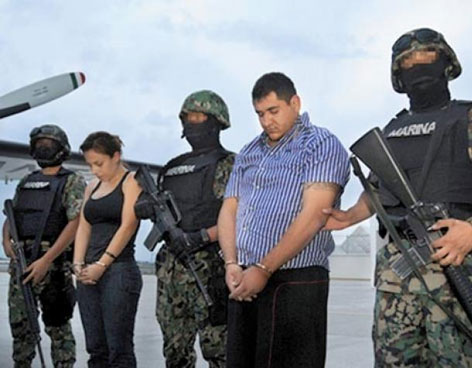
What the marines found on her and in the vehicle told the story of operational leadership in compressed, physical form. She was carrying a .38 Special caliber revolver. She had 100 individual packets of what field tests indicated was cocaine, 50 doses of crack cocaine, and two packages of marijuana. She also had six mobile phones, the command-and-control infrastructure of a plaza boss condensed into a handful of devices. It was not the arsenal of a street-level dealer. It was the inventory of someone who moved product, managed people, and kept lines of communication open with multiple branches of an organization.
She was transferred to the Subprocuraduría de Investigación Especializada en Delincuencia Organizada, the federal body known as SIEDO that handles organized crime cases in Mexico. There, investigators reported, she provided detailed accounts of the structure and operations of Los Zetas across the northern Monterrey municipalities. What exactly she said, and what value that information held in subsequent prosecutions, has not been made part of the public record in any comprehensive way.
The charges against her were serious: complicity in murders, drug trafficking offenses, and organized crime charges that carried the weight of her entire alleged tenure as plaza boss. What happened in the courts after that is precisely the kind of thing that Mexico's justice system, in the 2010s, did not always make transparent. No publicly verified conviction record, no final sentencing document, no acquittal has surfaced in available reporting, in either Spanish or English, through 2026. Her legal status, in the formal sense, remains unresolved in the public record.
Her case did something else, though, something that courts and convictions do not always accomplish: it entered the academic and journalistic literature as a landmark. Researchers studying the feminization of cartel violence, the rising role of women in organized crime leadership, and the relationship between law enforcement corruption and cartel recruitment began citing her case in conference papers and long-form investigations. She was not the first woman to work for Los Zetas, nor the first to hold informal authority within cartel operations. But she was, by the best available evidence, the first woman to hold a formal, recognized plaza command within that organization's hierarchy. The distinction mattered to people who study how power is distributed in criminal enterprises, and why.
The nickname La Flaka would go on to be adopted by two other women connected to cartel violence. Nancy Manríquez Quintanar, arrested in 2011 and linked to at least a dozen murders for Los Zetas, used it. Joselyn Alejandra Niño, who worked for Los Ciclones, a faction of the Gulf Cartel, carried the name until her murder and dismemberment in 2015. Names travel in the narco world the way titles travel in other hierarchies: worn by one person, inherited by another, accumulating history with each use.
Verónica Mireya Moreno Carreón earned hers first. She had been a model police officer. She had been wounded in defense of a stranger on a public street and decorated for it. She had failed drug tests or confidence exams or both, depending on which version of the record one reads, and she had been dismissed from the force that gave her purpose, or she had been kept on it until she wasn't. The details remain genuinely uncertain. What is not uncertain is what came after: a career in organized crime that used everything her years in law enforcement had taught her, directed against the institution she had once served.
The failure does not belong to her alone. It belongs to a system that decorated her and then lost track of her, that registered her in training programs while Navy intelligence built a file on her cartel command, that proved unable to account for the distance between the commendation and the arrest warrant. Mexico has grappled, for decades, with the question of how cartels infiltrate law enforcement, and how law enforcement sometimes infiltrates cartels. The story of La Flaka offers no easy answer to that question. It offers only a face, a file, and a set of facts that resist the comfort of a clean ending.
Timeline
Birth and Early Life in San Nicolás de los Garza
Verónica Mireya Moreno Carreón was born approximately in 1976, likely in San Nicolás de los Garza, Nuevo León, Mexico. She would grow up in the industrial northern metropolitan area of Monterrey, a region that would later become a fierce battleground for cartel territorial control.
Her origins in San Nicolás de los Garza placed her in the exact municipality she would later allegedly control as a Los Zetas plaza boss, making her intimate knowledge of the area a critical operational asset.
Joins San Nicolás de los Garza Municipal Police
Moreno Carreón joined the municipal police force of San Nicolás de los Garza, Nuevo León, beginning an approximately five-year career in law enforcement. She was regarded as a competent and dedicated officer, earning recognition as a 'model police officer' during her tenure.
Her law enforcement career gave her direct knowledge of police procedures, patrol routes, informant networks, and institutional vulnerabilities — skills she would allegedly exploit later as a cartel plaza boss.
Decorated for Bravery After Kidnapping Confrontation
While on duty, Moreno Carreón and a partner confronted armed kidnappers who were attempting to abduct a car salesman in San Nicolás de los Garza. During the confrontation she was wounded in a shootout but helped thwart the kidnapping, and after recovering from her injuries she was awarded a community service commendation for bravery.
This incident represented the apex of her legitimate law enforcement career and underscored the profound irony that she would later allegedly oversee kidnappings and extortion as a cartel plaza boss in the same municipality.
Dismissed from Police Force After Failed Drug and Confidence Tests
Despite her decorated service record, Moreno Carreón was dismissed from the San Nicolás de los Garza municipal police after reportedly failing mandatory antidoping tests and/or confidence control examinations (pruebas de control de confianza). Her dismissal marked the end of her formal law enforcement career, though municipal records would later show a person of the same name still enrolled in city training programs as late as 2011.
Her dismissal — and the ambiguity surrounding overlapping municipal records — highlighted systemic failures in Mexico's law enforcement vetting processes and became a key reference point in discussions of institutional corruption.
Alleged Recruitment into Los Zetas Cartel
Following her departure from the police force, Moreno Carreón allegedly joined the Los Zetas drug cartel, leveraging her law enforcement background to quickly establish herself as a valuable operative. She reportedly used her insider knowledge to recruit and corrupt active police officers, bribe ministerios públicos, and deploy municipal patrol cars to monitor federal authority movements in the San Nicolás area.
Her transition from decorated police officer to cartel operative exemplified the phenomenon of law enforcement corruption feeding directly into organized crime leadership, a pattern extensively documented in northern Mexico during this period.
Assumes Plaza Boss Command After El Sureño's Arrest
In August 2011, Mexican Navy (SEMAR) marines arrested Raúl García Rodríguez, alias 'El Sureño,' the Los Zetas plaza boss for San Nicolás de los Garza, in a military operation in Monterrey. According to SEMAR intelligence reports, Moreno Carreón — reportedly El Sureño's romantic partner — stepped in to assume command of the plaza, becoming responsible for executions, torture, extortion collections, drug distribution in the western zone, kidnappings, halcón (informant) networks, and police bribery.
This moment made Moreno Carreón historically notable as the first woman documented to hold a formal plaza leadership position within Los Zetas, one of Mexico's most violent and militarized criminal organizations.
Arrest by Mexican Navy in Colonia Santa Fe Oriente
Following weeks of intensive urban intelligence operations, elements of the Secretaría de Marina y Armada de México (SEMAR) captured Moreno Carreón in the Colonia Santa Fe Oriente neighborhood of San Nicolás de los Garza after a stolen vehicle she was driving was flagged during surveillance. At the time of her arrest she was found in possession of a .38 Special revolver, 100 packets of cocaine, 50 doses of crack cocaine, two packages of marijuana, and six mobile phones. José de Jesús Molina, alias 'El Chuy' or 'Mr. Chip,' an alleged communications equipment supplier for Los Zetas, was arrested alongside her.
Her capture was a significant intelligence and operational victory for SEMAR and marked the first high-profile arrest of a female cartel plaza boss in Mexico, generating extensive national and international media coverage.
Transfer to SIEDO and Provision of Cartel Intelligence
Following her arrest, Moreno Carreón was transferred to the Subprocuraduría de Investigación Especializada en Delincuencia Organizada (SIEDO), Mexico's specialized organized crime prosecution unit. There she reportedly provided detailed information about the command structure, operational methods, and personnel of Los Zetas operating across the northern Monterrey municipalities.
Her debriefing by SIEDO represented a potentially significant intelligence windfall regarding Los Zetas' organizational structure in Nuevo León, and her cooperation — or lack thereof — would have material consequences for ongoing federal prosecutions.
Charged with Murders, Drug Trafficking, and Organized Crime Offenses
Moreno Carreón was formally charged with complicity in numerous murders, drug trafficking, and organized crime offenses under Mexico's federal criminal statutes. SEMAR intelligence characterized her as possessing an 'aggressive character,' strong leadership qualities, and a pattern of constantly reprimanding subordinate cartel personnel, painting a portrait of an assertive and operationally hands-on commander.
The formal charges cemented her status as a landmark figure in Mexican criminal justice history and provided the evidentiary foundation for what became a widely cited case study in academic and journalistic analyses of women in cartel leadership.
Case Status Remains Unresolved in Public Record
As of 2026, no publicly verified conviction record, final sentencing document, or acquittal for Moreno Carreón has been identified in available English- or Spanish-language reporting. Her case continues to be cited in academic literature and journalism as a landmark example of the feminization of cartel violence, institutional corruption in Mexican law enforcement, and the failure of personnel vetting systems — while her ultimate judicial fate remains publicly unknown.
The unresolved public status of her case reflects broader challenges in transparency within Mexico's federal criminal justice system and leaves her legacy suspended between her documented arrest and an unknown judicial conclusion.
Crime Location
Photos
Verónica Mireya Moreno Carreón, 'La Vero' / 'La Flaka' — image published in Milenio Semanal criminal profile article

Caso Narvarte - First anniversary protest - 7

Demonstration against Javier Valdez murdering - May 16 2017 - Mexico City 05

Veronica Mireya Moreno Carreon
Sources
- La Flaka: La primera jefa de plaza de Los Zetas
- Marina captura a primera jefa de plaza de Los Zetas en San Nicolás de los Garza
- Secretaría de Marina y Armada de México — Comunicado de Prensa: Captura de jefa de plaza Los Zetas
- Women and Drug Trafficking in Mexico: Gender Roles in Organized Crime
- El Sureño detenido por marinos en Monterrey
- Registro de empleados municipales — San Nicolás de los Garza
- Wikipedia: List of journalists and media workers killed in Mexico
Frequently Asked Questions
Table of Contents
Case Summary
She had been decorated for bravery. She had taken a bullet in the line of duty, recovered, and returned to the streets of San Nicolás de los Garza as what colleagues called a model police officer. Then Verónica Mireya Moreno Carreón walked out of her uniform and into the most violent organization in northern Mexico. By the fall of 2011, Mexican Navy intelligence had identified her as the plaza boss of Los Zetas in San Nicolás, the first woman known to hold formal territorial command within the cartel's brutal hierarchy. She managed executions, torture operations, extortion networks, drug distribution, and a web of corrupted police officers, some of whom she almost certainly knew from her years on the force. When marines finally caught up with her in a stolen vehicle in a working-class neighborhood, they found a revolver, 150 doses of cocaine and crack, marijuana, and six cell phones. She was barely 35 years old. Her story has no clean ending: no publicly confirmed conviction, no final sentence on record. What remains is a portrait of institutional failure, personal transformation, and a question Mexico's justice system has never fully answered.
unknown (approximately 1976, based on reported age of ~35 at time of 2011 arrest), San Nicolás de los Garza, Nuevo León, Mexico (likely)(Age: Unknown)
Case Details
The marines moved through Colonia Santa Fe Oriente in the predawn quiet of September 2011, working off weeks of accumulated intelligence that had finally triangulated to this neighborhood in San Nicolás de los Garza, a mid-sized city folded into the sprawling metropolitan shadow of Monterrey, Nuevo León. What flagged the operation was, in the end, almost mundane: a stolen vehicle, its plates flagged in a database, sitting in a street where it had no business being. Inside was a woman in her mid-thirties, compact, watchful, the kind of person who read exits before she read menus. Her name was Verónica Mireya Moreno Carreón. On the street, people who knew her used three different names: La Vero, La Güera, and La Flaka.
The Navy's Secretaría de Marina y Armada de México, known as SEMAR, had been conducting sustained urban intelligence operations across the northern Monterrey municipalities for months. They had built a picture of her, fragment by fragment, informant by informant, intercepted call by intercepted call. What that picture showed was something Mexican law enforcement analysts had not encountered before in precisely this form: a woman holding not an informal, auxiliary position within Los Zetas, but a formal plaza command. She was the jefa de plaza of San Nicolás de los Garza. She ran the territory. She gave the orders.
She had also, not many years before, been a decorated municipal police officer.
Verónica Mireya Moreno Carreón was born around 1976, most likely in San Nicolás de los Garza itself, a city of roughly half a million people that sits directly north of Monterrey and carries the particular texture of industrial northern Mexico: factory districts, working-class colonias, a middle class that built itself block by block across the latter half of the twentieth century. She joined the San Nicolás municipal police force and served for approximately five years. By the accounts that would later surface in Navy intelligence reports and press coverage, she was good at it. Disciplined. Reliable. The kind of officer supervisors pointed to.
In April 2009, that reputation crystallized into something more tangible. She and a partner encountered kidnappers attempting to abduct a car salesman on the streets of San Nicolás. The confrontation turned violent. Moreno Carreón was shot, wounded badly enough to require recovery time, but she had stood her ground. When she healed, the city awarded her a commendation for bravery and community service. She returned to her patrol. The citation sat somewhere in a file.
The timeline of what happened next is where the record becomes genuinely murky, in the way that matters in true crime: not because the facts are unknown, but because the official story and the documented reality refuse to quite align. Reports consistently place her dismissal from the police force around 2005, citing failed mandatory drug tests and confidence control examinations, the battery of psychological, polygraph, and background screenings that Mexican law enforcement agencies are required to use to root out cartel infiltration. Yet the April 2009 shootout happened, per coverage at the time, while she was still an active officer. And municipal government records from San Nicolás de los Garza, obtained and reviewed by reporters in the aftermath of her 2011 arrest, showed a city employee with her exact name enrolled in training programs as late as Fall 2010 and Spring 2011.
The discrepancy has never been formally explained. Whether she was dismissed and quietly reinstated, whether the records reflect a different person sharing her name, or whether the official dismissal narrative was constructed after the fact to distance the city from its association with her, no authority has said publicly. What the discrepancy does make clear is that the institution charged with vetting its officers for cartel ties had catastrophically failed, by any reading of events, to do so.
After leaving the force under whatever precise circumstances, she moved toward Los Zetas. The cartel had, by 2010 and 2011, established some of the most sophisticated and feared territorial operations in Mexico. Founded by former members of the Mexican Army's elite Grupo Aeromóvil de Fuerzas Especiales, the Zetas had expanded from their origins as Gulf Cartel enforcers into an independent criminal empire that blanketed Tamaulipas, Nuevo León, Veracruz, and beyond. They were known, even among rivals, for systematic violence: executions, mass graves, torture as operational policy.
Moreno Carreón brought something specific to that organization: the architecture of a law enforcement career. She understood how police patrol zones worked, how shift rotations were scheduled, how information moved through a police department, and crucially, which officers could be reached. SEMAR intelligence concluded that she leveraged this knowledge systematically. She recruited and corrupted municipal police officers. She bribed ministerios públicos, the public prosecutors whose cooperation could make investigations disappear. She used municipal patrol cars as surveillance assets, deploying officers who were on the cartel payroll to monitor federal authority movements across San Nicolás. The uniform she had once worn became, in her hands, a tool of the organization that uniform was supposed to fight.
Her rise within Los Zetas accelerated in August 2011, when marines detained Raúl García Rodríguez, known by his alias El Sureño, in Monterrey. El Sureño had held the plaza command for San Nicolás. Some reports indicated he was Moreno Carreón's boyfriend; whether or not that was accurate, his removal created a leadership vacancy that she stepped into. She was, by SEMAR's subsequent accounting, already operational enough to absorb the command without significant disruption to the organization's activities in the area.
As plaza boss, her responsibilities were comprehensive and brutal. She organized and oversaw executions. She managed the torture of individuals suspected of cooperation with rival cartels or federal authorities. She ran the extortion infrastructure that collected piso payments, the mandatory fees that Los Zetas extracted from businesses, transport operators, and street-level vendors throughout San Nicolás. She supervised drug distribution in the western zone of the city, maintaining supply chains for cocaine, crack, and marijuana. She coordinated kidnappings and, according to investigators, forced disappearances. She managed the halcones, the network of lookouts and informants who served as the cartel's eyes across the municipal territory. And she paid, regularly and systematically, the officers and prosecutors who kept the organization insulated from consequences.
People who worked under her described, to Navy investigators, a leader who did not tolerate mistakes quietly. SEMAR intelligence characterized her as possessing an aggressive character, strong leadership qualities, and a marked habit of reprimanding subordinates directly and often. She adapted quickly to shifting operational conditions and projected confidence in a manner that commanded compliance. These were, stripped of context, the qualities her former police supervisors had likely admired. In a different life, they might have carried her to a command position within law enforcement. In the life she had built, they carried her to command a cartel plaza in one of Mexico's most contested metropolitan corridors.
The Navy's operation to locate and arrest her took weeks. SEMAR units worked across urban terrain that offered Los Zetas constant advantages: dense residential blocks, overlapping municipal jurisdictions, a population that had learned, through hard experience, that talking to authorities carried its own lethal risks. The intelligence picture was assembled slowly, through surveillance, through the monitoring of communications equipment, and through the network of informants that any sustained operation in cartel territory depends upon.
The vehicle she was driving when they found her had been stolen. It was flagged in a database check, a routine digital tripwire that, in the tangled operations of organized crime, sometimes catches what weeks of sophisticated intelligence cannot. She was in Colonia Santa Fe Oriente. Alongside her was José de Jesús Molina, who used the aliases El Chuy and Mr. Chip, and who had reportedly supplied communications equipment to Los Zetas operatives connected to El Sureño's network.
What the marines found on her and in the vehicle told the story of operational leadership in compressed, physical form. She was carrying a .38 Special caliber revolver. She had 100 individual packets of what field tests indicated was cocaine, 50 doses of crack cocaine, and two packages of marijuana. She also had six mobile phones, the command-and-control infrastructure of a plaza boss condensed into a handful of devices. It was not the arsenal of a street-level dealer. It was the inventory of someone who moved product, managed people, and kept lines of communication open with multiple branches of an organization.
She was transferred to the Subprocuraduría de Investigación Especializada en Delincuencia Organizada, the federal body known as SIEDO that handles organized crime cases in Mexico. There, investigators reported, she provided detailed accounts of the structure and operations of Los Zetas across the northern Monterrey municipalities. What exactly she said, and what value that information held in subsequent prosecutions, has not been made part of the public record in any comprehensive way.
The charges against her were serious: complicity in murders, drug trafficking offenses, and organized crime charges that carried the weight of her entire alleged tenure as plaza boss. What happened in the courts after that is precisely the kind of thing that Mexico's justice system, in the 2010s, did not always make transparent. No publicly verified conviction record, no final sentencing document, no acquittal has surfaced in available reporting, in either Spanish or English, through 2026. Her legal status, in the formal sense, remains unresolved in the public record.
Her case did something else, though, something that courts and convictions do not always accomplish: it entered the academic and journalistic literature as a landmark. Researchers studying the feminization of cartel violence, the rising role of women in organized crime leadership, and the relationship between law enforcement corruption and cartel recruitment began citing her case in conference papers and long-form investigations. She was not the first woman to work for Los Zetas, nor the first to hold informal authority within cartel operations. But she was, by the best available evidence, the first woman to hold a formal, recognized plaza command within that organization's hierarchy. The distinction mattered to people who study how power is distributed in criminal enterprises, and why.
The nickname La Flaka would go on to be adopted by two other women connected to cartel violence. Nancy Manríquez Quintanar, arrested in 2011 and linked to at least a dozen murders for Los Zetas, used it. Joselyn Alejandra Niño, who worked for Los Ciclones, a faction of the Gulf Cartel, carried the name until her murder and dismemberment in 2015. Names travel in the narco world the way titles travel in other hierarchies: worn by one person, inherited by another, accumulating history with each use.
Verónica Mireya Moreno Carreón earned hers first. She had been a model police officer. She had been wounded in defense of a stranger on a public street and decorated for it. She had failed drug tests or confidence exams or both, depending on which version of the record one reads, and she had been dismissed from the force that gave her purpose, or she had been kept on it until she wasn't. The details remain genuinely uncertain. What is not uncertain is what came after: a career in organized crime that used everything her years in law enforcement had taught her, directed against the institution she had once served.
The failure does not belong to her alone. It belongs to a system that decorated her and then lost track of her, that registered her in training programs while Navy intelligence built a file on her cartel command, that proved unable to account for the distance between the commendation and the arrest warrant. Mexico has grappled, for decades, with the question of how cartels infiltrate law enforcement, and how law enforcement sometimes infiltrates cartels. The story of La Flaka offers no easy answer to that question. It offers only a face, a file, and a set of facts that resist the comfort of a clean ending.
Timeline
Birth and Early Life in San Nicolás de los Garza
Verónica Mireya Moreno Carreón was born approximately in 1976, likely in San Nicolás de los Garza, Nuevo León, Mexico. She would grow up in the industrial northern metropolitan area of Monterrey, a region that would later become a fierce battleground for cartel territorial control.
Her origins in San Nicolás de los Garza placed her in the exact municipality she would later allegedly control as a Los Zetas plaza boss, making her intimate knowledge of the area a critical operational asset.
Joins San Nicolás de los Garza Municipal Police
Moreno Carreón joined the municipal police force of San Nicolás de los Garza, Nuevo León, beginning an approximately five-year career in law enforcement. She was regarded as a competent and dedicated officer, earning recognition as a 'model police officer' during her tenure.
Her law enforcement career gave her direct knowledge of police procedures, patrol routes, informant networks, and institutional vulnerabilities — skills she would allegedly exploit later as a cartel plaza boss.
Decorated for Bravery After Kidnapping Confrontation
While on duty, Moreno Carreón and a partner confronted armed kidnappers who were attempting to abduct a car salesman in San Nicolás de los Garza. During the confrontation she was wounded in a shootout but helped thwart the kidnapping, and after recovering from her injuries she was awarded a community service commendation for bravery.
This incident represented the apex of her legitimate law enforcement career and underscored the profound irony that she would later allegedly oversee kidnappings and extortion as a cartel plaza boss in the same municipality.
Dismissed from Police Force After Failed Drug and Confidence Tests
Despite her decorated service record, Moreno Carreón was dismissed from the San Nicolás de los Garza municipal police after reportedly failing mandatory antidoping tests and/or confidence control examinations (pruebas de control de confianza). Her dismissal marked the end of her formal law enforcement career, though municipal records would later show a person of the same name still enrolled in city training programs as late as 2011.
Her dismissal — and the ambiguity surrounding overlapping municipal records — highlighted systemic failures in Mexico's law enforcement vetting processes and became a key reference point in discussions of institutional corruption.
Alleged Recruitment into Los Zetas Cartel
Following her departure from the police force, Moreno Carreón allegedly joined the Los Zetas drug cartel, leveraging her law enforcement background to quickly establish herself as a valuable operative. She reportedly used her insider knowledge to recruit and corrupt active police officers, bribe ministerios públicos, and deploy municipal patrol cars to monitor federal authority movements in the San Nicolás area.
Her transition from decorated police officer to cartel operative exemplified the phenomenon of law enforcement corruption feeding directly into organized crime leadership, a pattern extensively documented in northern Mexico during this period.
Assumes Plaza Boss Command After El Sureño's Arrest
In August 2011, Mexican Navy (SEMAR) marines arrested Raúl García Rodríguez, alias 'El Sureño,' the Los Zetas plaza boss for San Nicolás de los Garza, in a military operation in Monterrey. According to SEMAR intelligence reports, Moreno Carreón — reportedly El Sureño's romantic partner — stepped in to assume command of the plaza, becoming responsible for executions, torture, extortion collections, drug distribution in the western zone, kidnappings, halcón (informant) networks, and police bribery.
This moment made Moreno Carreón historically notable as the first woman documented to hold a formal plaza leadership position within Los Zetas, one of Mexico's most violent and militarized criminal organizations.
Arrest by Mexican Navy in Colonia Santa Fe Oriente
Following weeks of intensive urban intelligence operations, elements of the Secretaría de Marina y Armada de México (SEMAR) captured Moreno Carreón in the Colonia Santa Fe Oriente neighborhood of San Nicolás de los Garza after a stolen vehicle she was driving was flagged during surveillance. At the time of her arrest she was found in possession of a .38 Special revolver, 100 packets of cocaine, 50 doses of crack cocaine, two packages of marijuana, and six mobile phones. José de Jesús Molina, alias 'El Chuy' or 'Mr. Chip,' an alleged communications equipment supplier for Los Zetas, was arrested alongside her.
Her capture was a significant intelligence and operational victory for SEMAR and marked the first high-profile arrest of a female cartel plaza boss in Mexico, generating extensive national and international media coverage.
Transfer to SIEDO and Provision of Cartel Intelligence
Following her arrest, Moreno Carreón was transferred to the Subprocuraduría de Investigación Especializada en Delincuencia Organizada (SIEDO), Mexico's specialized organized crime prosecution unit. There she reportedly provided detailed information about the command structure, operational methods, and personnel of Los Zetas operating across the northern Monterrey municipalities.
Her debriefing by SIEDO represented a potentially significant intelligence windfall regarding Los Zetas' organizational structure in Nuevo León, and her cooperation — or lack thereof — would have material consequences for ongoing federal prosecutions.
Charged with Murders, Drug Trafficking, and Organized Crime Offenses
Moreno Carreón was formally charged with complicity in numerous murders, drug trafficking, and organized crime offenses under Mexico's federal criminal statutes. SEMAR intelligence characterized her as possessing an 'aggressive character,' strong leadership qualities, and a pattern of constantly reprimanding subordinate cartel personnel, painting a portrait of an assertive and operationally hands-on commander.
The formal charges cemented her status as a landmark figure in Mexican criminal justice history and provided the evidentiary foundation for what became a widely cited case study in academic and journalistic analyses of women in cartel leadership.
Case Status Remains Unresolved in Public Record
As of 2026, no publicly verified conviction record, final sentencing document, or acquittal for Moreno Carreón has been identified in available English- or Spanish-language reporting. Her case continues to be cited in academic literature and journalism as a landmark example of the feminization of cartel violence, institutional corruption in Mexican law enforcement, and the failure of personnel vetting systems — while her ultimate judicial fate remains publicly unknown.
The unresolved public status of her case reflects broader challenges in transparency within Mexico's federal criminal justice system and leaves her legacy suspended between her documented arrest and an unknown judicial conclusion.
Crime Location
Photos
Verónica Mireya Moreno Carreón, 'La Vero' / 'La Flaka' — image published in Milenio Semanal criminal profile article
Caso Narvarte - First anniversary protest - 7
Demonstration against Javier Valdez murdering - May 16 2017 - Mexico City 05
Veronica Mireya Moreno Carreon
Sources
- La Flaka: La primera jefa de plaza de Los Zetas
- Marina captura a primera jefa de plaza de Los Zetas en San Nicolás de los Garza
- Secretaría de Marina y Armada de México — Comunicado de Prensa: Captura de jefa de plaza Los Zetas
- Women and Drug Trafficking in Mexico: Gender Roles in Organized Crime
- El Sureño detenido por marinos en Monterrey
- Registro de empleados municipales — San Nicolás de los Garza
- Wikipedia: List of journalists and media workers killed in Mexico
Frequently Asked Questions
Related Cases
Alleged
Connection tags:
Convicted
Connection tags:
Convicted
Connection tags:
Convicted
Connection tags:
Alleged
Connection tags:
Accused
Connection tags:
Tags
Popular Culture
TV (2011)
While not directly depicting Moreno Carreón, this Telemundo/Antena 3 narco-drama popularized the archetype of the female cartel leader in Mexican popular culture at the same time La Flaka's arrest made headlines, and her case was frequently invoked in media commentary about the show's themes.
documentary (2013)
Documentary examining cartel culture in northern Mexico, within which female plaza bosses like Moreno Carreón are discussed as part of the evolving landscape of Los Zetas operations in Nuevo León.