Nancy Agnes Hazel Doss
Case Summary
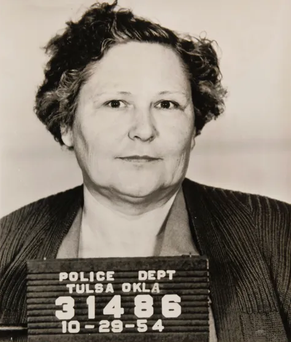
She sat across from Tulsa police Captain Harry Stege in November 1954 and giggled. She giggled when she described stirring rat poison into her husband's coffee. She giggled when she confirmed she had poisoned four of her five husbands. She giggled when the officers pressed her about the grandchildren, the sisters, the mother. The laughter never quite left her face.
Nannie Doss was 49 years old, soft-featured, grandmotherly, and by the time she was arraigned on November 29, 1954, the prime suspect in at least eleven deaths spanning four states and nearly three decades. Her weapons were domestic and unremarkable: stewed prunes, corn whiskey, a slice of prune cake, a cup of morning coffee laced with arsenic. Her victims were the people closest to her, the ones who ate at her table and slept in her bed.
Investigators called her 'The Giggling Granny.' The press added 'The Black Widow,' 'Lady Bluebeard,' and 'The Lonely Hearts Killer.' Each nickname captured a piece of her; none captured all of her. Because behind the laughter sat something more complicated and more chilling: a woman who had dreamed her whole life of storybook romance, and who killed, methodically and repeatedly, every time reality fell short of the fantasy.
This is the story of Nancy Agnes Hazel Doss, born in rural Alabama in 1905 and buried in a prison cemetery in Oklahoma in 1965. In between, she made sure a great many people never made it out alive.
November 4, 1905, Blue Mountain, Calhoun County, Alabama, USA(Age: 59)
June 2, 1965, Hospital ward, Oklahoma State Penitentiary, McAlester, Oklahoma, USA (Leukemia)
Related Cases
Convicted
Connection tags:

Accused
Connection tags:

Convicted
Connection tags:
Convicted
Connection tags:

Accused
Connection tags:

Convicted
Connection tags:
Case Details
On the morning of October 5, 1954, a Tulsa man named Samuel Doss walked out of a hospital and into his wife's kitchen. He had spent a month being treated for a mysterious gastrointestinal illness, poked and tested by physicians who could not quite determine what had laid him so low so suddenly. He came home thin and weak and grateful. His wife, Nannie, had a pot of coffee waiting.
Samuel Doss was dead seven days later.
His physician, troubled by the sudden collapse of a man who had appeared to be recovering, refused to sign a death certificate without an autopsy. The result was staggering: Samuel Doss's body contained enough arsenic to kill a horse. Police arrived at Nannie's door within days. She went with them almost cheerfully, settled into the interrogation room at the Tulsa police station, and proceeded to confound everyone in it.
She laughed. She giggled and smiled at Captain Harry Stege as if they were sharing a pleasant afternoon conversation. When County Attorney J. Howard Edmondson offered her a romance magazine if she cooperated, she accepted the deal happily, and then she confessed to killing eight people. She named them. She described the methods. Through all of it, the laughter kept coming.
The newspapers called her 'The Giggling Granny.' They also called her 'The Black Widow,' 'Lady Bluebeard,' and 'The Lonely Hearts Killer.' Every nickname fit. None told the whole story.
Nancy Agnes Hazel was born on November 4, 1905, in Blue Mountain, Calhoun County, Alabama, the daughter of James and Louisa Hazel. The household was governed by her father with a rigidity that pressed against his children like a physical weight. James Hazel pulled his sons and daughters out of school and set them to work the family farm. He forbade his daughters from wearing makeup or attractive clothing, from socializing freely, from experiencing the ordinary textures of adolescent life. For a girl with a hungry imagination, the deprivation was acute.
The wound cut deeper in 1912, when seven-year-old Nannie was riding a train and it stopped suddenly. She struck her head on a metal seat bar. Headaches and blackouts followed, along with spells of depression that recurred throughout her life. She later told investigators that this injury explained much of her instability. Whether it did or not, it gave her a story to tell about herself: a private mythology of damage.
What filled the space her father had emptied out was her mother's stack of romance magazines. Nannie read the lonely hearts columns with the concentration of a scholar. She absorbed the language of courtship, the vocabulary of idealized love, the promise that somewhere out there was a man who would be tender and attentive and faithful. She built a fantasy, brick by brick, and she spent the rest of her life trying to make reality conform to it.
It never did.
Her father arranged her first marriage when she was sixteen. Charley Braggs was, in some ways, simply a variation of James Hazel: controlling, limiting, a ceiling instead of a door. The couple had four daughters together. By 1927, two of the middle daughters had died under circumstances attributed at the time to food poisoning. Braggs grew suspicious of his wife. He took their eldest daughter and left, depositing a younger daughter with relatives as he went. Nannie kept the infant. Braggs was the only one of her five husbands to survive her, a fact that may say as much about his instincts as anything else.
Her second marriage, to Robert Franklin Harrelson in 1929, lasted sixteen years. They were not good years. Harrelson drank heavily and his behavior toward his wife grew brutal. In 1945, after Harrelson raped her, Nannie spiked his corn whiskey with rat poison. He died. No one looked too closely.
By that same year, the killing had already spread beyond her marriages. On July 7, 1945, Nannie's grandson Robert Lee Haynes died of asphyxiation. She collected a five-hundred-dollar life insurance payout. There were also allegations, never formally prosecuted, that she had killed a granddaughter at birth by inserting a hatpin. These were not the acts of a woman in the grip of a single rage. They were the acts of someone who had incorporated murder into the rhythm of ordinary domestic life.
In roughly 1947, Nannie married Arlie Lanning in Lexington, North Carolina. Around 1950, Lanning died of what was ruled a heart attack; no autopsy was performed. After his death, Nannie also poisoned his mother, who had been living in the house. Around this same period, her sister Dovie Frances Hazel Weaver died after spending time in Nannie's company.
The body count was climbing, and no one was keeping score.
January 1953 brought another death: Nannie's mother, Louisa Hazel, died after visiting her daughter. Louisa had survived a brutal marriage to James Hazel. She did not survive her daughter's hospitality.
Four months later, on May 19, 1953, Nannie's fourth husband, Richard L. Morton, whom she had married in Emporia, Kansas, the previous year, was dead as well. She had already identified her next prospect. She married Samuel Doss in Tulsa, Oklahoma, in June of 1953.
Samuel Doss was a devout Nazarene minister, a serious and religious man. He banned romance novels from the house. He restricted television. He was, in Nannie's estimation, one more man who had promised a fantasy and delivered a cage. She took out two life insurance policies on him.
In September 1954, she baked him a prune cake laced with arsenic. Doss became severely ill and was hospitalized for a month. Doctors puzzled over his condition without arriving at the truth. When he was discharged on October 5th and came home to that waiting cup of coffee, he had no way of knowing his wife had simply decided to finish what she had started. He died on October 12, 1954.
The doctor who had treated Samuel Doss refused to accept that his patient had simply and suddenly died. The autopsy he ordered told the story that thirty years of deaths had failed to tell. Police arrived at Nannie's door, and she sat down with Captain Stege and County Attorney J. Howard Edmondson, who would later become Governor of Oklahoma, and she confounded them completely.
Edmondson had presumably interviewed many people over the course of his career. Nannie Doss was not like the others. The romance magazine he offered as an incentive was accepted with apparent delight; the confession that followed came just as freely. Eight killings, delivered with giggles.
The press descended and the nicknames crystallized. She was fifty years old, plump and pleasant-looking, the kind of woman you might expect to find arranging flowers in a church hall. The dissonance between her appearance and her acts was part of what made her so deeply unsettling. People kept searching her face for the monster and finding a grandmother instead.
She was arraigned on November 29, 1954, the same day the now-iconic photographs were taken of her laughing in the presence of her interrogators. On May 17, 1955, she pleaded guilty to the murder of Samuel Doss. It was the only charge ever formally brought against her; authorities in Kansas, Arkansas, and North Carolina all charged her with murder in their respective jurisdictions but never brought her to trial.
The question of punishment produced its own uncomfortable reckoning. The state of Oklahoma did not seek the death penalty. Judge Elmer Adams, who sentenced her on June 2, 1955, said he considered it a poor precedent to make Nannie Doss the first woman executed in Oklahoma. She was sentenced to life imprisonment.
After two years behind bars, she reportedly said she would have preferred the death sentence.
Before her arrest, she had already identified her next prospective husband: a North Carolina dairy farmer named John H. Keel. She had reportedly sent him a cake.
Officials who reviewed the case believed the total death toll reached at least twelve people, possibly more. The Encyclopedia of Alabama would later place the figure at no fewer than twelve. The deaths spanned four states and stretched across nearly thirty years, from 1927 to 1954. Arsenic was her primary instrument, administered in prunes, coffee, corn whiskey, and baked goods with a domestic casualness that is, in retrospect, the most disturbing thing about her. There was no frenzy, no apparent crisis of conscience. There was just dinner.
Nannie Doss died of leukemia on June 2, 1965, the tenth anniversary of her life sentence, in the hospital ward of the Oklahoma State Penitentiary in McAlester. She was buried at Oak Hill Memorial Park in McAlester. She was fifty-nine years old.
She never expressed remorse. What she expressed, in those interrogation sessions and in the press accounts that followed, was something closer to frustration: the men in her life had never matched the men in her magazines. Reality had been a persistent and terminal disappointment. She had spent her days chasing a dream of romantic love that no living human being was ever going to provide, and so, one by one, she had disposed of them.
Criminologists who have studied her case situate Nannie Doss within a pattern of female serial killing driven by financial gain, convenience, and romantic disillusionment. The insurance policies she collected, the wills she benefited from, the sheer practicality of poison as a method all point toward a calculating intelligence operating beneath the giggles. She was not a woman in a fugue state. She was a woman who made decisions and then made dinner.
What the case left behind, apart from the bodies, was a question the laughter made impossible to answer cleanly. What exactly was going on behind those smiling eyes? Was remorse buried somewhere under the performance? Was the performance itself the truth? The nicknames the press assigned her tried to pin her to a recognizable type, but Nannie Doss kept slipping the frame.
She remains one of the most studied female serial killers in American criminal history, a case study in how thoroughly a person can hide in plain sight when the hiding place is a grandmother's apron and an easy laugh. The romance magazines she loved so dearly never wrote about women like her. Perhaps, in the end, that was precisely the point.
Timeline
Birth of Nancy Agnes Hazel
Nancy Agnes Hazel was born on November 4, 1905, in Blue Mountain, Calhoun County, Alabama, to James F. Hazel and Louisa 'Lou' Hazel. She was raised in a harsh, controlling household where her abusive father forced his children to work the family farm and forbade his daughters from wearing makeup or socializing freely.
Her repressive upbringing and limited education planted the seeds of resentment and romantic obsession that would later drive her to murder.
Traumatic Head Injury on Train
At approximately age seven, Nannie suffered a severe head injury when a train stopped abruptly and she struck her head on a metal seat bar. She later attributed her lifelong headaches, blackouts, depression, and 'mental instability' to this accident.
The injury became a central element of her personal narrative and was later cited as a contributing factor to her psychological instability and criminal behavior.
Obsession with Romance Magazines Begins
As a teenager, Nannie became deeply fixated on her mother's romance magazines, particularly the 'lonely hearts' columns, developing a fantasy-driven and idealized vision of marriage and romantic love. This obsession would define her motivation for five marriages and, ultimately, a string of murders spanning nearly three decades.
Her romantic delusions created a pattern of disillusionment with each husband, providing the psychological trigger for her poisoning campaigns.
First Marriage to Charley Braggs
Nannie married Charley Braggs in 1921, her first of five husbands and the only one to survive her. The marriage was troubled; two of their daughters died in 1927 under circumstances attributed to 'food poisoning,' widely believed to have been Nannie's first murders. Braggs eventually fled the marriage around 1928, reportedly sensing danger.
The deaths of her daughters in 1927 are considered her first known murders, marking the beginning of nearly three decades of poisoning.
Murder of Two Daughters
Two of Nannie's daughters died in 1927, officially attributed to food poisoning, but later suspected to have been deliberately poisoned by Nannie herself. No autopsies were performed at the time, and no charges were ever filed in connection with these deaths.
These killings, if confirmed, represent the opening of Nannie's murder campaign and illustrate the ease with which she evaded suspicion for decades.
Murder of Grandson and Second Husband
On July 7, 1945, Nannie asphyxiated her grandson Robert Lee Haynes and collected a $500 life insurance policy on his death. Later that same year, she poisoned her second husband, Robert Franklin Harrelson, by lacing his corn whiskey with rat poison, reportedly in retaliation for a sexual assault he had committed against her.
These murders revealed Nannie's dual motives of financial gain through insurance fraud and personal retribution, and marked a sharp escalation in her killing.
Murders of Third Husband, His Mother, and Her Sister
Around 1950, Nannie poisoned her third husband, Arlie Lanning, in Lexington, North Carolina; his death was ruled a heart failure with no autopsy ordered. She also poisoned Lanning's mother and her own sister, Dovie Frances Hazel Weaver, during this period, escaping all suspicion.
The absence of autopsies and the acceptance of natural-cause rulings allowed Nannie to continue killing undetected, demonstrating systemic failures in forensic oversight of the era.
Murder of Mother and Fourth Husband
In January 1953, Nannie poisoned her own mother, Louisa 'Lou' Hazel, and on May 19, 1953, she poisoned her fourth husband, Richard L. Morton, in Emporia, Kansas. Both deaths went uninvestigated, and Nannie moved on to identify and marry her fifth husband within weeks of Morton's death.
The murder of her own mother underscored the breadth of Nannie's willingness to kill anyone who inconvenienced her, while Morton's death continued her pattern of insurance-motivated spousal murder.
Poisoning and Death of Samuel Doss
Nannie first poisoned her fifth husband, Samuel Doss — a devout Nazarene minister — with arsenic-laced prune cake in September 1954, landing him in the hospital for a month. After his release on October 5, 1954, she administered arsenic-laced coffee; he died on October 12, 1954. His suspicious doctor ordered an autopsy that revealed a lethal quantity of arsenic — reportedly enough to kill a horse.
The autopsy of Samuel Doss was the critical forensic breakthrough that finally unraveled Nannie's decades-long killing spree and led directly to her arrest.
Arraignment, Confession, and Guilty Plea
Nannie was arraigned on November 29, 1954, and during interrogation by Tulsa Police Captain Harry Stege and County Attorney J. Howard Edmondson, she laughed and giggled throughout, earning her the nicknames 'The Giggling Granny' and 'The Lonely Hearts Killer.' After being promised she could keep a romance magazine, she confessed to killing eight people. She pleaded guilty on May 17, 1955, to the murder of Samuel Doss and was sentenced to life imprisonment; Judge Elmer Adams declined to pursue the death penalty, calling it a 'poor precedent' to execute the first woman in Oklahoma.
Her cheerful demeanor during confession shocked the nation and cemented her infamy, while her life sentence — the only charge ever formally brought — left the full scope of her crimes legally unresolved.
Crime Location
Photos
Nannie Doss (mugshot)
Sources
- Nannie Doss — Encyclopedia of Alabama
- Mrs. Nannie Doss Laughs as She Is Interviewed by Captain Harry Stege
- Nannie Doss Smiles After Receiving Life Sentence
- Nannie Doss at Oklahoma State Penitentiary, 1955 (AP Photo, released 1965)
- Nannie Doss — Tulsa World Archive
- Nannie Doss Portrait — Bettmann Archive
- Nannie Doss — Wikipedia
Frequently Asked Questions
Table of Contents
Case Summary
She sat across from Tulsa police Captain Harry Stege in November 1954 and giggled. She giggled when she described stirring rat poison into her husband's coffee. She giggled when she confirmed she had poisoned four of her five husbands. She giggled when the officers pressed her about the grandchildren, the sisters, the mother. The laughter never quite left her face.
Nannie Doss was 49 years old, soft-featured, grandmotherly, and by the time she was arraigned on November 29, 1954, the prime suspect in at least eleven deaths spanning four states and nearly three decades. Her weapons were domestic and unremarkable: stewed prunes, corn whiskey, a slice of prune cake, a cup of morning coffee laced with arsenic. Her victims were the people closest to her, the ones who ate at her table and slept in her bed.
Investigators called her 'The Giggling Granny.' The press added 'The Black Widow,' 'Lady Bluebeard,' and 'The Lonely Hearts Killer.' Each nickname captured a piece of her; none captured all of her. Because behind the laughter sat something more complicated and more chilling: a woman who had dreamed her whole life of storybook romance, and who killed, methodically and repeatedly, every time reality fell short of the fantasy.
This is the story of Nancy Agnes Hazel Doss, born in rural Alabama in 1905 and buried in a prison cemetery in Oklahoma in 1965. In between, she made sure a great many people never made it out alive.
November 4, 1905, Blue Mountain, Calhoun County, Alabama, USA(Age: 59)
June 2, 1965, Hospital ward, Oklahoma State Penitentiary, McAlester, Oklahoma, USA (Leukemia)
Case Details
On the morning of October 5, 1954, a Tulsa man named Samuel Doss walked out of a hospital and into his wife's kitchen. He had spent a month being treated for a mysterious gastrointestinal illness, poked and tested by physicians who could not quite determine what had laid him so low so suddenly. He came home thin and weak and grateful. His wife, Nannie, had a pot of coffee waiting.
Samuel Doss was dead seven days later.
His physician, troubled by the sudden collapse of a man who had appeared to be recovering, refused to sign a death certificate without an autopsy. The result was staggering: Samuel Doss's body contained enough arsenic to kill a horse. Police arrived at Nannie's door within days. She went with them almost cheerfully, settled into the interrogation room at the Tulsa police station, and proceeded to confound everyone in it.
She laughed. She giggled and smiled at Captain Harry Stege as if they were sharing a pleasant afternoon conversation. When County Attorney J. Howard Edmondson offered her a romance magazine if she cooperated, she accepted the deal happily, and then she confessed to killing eight people. She named them. She described the methods. Through all of it, the laughter kept coming.
The newspapers called her 'The Giggling Granny.' They also called her 'The Black Widow,' 'Lady Bluebeard,' and 'The Lonely Hearts Killer.' Every nickname fit. None told the whole story.
Nancy Agnes Hazel was born on November 4, 1905, in Blue Mountain, Calhoun County, Alabama, the daughter of James and Louisa Hazel. The household was governed by her father with a rigidity that pressed against his children like a physical weight. James Hazel pulled his sons and daughters out of school and set them to work the family farm. He forbade his daughters from wearing makeup or attractive clothing, from socializing freely, from experiencing the ordinary textures of adolescent life. For a girl with a hungry imagination, the deprivation was acute.
The wound cut deeper in 1912, when seven-year-old Nannie was riding a train and it stopped suddenly. She struck her head on a metal seat bar. Headaches and blackouts followed, along with spells of depression that recurred throughout her life. She later told investigators that this injury explained much of her instability. Whether it did or not, it gave her a story to tell about herself: a private mythology of damage.
What filled the space her father had emptied out was her mother's stack of romance magazines. Nannie read the lonely hearts columns with the concentration of a scholar. She absorbed the language of courtship, the vocabulary of idealized love, the promise that somewhere out there was a man who would be tender and attentive and faithful. She built a fantasy, brick by brick, and she spent the rest of her life trying to make reality conform to it.
It never did.
Her father arranged her first marriage when she was sixteen. Charley Braggs was, in some ways, simply a variation of James Hazel: controlling, limiting, a ceiling instead of a door. The couple had four daughters together. By 1927, two of the middle daughters had died under circumstances attributed at the time to food poisoning. Braggs grew suspicious of his wife. He took their eldest daughter and left, depositing a younger daughter with relatives as he went. Nannie kept the infant. Braggs was the only one of her five husbands to survive her, a fact that may say as much about his instincts as anything else.
Her second marriage, to Robert Franklin Harrelson in 1929, lasted sixteen years. They were not good years. Harrelson drank heavily and his behavior toward his wife grew brutal. In 1945, after Harrelson raped her, Nannie spiked his corn whiskey with rat poison. He died. No one looked too closely.
By that same year, the killing had already spread beyond her marriages. On July 7, 1945, Nannie's grandson Robert Lee Haynes died of asphyxiation. She collected a five-hundred-dollar life insurance payout. There were also allegations, never formally prosecuted, that she had killed a granddaughter at birth by inserting a hatpin. These were not the acts of a woman in the grip of a single rage. They were the acts of someone who had incorporated murder into the rhythm of ordinary domestic life.
In roughly 1947, Nannie married Arlie Lanning in Lexington, North Carolina. Around 1950, Lanning died of what was ruled a heart attack; no autopsy was performed. After his death, Nannie also poisoned his mother, who had been living in the house. Around this same period, her sister Dovie Frances Hazel Weaver died after spending time in Nannie's company.
The body count was climbing, and no one was keeping score.
January 1953 brought another death: Nannie's mother, Louisa Hazel, died after visiting her daughter. Louisa had survived a brutal marriage to James Hazel. She did not survive her daughter's hospitality.
Four months later, on May 19, 1953, Nannie's fourth husband, Richard L. Morton, whom she had married in Emporia, Kansas, the previous year, was dead as well. She had already identified her next prospect. She married Samuel Doss in Tulsa, Oklahoma, in June of 1953.
Samuel Doss was a devout Nazarene minister, a serious and religious man. He banned romance novels from the house. He restricted television. He was, in Nannie's estimation, one more man who had promised a fantasy and delivered a cage. She took out two life insurance policies on him.
In September 1954, she baked him a prune cake laced with arsenic. Doss became severely ill and was hospitalized for a month. Doctors puzzled over his condition without arriving at the truth. When he was discharged on October 5th and came home to that waiting cup of coffee, he had no way of knowing his wife had simply decided to finish what she had started. He died on October 12, 1954.
The doctor who had treated Samuel Doss refused to accept that his patient had simply and suddenly died. The autopsy he ordered told the story that thirty years of deaths had failed to tell. Police arrived at Nannie's door, and she sat down with Captain Stege and County Attorney J. Howard Edmondson, who would later become Governor of Oklahoma, and she confounded them completely.
Edmondson had presumably interviewed many people over the course of his career. Nannie Doss was not like the others. The romance magazine he offered as an incentive was accepted with apparent delight; the confession that followed came just as freely. Eight killings, delivered with giggles.
The press descended and the nicknames crystallized. She was fifty years old, plump and pleasant-looking, the kind of woman you might expect to find arranging flowers in a church hall. The dissonance between her appearance and her acts was part of what made her so deeply unsettling. People kept searching her face for the monster and finding a grandmother instead.
She was arraigned on November 29, 1954, the same day the now-iconic photographs were taken of her laughing in the presence of her interrogators. On May 17, 1955, she pleaded guilty to the murder of Samuel Doss. It was the only charge ever formally brought against her; authorities in Kansas, Arkansas, and North Carolina all charged her with murder in their respective jurisdictions but never brought her to trial.
The question of punishment produced its own uncomfortable reckoning. The state of Oklahoma did not seek the death penalty. Judge Elmer Adams, who sentenced her on June 2, 1955, said he considered it a poor precedent to make Nannie Doss the first woman executed in Oklahoma. She was sentenced to life imprisonment.
After two years behind bars, she reportedly said she would have preferred the death sentence.
Before her arrest, she had already identified her next prospective husband: a North Carolina dairy farmer named John H. Keel. She had reportedly sent him a cake.
Officials who reviewed the case believed the total death toll reached at least twelve people, possibly more. The Encyclopedia of Alabama would later place the figure at no fewer than twelve. The deaths spanned four states and stretched across nearly thirty years, from 1927 to 1954. Arsenic was her primary instrument, administered in prunes, coffee, corn whiskey, and baked goods with a domestic casualness that is, in retrospect, the most disturbing thing about her. There was no frenzy, no apparent crisis of conscience. There was just dinner.
Nannie Doss died of leukemia on June 2, 1965, the tenth anniversary of her life sentence, in the hospital ward of the Oklahoma State Penitentiary in McAlester. She was buried at Oak Hill Memorial Park in McAlester. She was fifty-nine years old.
She never expressed remorse. What she expressed, in those interrogation sessions and in the press accounts that followed, was something closer to frustration: the men in her life had never matched the men in her magazines. Reality had been a persistent and terminal disappointment. She had spent her days chasing a dream of romantic love that no living human being was ever going to provide, and so, one by one, she had disposed of them.
Criminologists who have studied her case situate Nannie Doss within a pattern of female serial killing driven by financial gain, convenience, and romantic disillusionment. The insurance policies she collected, the wills she benefited from, the sheer practicality of poison as a method all point toward a calculating intelligence operating beneath the giggles. She was not a woman in a fugue state. She was a woman who made decisions and then made dinner.
What the case left behind, apart from the bodies, was a question the laughter made impossible to answer cleanly. What exactly was going on behind those smiling eyes? Was remorse buried somewhere under the performance? Was the performance itself the truth? The nicknames the press assigned her tried to pin her to a recognizable type, but Nannie Doss kept slipping the frame.
She remains one of the most studied female serial killers in American criminal history, a case study in how thoroughly a person can hide in plain sight when the hiding place is a grandmother's apron and an easy laugh. The romance magazines she loved so dearly never wrote about women like her. Perhaps, in the end, that was precisely the point.
Timeline
Birth of Nancy Agnes Hazel
Nancy Agnes Hazel was born on November 4, 1905, in Blue Mountain, Calhoun County, Alabama, to James F. Hazel and Louisa 'Lou' Hazel. She was raised in a harsh, controlling household where her abusive father forced his children to work the family farm and forbade his daughters from wearing makeup or socializing freely.
Her repressive upbringing and limited education planted the seeds of resentment and romantic obsession that would later drive her to murder.
Traumatic Head Injury on Train
At approximately age seven, Nannie suffered a severe head injury when a train stopped abruptly and she struck her head on a metal seat bar. She later attributed her lifelong headaches, blackouts, depression, and 'mental instability' to this accident.
The injury became a central element of her personal narrative and was later cited as a contributing factor to her psychological instability and criminal behavior.
Obsession with Romance Magazines Begins
As a teenager, Nannie became deeply fixated on her mother's romance magazines, particularly the 'lonely hearts' columns, developing a fantasy-driven and idealized vision of marriage and romantic love. This obsession would define her motivation for five marriages and, ultimately, a string of murders spanning nearly three decades.
Her romantic delusions created a pattern of disillusionment with each husband, providing the psychological trigger for her poisoning campaigns.
First Marriage to Charley Braggs
Nannie married Charley Braggs in 1921, her first of five husbands and the only one to survive her. The marriage was troubled; two of their daughters died in 1927 under circumstances attributed to 'food poisoning,' widely believed to have been Nannie's first murders. Braggs eventually fled the marriage around 1928, reportedly sensing danger.
The deaths of her daughters in 1927 are considered her first known murders, marking the beginning of nearly three decades of poisoning.
Murder of Two Daughters
Two of Nannie's daughters died in 1927, officially attributed to food poisoning, but later suspected to have been deliberately poisoned by Nannie herself. No autopsies were performed at the time, and no charges were ever filed in connection with these deaths.
These killings, if confirmed, represent the opening of Nannie's murder campaign and illustrate the ease with which she evaded suspicion for decades.
Murder of Grandson and Second Husband
On July 7, 1945, Nannie asphyxiated her grandson Robert Lee Haynes and collected a $500 life insurance policy on his death. Later that same year, she poisoned her second husband, Robert Franklin Harrelson, by lacing his corn whiskey with rat poison, reportedly in retaliation for a sexual assault he had committed against her.
These murders revealed Nannie's dual motives of financial gain through insurance fraud and personal retribution, and marked a sharp escalation in her killing.
Murders of Third Husband, His Mother, and Her Sister
Around 1950, Nannie poisoned her third husband, Arlie Lanning, in Lexington, North Carolina; his death was ruled a heart failure with no autopsy ordered. She also poisoned Lanning's mother and her own sister, Dovie Frances Hazel Weaver, during this period, escaping all suspicion.
The absence of autopsies and the acceptance of natural-cause rulings allowed Nannie to continue killing undetected, demonstrating systemic failures in forensic oversight of the era.
Murder of Mother and Fourth Husband
In January 1953, Nannie poisoned her own mother, Louisa 'Lou' Hazel, and on May 19, 1953, she poisoned her fourth husband, Richard L. Morton, in Emporia, Kansas. Both deaths went uninvestigated, and Nannie moved on to identify and marry her fifth husband within weeks of Morton's death.
The murder of her own mother underscored the breadth of Nannie's willingness to kill anyone who inconvenienced her, while Morton's death continued her pattern of insurance-motivated spousal murder.
Poisoning and Death of Samuel Doss
Nannie first poisoned her fifth husband, Samuel Doss — a devout Nazarene minister — with arsenic-laced prune cake in September 1954, landing him in the hospital for a month. After his release on October 5, 1954, she administered arsenic-laced coffee; he died on October 12, 1954. His suspicious doctor ordered an autopsy that revealed a lethal quantity of arsenic — reportedly enough to kill a horse.
The autopsy of Samuel Doss was the critical forensic breakthrough that finally unraveled Nannie's decades-long killing spree and led directly to her arrest.
Arraignment, Confession, and Guilty Plea
Nannie was arraigned on November 29, 1954, and during interrogation by Tulsa Police Captain Harry Stege and County Attorney J. Howard Edmondson, she laughed and giggled throughout, earning her the nicknames 'The Giggling Granny' and 'The Lonely Hearts Killer.' After being promised she could keep a romance magazine, she confessed to killing eight people. She pleaded guilty on May 17, 1955, to the murder of Samuel Doss and was sentenced to life imprisonment; Judge Elmer Adams declined to pursue the death penalty, calling it a 'poor precedent' to execute the first woman in Oklahoma.
Her cheerful demeanor during confession shocked the nation and cemented her infamy, while her life sentence — the only charge ever formally brought — left the full scope of her crimes legally unresolved.
Crime Location
Photos
Nannie Doss (mugshot)
Sources
- Nannie Doss — Encyclopedia of Alabama
- Mrs. Nannie Doss Laughs as She Is Interviewed by Captain Harry Stege
- Nannie Doss Smiles After Receiving Life Sentence
- Nannie Doss at Oklahoma State Penitentiary, 1955 (AP Photo, released 1965)
- Nannie Doss — Tulsa World Archive
- Nannie Doss Portrait — Bettmann Archive
- Nannie Doss — Wikipedia
Frequently Asked Questions
Related Cases
Convicted
Connection tags:
Accused
Connection tags:
Convicted
Connection tags:
Convicted
Connection tags:
Accused
Connection tags:
Convicted
Connection tags:
Tags
Popular Culture
TV (2004)
Oxygen Network true crime series has featured Nannie Doss as a subject in episodes examining female killers.
TV (2014)
The character Dandy Mott's murderous mother is widely cited as partially inspired by the archetype of the smiling, domestic female poisoner typified by Nannie Doss.
podcast (2016)
Popular true crime podcast has discussed Nannie Doss's case as an example of a mid-century female serial killer and 'black widow' poisoner.
TV (2008)
Investigation Discovery series featured Nannie Doss in an episode profiling female serial killers who used poison as their primary method.
book (2015)
True crime book dedicated to the life and crimes of Nannie Doss, covering her marriages, murders, confession, and imprisonment.
book (2003)
Nannie Doss is frequently profiled in true crime anthologies as a definitive American female serial killer and black widow poisoner of the mid-20th century.