14 cases tagged “female serial killer”
Convicted: Dagmar Johanne Amalie Overbye
When Copenhagen police sifted through the cold ashes of a masonry stove in a Vesterbro apartment in the autumn of 1920, they found what they had feared most: charred bone fragments and a small, unmistakable human skull. The apartment belonged to Dagmar Johanne Amalie Overbye, a soft-spoken woman who had built a quiet business promising desperate, unmarried mothers a better life for their newborns. She charged them roughly 200 kroner, shook their hands, and took their babies. Then she burned them alive, drowned them, smothered them, or strangled them, disposing of the remains in her stove, her garden, or the building's loft. Between 1913 and 1920, she confessed to killing 16 infants. Police could physically confirm only 9. She is Denmark's most prolific known serial killer, the first woman sentenced to death in the country since 1861, and the architect, however grotesquely, of the child welfare laws that Denmark passed in 1923. Her nickname, whispered across Copenhagen for a century since, is 'Englemagersken': The Angel Maker. This is her story.
Convicted: Magdalena Solís
On a May night in 1963, a fourteen-year-old boy named Sebastián Guerrero crept close enough to a limestone cave in rural Tamaulipas, Mexico, to see what was happening inside. What he witnessed sent him sprinting more than twenty-five kilometers through scrubland and darkness to the nearest police station, his lungs burning, his story so horrific that the officer on duty refused to believe him. That decision cost two people their lives. The officer who eventually agreed to escort Guerrero back to the caves was found the next day with his heart cut from his chest. At the center of it all was Magdalena Solís, a former prostitute from the slums of Tamaulipas who had, in the span of a few months, transformed herself into a goddess. Or, more precisely, allowed herself to be transformed, then seized the role entirely. Known as 'The High Priestess of Blood,' Solís presided over at least eight confirmed murders in the isolated village of Yerbabuena, orchestrating rituals so brutal that investigators who arrived at the scene struggled to process what they found. The true death toll, authorities suspected, reached fifteen or sixteen victims. Solís would serve fifty years in prison; whether she lived to see her release remains, to this day, unconfirmed.
Convicted: Rosemary Pauline West (née Letts; also known as Jennifer Jones since 2020)
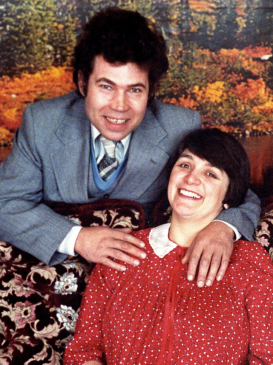
In February 1994, police arrived at 25 Cromwell Street, Gloucester, looking for a missing teenage girl. What they found instead would stop Britain cold: nine sets of human remains buried beneath the floorboards and garden of a nondescript terraced house — and that was only the beginning. Rosemary West, a 40-year-old mother of eight, sat at the center of it all. She had helped lure young women and girls to that house. She had participated in their torture, their sexual abuse, their deaths. She had then gone on living there — cooking meals, watching television, raising children — while the bodies of ten victims, including her own stepdaughter and her own teenage daughter, rotted in the earth beneath her feet. On 22 November 1995, a jury took less than two days to convict her on all ten counts of murder. The judge said she should never be freed. He was right. Thirty years later, Rose West — now calling herself Jennifer Jones — remains in a prison cell, in declining health, largely alone, still insisting she is innocent. This is the story of how ordinary evil hides in plain sight.
Convicted: Mary Ann Cotton (née Robson)
'I won't be troubled long. He'll go like all the rest of the Cottons.' That was Mary Ann Cotton's assessment of her seven-year-old stepson Charles Edward, delivered to a parish official in West Auckland, County Durham, in the spring of 1872. Five days later, the boy was dead. It was the statement that finally brought her down. By the time investigators began pulling at the thread, they found two decades of bodies behind it: eleven of her thirteen children, three of her four husbands, her own mother, and a string of lodgers and stepchildren, each one dead of 'gastric fever,' each one insured, each one mourned briefly and then forgotten. The death toll, historians estimate, may have reached twenty-one. Mary Ann Cotton was a nurse, a mother, a wife. She was trusted by the sick she nursed and by the physicians who signed off on her victims' deaths. She understood, precisely, that Victorian medicine would not look twice at a working-class child dying of gastroenteritis. She killed for insurance money: modest sums, accumulated over years, in exchange for the lives of nearly everyone who had ever depended on her. She was only ever convicted of one murder. She was hanged in Durham County Gaol on March 24, 1873, in a botched execution that left her strangling at the end of a too-short rope. She was forty years old. The full story of what she did is both a portrait of individual evil and an indictment of a system that made it catastrophically easy.
Convicted: Vera Renczi
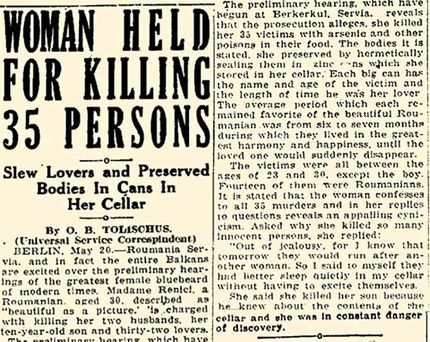
Thirty-two men lay in zinc-lined coffins in the wine cellar beneath a Romanian chateau, each one poisoned with arsenic by the woman who had loved them. Or so the story goes. Vera Renczi, dubbed the 'Black Widow' and 'Chatelaine of Berkerekul,' is one of history's most notorious female serial killers: a wealthy beauty who allegedly confessed to murdering 35 people during the 1920s, including two husbands, dozens of lovers, and her own son. According to the legend, she laced their wine when she feared they might leave her, then kept their bodies in the cellar so they never could. Police reportedly found her sitting peacefully among the coffins. But here is where the story fractures. When the Guinness Book of World Records investigated in 1972, researchers found nothing verifiable: no arrest records, no trial transcripts, no regional newspapers, no prison files. Every account traces back to a single 1925 dispatch by an American journalist who cited no primary sources. Photographs circulated as Renczi's have been identified as a Russian actress dead since 1910. The Daily Mirror once published a photo of a living Spanish fashion model and called it Renczi, later apologizing unreservedly. Was Vera Renczi a monster, or a myth? The answer, it turns out, is more unsettling than either option alone.
Accused: Enriqueta Martí Ripollés
On the morning of February 10, 1912, Barcelona police broke down the door of a ground-floor apartment on Carrer de Ponent and found something that would haunt the city for generations. Behind a locked interior door sat roughly fifty jars and basins arranged with terrible precision: congealed human blood, rendered fat, hand skeletons, bone dust, and small glass vials of finished elixirs, each one labeled in elegant calligraphy. Cowering in the front room were two children, one of them a five-year-old girl named Teresita who had been missing from the streets of El Raval for only days. The apartment's tenant was a woman named Enriqueta Martí Ripollés. By day, neighbors knew her as a ragged beggar who shuffled through Barcelona's poorest quarters with a child at her side. By night, she was something else entirely: wigged, jeweled, and dressed in silk, moving through the parlors of the city's wealthiest families and selling them preparations she claimed could cure tuberculosis, reverse aging, and treat venereal disease. Preparations made, authorities alleged, from the bodies of the city's most vulnerable children. She became known across Spain as "The Vampire of Barcelona." She was never convicted. She never stood trial. And the full truth of what happened inside that locked room may have been buried, deliberately and permanently, by the very people she served.
Convicted: Judias Anna Lou 'Judy' Buenoano
At 7:08 on the morning of March 30, 1998, a correctional officer at Florida State Prison threw the switch on the electric chair. The woman strapped into it, asked moments earlier if she had any final words, had answered only 'No, sir,' and closed her eyes. She was pronounced dead at 7:13 a.m. Her name was Judy Buenoano, and she had spent the previous evening watching a hunting and fishing show, eating chocolates, and reading a Mary Higgins Clark murder mystery. The neatness of that detail feels almost unbearable: a woman convicted of poisoning her husband, her son, and her boyfriend with arsenic, spending her last hours absorbed in fiction about someone else's crime. Prosecutor Russell Edgar had a name for her. He called her the Black Widow, a woman who 'fed off her mates and her young.' The evidence bore him out. Across nearly two decades, Buenoano is believed to have poisoned at least three people and built a life on their insurance payouts. She never confessed. She maintained her innocence to the end, eyes shut, silent in the chair. This is the story of how she got there.
Alleged Offender: Belle Sorenson Gunness (born Brynhild Paulsdatter Størseth)
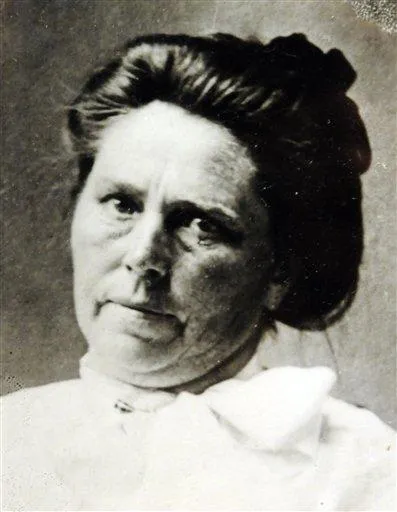
They came to La Porte, Indiana, one by one, with their life savings tucked in their coat pockets and her letters folded in their hands. A warm heart waiting, she had promised. A fine farm. A future. Belle Gunness wrote those letters for years, placing matrimonial advertisements in Norwegian-language newspapers across the Midwest, casting for men who were lonely and solvent and, crucially, willing to tell no one where they were going. When investigators finally dug up her farm in May 1908, they found the answer to where those men had gone: butchered, dismembered, folded into gunny sacks, and buried in shallow graves near the hog pen. More than forty victims lay scattered beneath the Indiana soil. Then the farmhouse burned, a headless torso was found in the ruins, and the question of whether Belle Gunness had died alongside her crimes or simply escaped them has never been definitively answered. One of the most prolific female serial killers in American history, she was never charged with a single murder. This is her story.
Convicted: Nancy Agnes Hazel Doss
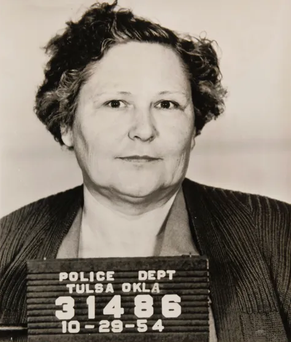
She sat across from Tulsa police Captain Harry Stege in November 1954 and giggled. She giggled when she described stirring rat poison into her husband's coffee. She giggled when she confirmed she had poisoned four of her five husbands. She giggled when the officers pressed her about the grandchildren, the sisters, the mother. The laughter never quite left her face. Nannie Doss was 49 years old, soft-featured, grandmotherly, and by the time she was arraigned on November 29, 1954, the prime suspect in at least eleven deaths spanning four states and nearly three decades. Her weapons were domestic and unremarkable: stewed prunes, corn whiskey, a slice of prune cake, a cup of morning coffee laced with arsenic. Her victims were the people closest to her, the ones who ate at her table and slept in her bed. Investigators called her 'The Giggling Granny.' The press added 'The Black Widow,' 'Lady Bluebeard,' and 'The Lonely Hearts Killer.' Each nickname captured a piece of her; none captured all of her. Because behind the laughter sat something more complicated and more chilling: a woman who had dreamed her whole life of storybook romance, and who killed, methodically and repeatedly, every time reality fell short of the fantasy. This is the story of Nancy Agnes Hazel Doss, born in rural Alabama in 1905 and buried in a prison cemetery in Oklahoma in 1965. In between, she made sure a great many people never made it out alive.
Convicted: Amy Duggan Archer-Gilligan
Between 1911 and 1916, forty-eight elderly residents died inside the Archer Home for Elderly People and Chronic Invalids in Windsor, Connecticut. The Jefferson Street Home in Hartford housed seven times as many residents and buried a similar number in the same period. The math was damning. The woman behind those numbers was Amy Archer-Gilligan, known to her congregation as 'Sister Amy,' a woman who donated a stained-glass window to St. Gabriel's Church and whom neighbors described as compassionate and devout. She was also a poisoner of breathtaking audacity. She had purchased more than ten ounces of arsenic from a local drugstore, enough to kill over a hundred people. She had forged a dead man's will. She had taken out life insurance policies on her husbands and encouraged her elderly boarders to name her as their beneficiary. When Connecticut state police exhumed five bodies, every single one tested positive for poison. The case scandalized the nation, inspired one of Broadway's most beloved dark comedies, and forced Connecticut to overhaul its elder care laws entirely. It also left behind questions the courts never fully answered: how many people truly died at Amy's hands, and how long had she been killing? This is the story of Sister Amy.
Convicted: Amelia Elizabeth Dyer (née Hobley)
'You'll know all mine by the tape around their necks.' When Amelia Dyer spoke those words to Reading police in the spring of 1896, she did so with the calm of a woman who had been getting away with murder — quite literally — for two decades. On March 30, 1896, a bargeman pulled a brown paper parcel from the River Thames near Caversham. Inside was a baby girl, strangled with white dressmaker's tape. She would not be the last. By the time detectives closed in on the mild-mannered, churchgoing widow operating out of a modest terrace on Kensington Road, seven infant bodies had been recovered from the river. Experts now estimate that Amelia Dyer — the 'Ogress of Reading,' a trained nurse turned baby farmer — murdered between 200 and 400 children over twenty years, making her one of the most prolific killers in British history. The jury took four and a half minutes to convict her. The tape never lied. This is her story.
Convicted: Katherine Mary Knight
The dinner plates were already set when police broke down the back door of 84 St Andrews Street in Aberdeen, New South Wales, on the morning of 1 March 2000. Two place settings, two handwritten notes, two names: the children of John Price, a local miner who had not shown up for his shift. The food was still warm. So was what was in the pot on the stove, which turned out to be John Price's head, simmered with vegetables and seasoned with care. In the hallway, Price's skin hung from a meat hook his killer had recently installed in the living room ceiling. He had been stabbed at least 37 times. Katherine Mary Knight, a former abattoir worker with a decades-long history of escalating violence against the men in her life, was found unconscious at the scene from a drug overdose. She was 44 years old. On 8 November 2001, she became the first woman in Australian history sentenced to life imprisonment without the possibility of parole. She remains at Silverwater Women's Correctional Centre today, aged 69, banned from access to knives and assessed as too dangerous to share a cell. This is her story.
Convicted: Aileen Carol Wuornos (née Pittman)
Her last words from the execution chamber stopped the witnesses cold. "I'd just like to say I'm sailing with the rock, and I'll be back like Independence Day, with Jesus, June 6, like the movie, big mothership and all. I'll be back." Moments later, at 9:47 a.m. on October 9, 2002, Aileen Carol Wuornos was pronounced dead. She had declined her final meal. She accepted only a cup of coffee. Between November 1989 and November 1990, Wuornos shot and killed seven men along the highways of Florida, each of them a middle-aged motorist who had stopped for a woman working the roads. She took their money, their cars, and their lives. She was a highway prostitute operating under multiple aliases, a drifter with a .22 and a history that read less like a criminal file and more like an indictment of everyone who had ever failed her. She was raised by alcoholic grandparents after her mother abandoned her at age four. Her father, whom she never met, was serving a life sentence for raping a seven-year-old child when he hanged himself in his prison cell. She was pregnant and living on the streets by fourteen. She told police, and later the courts, that every man she killed had attacked her first. The jury in her first trial deliberated for less than two hours before convicting her. She received six death sentences in total. The tabloids called her America's first female serial killer. The more precise truth: she was the first woman formally profiled by the FBI as a serial killer. The distinction hardly seemed to matter by the end. What mattered was that seven men were dead, and Aileen Wuornos had spent a lifetime arriving at that outcome.
Convicted: Dorothea Helen Puente
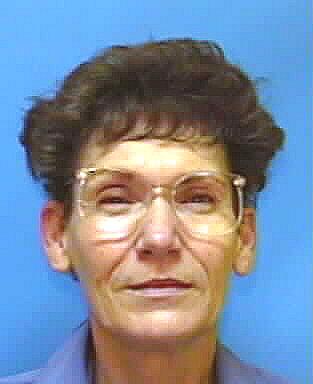
On the morning of November 11, 1988, police began digging up the yard of a blue-and-white Victorian boarding house at 1426 F Street in Sacramento, California. By the end of the day, they had found seven bodies. The woman who owned the house, a stout, silver-haired grandmother type named Dorothea Puente, stood nearby in a housecoat and watched. Detectives didn't consider her a suspect yet. They let her walk to a nearby café to get coffee. She never came back. For years, Puente had presented herself to social workers and city officials as a saint: a warm, generous landlady who took in the elderly, the mentally ill, the homeless, the people no one else would accept. She cooked elaborate meals and sent tenants to bed with warm milk. She also drugged them, buried them in her yard, and cashed their Social Security checks. Prosecutors would later allege she collected over $87,000 this way, spending some of it on a facelift. The Death House Landlady, as the press called her, was eventually convicted of three murders and died in prison in 2011 at age 82, still insisting she was innocent. The full story of how Dorothea Puente became one of America's most prolific female serial killers is a portrait of survival twisted into something monstrous.





:max_bytes(150000):strip_icc():focal(761x475:763x477):format(webp)/katherine-knight-041125-7fb225de4bb047228ad1f5edfc0840fe.jpg)

