8 cases tagged “arsenic poisoning”
Convicted: Mary Ann Cotton (née Robson)
'I won't be troubled long. He'll go like all the rest of the Cottons.' That was Mary Ann Cotton's assessment of her seven-year-old stepson Charles Edward, delivered to a parish official in West Auckland, County Durham, in the spring of 1872. Five days later, the boy was dead. It was the statement that finally brought her down. By the time investigators began pulling at the thread, they found two decades of bodies behind it: eleven of her thirteen children, three of her four husbands, her own mother, and a string of lodgers and stepchildren, each one dead of 'gastric fever,' each one insured, each one mourned briefly and then forgotten. The death toll, historians estimate, may have reached twenty-one. Mary Ann Cotton was a nurse, a mother, a wife. She was trusted by the sick she nursed and by the physicians who signed off on her victims' deaths. She understood, precisely, that Victorian medicine would not look twice at a working-class child dying of gastroenteritis. She killed for insurance money: modest sums, accumulated over years, in exchange for the lives of nearly everyone who had ever depended on her. She was only ever convicted of one murder. She was hanged in Durham County Gaol on March 24, 1873, in a botched execution that left her strangling at the end of a too-short rope. She was forty years old. The full story of what she did is both a portrait of individual evil and an indictment of a system that made it catastrophically easy.
Convicted: Vera Renczi
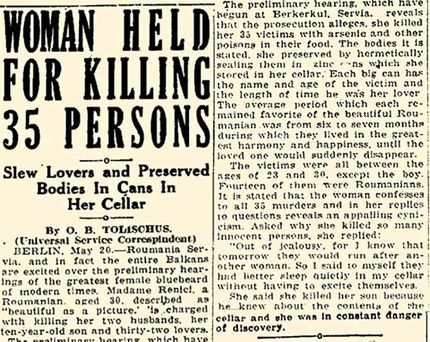
Thirty-two men lay in zinc-lined coffins in the wine cellar beneath a Romanian chateau, each one poisoned with arsenic by the woman who had loved them. Or so the story goes. Vera Renczi, dubbed the 'Black Widow' and 'Chatelaine of Berkerekul,' is one of history's most notorious female serial killers: a wealthy beauty who allegedly confessed to murdering 35 people during the 1920s, including two husbands, dozens of lovers, and her own son. According to the legend, she laced their wine when she feared they might leave her, then kept their bodies in the cellar so they never could. Police reportedly found her sitting peacefully among the coffins. But here is where the story fractures. When the Guinness Book of World Records investigated in 1972, researchers found nothing verifiable: no arrest records, no trial transcripts, no regional newspapers, no prison files. Every account traces back to a single 1925 dispatch by an American journalist who cited no primary sources. Photographs circulated as Renczi's have been identified as a Russian actress dead since 1910. The Daily Mirror once published a photo of a living Spanish fashion model and called it Renczi, later apologizing unreservedly. Was Vera Renczi a monster, or a myth? The answer, it turns out, is more unsettling than either option alone.
Convicted: Masumi Hayashi (林 眞須美)
On a sweltering July evening in 1998, residents of a quiet Wakayama neighborhood lined up to ladle curry from a communal pot at their summer festival. Within hours, sixty-seven of them were fighting for their lives. Four never recovered: a local council president, his vice president, a ten-year-old boy, and a sixteen-year-old girl. Investigators would eventually determine the pot contained at least 130 grams of arsenic trioxide — enough poison to kill more than one hundred people. The suspect was a thirty-seven-year-old mother of four who had been seen loitering near the curry pots, alone, for over forty minutes. Before her arrest, a photograph captured her in her garden, smiling, hosing down a crowd of reporters. That image would follow her everywhere. Masumi Hayashi was convicted of mass murder and sentenced to death on purely circumstantial evidence: no confession, no confirmed motive, no direct physical evidence. She has maintained her innocence ever since. Now sixty-three years old and still on death row, her case raises a question that haunts Japanese legal scholars: what if the evidence was never enough?
Convicted: Judias Anna Lou 'Judy' Buenoano
At 7:08 on the morning of March 30, 1998, a correctional officer at Florida State Prison threw the switch on the electric chair. The woman strapped into it, asked moments earlier if she had any final words, had answered only 'No, sir,' and closed her eyes. She was pronounced dead at 7:13 a.m. Her name was Judy Buenoano, and she had spent the previous evening watching a hunting and fishing show, eating chocolates, and reading a Mary Higgins Clark murder mystery. The neatness of that detail feels almost unbearable: a woman convicted of poisoning her husband, her son, and her boyfriend with arsenic, spending her last hours absorbed in fiction about someone else's crime. Prosecutor Russell Edgar had a name for her. He called her the Black Widow, a woman who 'fed off her mates and her young.' The evidence bore him out. Across nearly two decades, Buenoano is believed to have poisoned at least three people and built a life on their insurance payouts. She never confessed. She maintained her innocence to the end, eyes shut, silent in the chair. This is the story of how she got there.
Convicted: Debra Lynn Baker
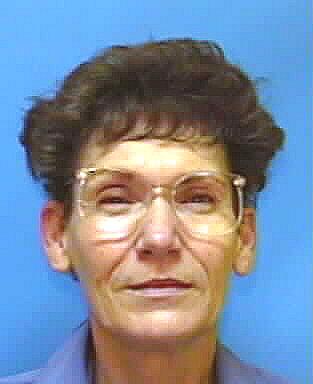
In June 1990, as Jerry Sternadel lay dying in a Wichita Falls hospital, he did something extraordinary: he told doctors and family members exactly who had killed him. He named two women. One of them, his bookkeeper Debra Lynn Baker, would eventually be convicted of first-degree murder for poisoning him with arsenic administered in his cran-apple juice. The other, his wife Lou-Ann, was never charged. Baker's trial ended on the fourth anniversary of Sternadel's death with a verdict that stunned the courtroom: guilty of murder, sentenced to just ten years' probation and a $10,000 fine. No prison time. Not yet. The case of Debra Baker is a story of loyalty twisted into something lethal, of a privileged life built on a dead man's money, and of a justice system that the victim's own family condemned as a catastrophic failure. His daughter called it a terrible injustice. His first wife wrote a book about it. And Debra Baker, who refused to implicate her best friend even at the cost of a life sentence, walked out of that courtroom a free woman.
Alleged Offender: Giulia Tofana (also spelled Toffana, Tophana, Tophania; possible true surname: Mangiardi, per modern scholarship)
A woman stands over a pot of soup, a small vial in her hand. The liquid she has just tipped into the broth is colorless, odorless, invisible. Then something breaks inside her. She pulls the bowl away from her husband and confesses everything. That single moment of conscience, recorded in court testimony from the 1659 Roman poison investigation, may have unraveled one of the most elaborate criminal networks in early modern history. At its center, at least according to legend, stood a Sicilian woman named Giulia Tofana, creator of a poison so perfectly engineered it mimicked natural illness, so cleverly packaged it passed as a devotional product bearing the image of a saint. Traditional accounts credit her with over 600 deaths, mostly husbands of women with nowhere else to turn. But modern scholarship tells a different story entirely: the woman behind the myth may have died quietly in her sleep around 1651, years before the trial that made her famous. Her real surname may not have been Tofana at all. And the network eventually prosecuted by Roman authorities may have been run by someone else. This is the true story of Giulia Tofana: part documented history, part deliberate mythology, and wholly extraordinary.
Convicted: Nancy Agnes Hazel Doss
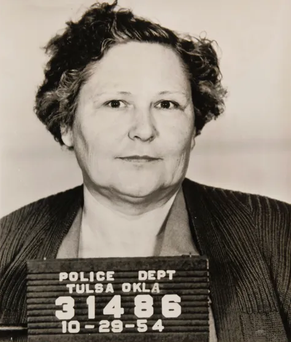
She sat across from Tulsa police Captain Harry Stege in November 1954 and giggled. She giggled when she described stirring rat poison into her husband's coffee. She giggled when she confirmed she had poisoned four of her five husbands. She giggled when the officers pressed her about the grandchildren, the sisters, the mother. The laughter never quite left her face. Nannie Doss was 49 years old, soft-featured, grandmotherly, and by the time she was arraigned on November 29, 1954, the prime suspect in at least eleven deaths spanning four states and nearly three decades. Her weapons were domestic and unremarkable: stewed prunes, corn whiskey, a slice of prune cake, a cup of morning coffee laced with arsenic. Her victims were the people closest to her, the ones who ate at her table and slept in her bed. Investigators called her 'The Giggling Granny.' The press added 'The Black Widow,' 'Lady Bluebeard,' and 'The Lonely Hearts Killer.' Each nickname captured a piece of her; none captured all of her. Because behind the laughter sat something more complicated and more chilling: a woman who had dreamed her whole life of storybook romance, and who killed, methodically and repeatedly, every time reality fell short of the fantasy. This is the story of Nancy Agnes Hazel Doss, born in rural Alabama in 1905 and buried in a prison cemetery in Oklahoma in 1965. In between, she made sure a great many people never made it out alive.
Convicted: Amy Duggan Archer-Gilligan
Between 1911 and 1916, forty-eight elderly residents died inside the Archer Home for Elderly People and Chronic Invalids in Windsor, Connecticut. The Jefferson Street Home in Hartford housed seven times as many residents and buried a similar number in the same period. The math was damning. The woman behind those numbers was Amy Archer-Gilligan, known to her congregation as 'Sister Amy,' a woman who donated a stained-glass window to St. Gabriel's Church and whom neighbors described as compassionate and devout. She was also a poisoner of breathtaking audacity. She had purchased more than ten ounces of arsenic from a local drugstore, enough to kill over a hundred people. She had forged a dead man's will. She had taken out life insurance policies on her husbands and encouraged her elderly boarders to name her as their beneficiary. When Connecticut state police exhumed five bodies, every single one tested positive for poison. The case scandalized the nation, inspired one of Broadway's most beloved dark comedies, and forced Connecticut to overhaul its elder care laws entirely. It also left behind questions the courts never fully answered: how many people truly died at Amy's hands, and how long had she been killing? This is the story of Sister Amy.