8 cases from Mexico
Convicted: Magdalena Solís
On a May night in 1963, a fourteen-year-old boy named Sebastián Guerrero crept close enough to a limestone cave in rural Tamaulipas, Mexico, to see what was happening inside. What he witnessed sent him sprinting more than twenty-five kilometers through scrubland and darkness to the nearest police station, his lungs burning, his story so horrific that the officer on duty refused to believe him. That decision cost two people their lives. The officer who eventually agreed to escort Guerrero back to the caves was found the next day with his heart cut from his chest. At the center of it all was Magdalena Solís, a former prostitute from the slums of Tamaulipas who had, in the span of a few months, transformed herself into a goddess. Or, more precisely, allowed herself to be transformed, then seized the role entirely. Known as 'The High Priestess of Blood,' Solís presided over at least eight confirmed murders in the isolated village of Yerbabuena, orchestrating rituals so brutal that investigators who arrived at the scene struggled to process what they found. The true death toll, authorities suspected, reached fifteen or sixteen victims. Solís would serve fifty years in prison; whether she lived to see her release remains, to this day, unconfirmed.
Convicted: Delfina María de Jesús González
Delfina de Jesús González, along with her sister María de Jesús González, were Mexican serial killers. They operated a bordello in the state of Guanajuato, Mexico, from the 1950s to the mid-1960s, luring poor girls with promises of good jobs, only to force them into prostitution. The sisters murdered the girls when they became ill, unattractive to clients, or stopped complying. The exact number of their victims remains unknown, with estimates ranging from 91 to 150 people.
Alleged Offender: Claudia Berenice Ochoa Félix
In May 2014, a young woman named Yuriana Castillo Torres was kidnapped off the streets of Culiacán, Sinaloa, and murdered. The men who took her believed she was someone else: a glamorous social media star whose physical resemblance to Kim Kardashian had made her the most-talked-about woman in the narco underworld. The intended target, Claudia Ochoa Félix, was alive. For now. She had been born into the capital of Mexico's deadliest cartel territory, married a Sinaloa Cartel lieutenant, survived a car crash that killed her boyfriend, and allegedly fallen in love with the man who commanded the cartel's most feared assassination squad. By 2014, her Instagram account was a fever dream of gold-plated rifles, stacks of cash, and designer everything, and the world had decided she was the 'Empress of the Ántrax.' She said it was all lies. Mexican authorities said she was never under investigation. A respected journalist who knew the cartel better than almost anyone agreed she showed no signs of actual membership. Then, on a September morning in 2019, she was found dead in a private residence in her hometown. She was 32. The cause was accidental. Some people never believed it.
Convicted: Felícitas Sánchez Aguillón
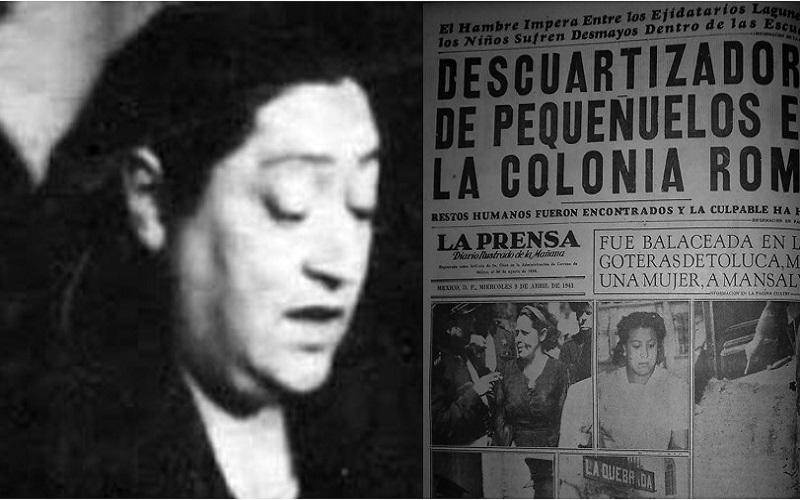
Felícitas Sánchez Aguillón, also known as Sánchez Neyra, was a notorious Mexican nurse, midwife, baby farmer, and serial killer who operated in Mexico City during the 1930s. She became infamous for killing babies under her care, with a total of 40 to 50 murders attributed to her. Sánchez Aguillón was also referred to as 'The Ogress of Colonia Roma,' 'The Female Ripper of Colonia Roma,' and 'The Human Crusher of Little Angels.'
Convicted: Sandra Ávila Beltrán
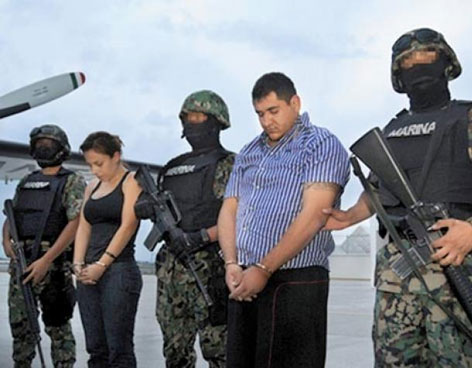
When federal agents swarmed a Mexico City restaurant on September 28, 2007, and placed Sandra Ávila Beltrán under arrest, she did not flinch. She smiled. Then she asked if she could freshen her makeup before the cameras filmed her. It was the kind of composure that takes a lifetime to cultivate, and Sandra's lifetime had been extraordinary preparation. Born into one of Mexico's most storied narco dynasties, niece of Guadalajara Cartel godfather Miguel Ángel Félix Gallardo, she had watched the drug trade operate from her cradle. She had buried two husbands, both former police commanders turned traffickers, both killed by hired assassins. She had allegedly coordinated a 9.5-ton cocaine shipment and paid millions in ransom when her own son was kidnapped. By the time the agents clicked the handcuffs, she had already become a legend: La Reina del Pacífico. The Queen of the Pacific. What followed her arrest was almost as astonishing as the life that preceded it. This is the true story of the most glamorous and dangerous woman in the history of the Mexican drug war.
Accused: Verónica Mireya Moreno Carreón
She had been decorated for bravery. She had taken a bullet in the line of duty, recovered, and returned to the streets of San Nicolás de los Garza as what colleagues called a model police officer. Then Verónica Mireya Moreno Carreón walked out of her uniform and into the most violent organization in northern Mexico. By the fall of 2011, Mexican Navy intelligence had identified her as the plaza boss of Los Zetas in San Nicolás, the first woman known to hold formal territorial command within the cartel's brutal hierarchy. She managed executions, torture operations, extortion networks, drug distribution, and a web of corrupted police officers, some of whom she almost certainly knew from her years on the force. When marines finally caught up with her in a stolen vehicle in a working-class neighborhood, they found a revolver, 150 doses of cocaine and crack, marijuana, and six cell phones. She was barely 35 years old. Her story has no clean ending: no publicly confirmed conviction, no final sentence on record. What remains is a portrait of institutional failure, personal transformation, and a question Mexico's justice system has never fully answered.
Convicted: Juana Dayanara Barraza Samperio
Juana Dayanara Barraza Samperio, a former professional wrestler and a Mexican serial killer, also known as La Mataviejitas, was sentenced to 759 years in prison for the murder of 16 elderly women. The first murder attributed to Mataviejitas has been dated variously to the late 1990s and to a specific killing on 17 November 2003. Estimates of the total number of the Mataviejitas victims range from 42 to 48 deaths. After Barraza's arrest, the case was officially closed despite more than 30 unresolved cases. Two other individuals, Araceli Vázquez and Mario Tablas, were also arrested in 2005 and labelled as The Mataviejitas by police and media.
Alleged Offender: Enedina Arellano Félix de Toledo
She outlasted them all. While her brothers were being shot in the streets, arrested by federal police, and extradited to American courtrooms, Enedina Arellano Félix de Toledo was doing something none of them ever managed: disappearing in plain sight. Born in Mazatlán in 1961, she earned a legitimate accounting degree, married a Tijuana lawyer, and spent decades managing the financial engine of one of Mexico's most brutal criminal organizations. The U.S. Treasury sanctioned her in 2000. The DEA tracked her for years. Mexico's attorney general eventually put her on a priority fugitives list shared with U.S. authorities. And yet, as of early 2026, she has never been arrested. Not once. No handcuffs, no courtroom, no extradition hearing. While the Tijuana Cartel her family built collapsed around her, one brother killed, the others imprisoned, she transformed what remained into a quieter, more businesslike operation running through pharmacies and real estate in Guadalajara. The DEA and Mexican authorities consider her the first woman ever to lead a major Mexican drug cartel. She carries the aliases La Jefa, La Madrina, and La Narcomami. Intelligence reports place her in Guadalajara today, living under a false identity. The accountant, it turns out, has always been the hardest one to catch.