Bonnie Elizabeth Parker
Case Summary
Bonnie Elizabeth Parker, a pivotal figure among American female criminals, captured the public's attention as part of the infamous duo Bonnie and Clyde. Their crime spree during the Great Depression positioned them as both feared outlaws and pop culture icons. Bonnie, born in 1910 in Rowena, Texas, joined forces with Clyde Barrow in the early 1930s, embarking on a notorious journey that included bank robberies and violent confrontations with law enforcement.
The duo's criminal activities culminated in their death in 1934 in Bienville Parish, Louisiana, where they were ambushed and killed by police in their well-known Bonnie and Clyde car. The bullet-riddled vehicle and their dramatic demise are emblematic of their violent lifestyle. Bonnie and Clyde's funeral drew significant attention, reflecting their infamy. Their story remains a fascinating study of crime and desperation during one of America's most challenging eras, with Bonnie Parker at the heart of this enduring narrative.
October 1, 1910, Rowena, Texas, United States(Age: 23)
May 23, 1934, Bienville Parish, Louisiana,
Related Cases
Accused
Connection tags:

Convicted
Connection tags:

Accused
Connection tags:

Convicted
Connection tags:
Convicted
Connection tags:

Convicted
Connection tags:
Case Details
In the heart of Rowena, Texas, on October 1, 1910, Bonnie Elizabeth Parker was born into a world poised on the brink of economic strife. Her father, a bricklayer, passed away when Bonnie was just four years old, leaving her mother to shoulder the heavy burden of raising her family alone. They relocated to the impoverished neighborhoods of West Dallas, a stark backdrop for a childhood marked by economic hardship.
Bonnie was a bright child, her academic and creative talents shining like beacons in the dim surroundings of her upbringing. She excelled at school and had a particular flair for creative writing, hinting at a future that might have veered away from the path it ultimately took. However, life had other plans, and at the tender age of 16, Bonnie's trajectory took a sharp turn.
The year was 1926, and Bonnie made a decision that would pivot her life forever—she married Roy Thornton. The marriage was tumultuous from the start, marred by Thornton's frequent absences and brushes with the law. The union, although legally binding, was short-lived in practice, as Thornton's criminal activities led to his incarceration, leaving Bonnie alone once again.
The early 1930s were a time of significant change for Bonnie. It was in January 1930 that her path crossed with Clyde Barrow, a man whose name would soon be inextricably linked with hers in the annals of American criminal history. Clyde, a charismatic figure with a troubled past, was already deep into a life of crime, having amassed a record that included burglaries and car thefts.
Bonnie, perhaps drawn to Clyde’s dangerous allure, fell rapidly into a relationship with him. Their partnership was both passionate and destructive, catapulting Bonnie from the fringes of criminal activity into the glaring spotlight of infamy. Together, they embarked on a series of crimes that ranged from petty thefts to high-profile bank robberies.
As Bonnie and Clyde's criminal activities escalated, so did their notoriety. Their first brush with the law came in 1932, when they, along with Clyde’s brother Buck and their companions, found themselves in a fierce shootout with police in Joplin, Missouri. This encounter led to the deaths of two police officers and marked the beginning of their reputation as public enemies.
The couple's life of crime continued unabated, with their acts growing bolder and more frequent. Robberies at grocery stores, gas stations, and occasionally banks across the Central United States became their modus operandi. However, it wasn't just the thefts that drew media attention; it was the cold-blooded violence that accompanied their spree. Bonnie and Clyde were believed to have killed at least nine police officers and several civilians, underscoring their transformation from petty criminals to hardened outlaws.
Bonnie's role in these activities has been a subject of much speculation and debate. While some sources depict her as a gun-toting equal partner to Clyde, others suggest she was less involved in the actual crimes. Nonetheless, her presence at numerous crime scenes and her partnership with Clyde were undeniable.
Their story took a grim turn on May 23, 1934, when a carefully laid trap by law enforcement ended their lives in a hail of bullets in Bienville Parish, Louisiana. The bullet-riddled car, the dramatic and violent demise, and the subsequent public spectacle of their funeral attendance captured the nation's attention.
Bonnie Parker's early life, filled with potential and promise, diverged drastically in her later years, leading her down a path of infamy and tragedy. Her story remains a poignant narrative of desperation, crime, and the search for identity in the harsh landscape of the Great Depression-era America.
Bonnie Elizabeth Parker, a name synonymous with crime and desperation, became one of the most renowned American female criminals of the 1930s. Alongside Clyde Barrow, she formed the other half of the infamous duo, Bonnie and Clyde, whose criminal exploits during the Great Depression captured the American public's imagination and fear. Born into poverty in Rowena, Texas, Bonnie's early life was marked by hardship, but nothing predestined her for the life of an outlaw until she met Clyde.
Their partnership turned deadly in the early 1930s. Initially involving minor crimes, their activities soon escalated into a series of more audacious and violent acts. By 1932, Bonnie and Clyde had commenced a notorious spree of bank robberies, kidnappings, and murders, solidifying their status as Great Depression outlaws. Their targets varied from small stores to rural gas stations, but it was the bank robberies that gained them national attention.
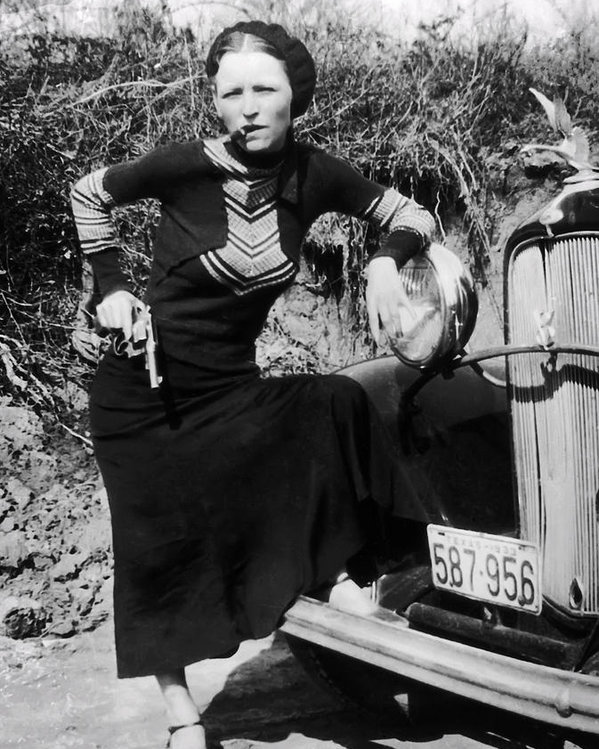
The duo's reputation for brutality was sealed with incidents like the Grapevine murders in 1934, where they reportedly killed two young highway patrolmen in Texas. This act of violence was so shocking that it intensified the nationwide manhunt for the deadly partners. Bonnie, often portrayed as the cigar-smoking femme fatale in photographs, played a crucial role in these criminal endeavors, though the extent of her involvement in the actual shootings remains a topic of debate among historians.
Their life on the run was punctuated by close calls and narrow escapes, which only added to their legend. In 1933, Bonnie was captured and arrested but was soon released, allowing her to rejoin Clyde. The pair continued their criminal activities, relentlessly pursued by law enforcement across multiple states. Their ability to elude capture, time and again, made them figures of public fascination and media darlings, despite the growing list of serious crimes attached to their names.
The relentless pursuit of Bonnie and Clyde culminated in a dramatic and violent end. On May 23, 1934, they were ambushed by police in Bienville Parish, Louisiana. In a hail of gunfire, Bonnie and Clyde were shot multiple times, an event that marked the end of their crime spree and their lives. Photographs of the bullet-riddled Bonnie and Clyde car post-ambush became iconic, symbolizing the violent end of the most notorious 1930s bank robbers.
Their deaths were met with a mix of relief and spectacle. Bonnie and Clyde's funeral attendance reflected their infamy, drawing large crowds, a testament to the public's complex fascination with the couple. They were buried separately, as per the family's wishes, marking an end to their tumultuous journey together.
The story of Bonnie and Clyde is not just one of crime, but also one of love, rebellion, and tragedy, set against the backdrop of a struggling America. Their saga has been retold in various forms of media, continuing to intrigue and captivate people worldwide. Despite their violent acts, the legend of Bonnie and Clyde endures, a somber reminder of the allure and dangers of the outlaw persona in American cultural history.
In the early 1930s, America was plunged into the depths of the Great Depression, creating a fertile ground for outlaws who captured the public's imagination. Among them was Bonnie Elizabeth Parker, a name that would become synonymous with crime and defiance. As one-half of the infamous duo known as Bonnie and Clyde, Bonnie's journey from a poverty-stricken childhood in Texas to becoming one of America's most notorious female criminals was marked by a series of audacious crimes and a dramatic finale.
Bonnie met Clyde Barrow in January 1930, a convergence of two desperate souls that sparked one of the most sensational crime sprees in American history. Initially involved in petty thefts, their criminal activities quickly escalated, capturing the attention of law enforcement agencies across several states. By the time they were recognized as notorious figures, Bonnie and Clyde had been involved in numerous bank robberies, kidnappings, and murders.
The investigation into Bonnie and Clyde's crimes was complex and exhaustive. Law enforcement agencies in the Central United States, where most of their crimes were committed, struggled to keep up with the couple's movements. Their ability to evade capture became almost as legendary as the crimes themselves. In response, a formidable posse led by former Texas Ranger Frank Hamer was assembled. Hamer, known for his tenacity, was commissioned to bring an end to Bonnie and Clyde's reign of terror.
On May 23, 1934, after meticulous planning and tracking, the law finally caught up with Bonnie and Clyde. In an orchestrated ambush set up by Hamer and his team in Bienville Parish, Louisiana, the couple's infamous journey came to a violent end. As they drove into the trap in their well-known Bonnie and Clyde car, the officers unleashed a hail of bullets, ensuring there was no chance of escape.
The bullet-riddled car in which Bonnie and Clyde met their demise became an emblem of their violent end. The ambush was not just a law enforcement victory; it also marked a turning point in the public perception of the duo. While initially romanticized as modern-day Robin Hoods, the reality of their violent actions could no longer be glamorized.
Bonnie and Clyde's death did little to quell the public's fascination with their story. Their funeral drew massive crowds, reflective of their infamy and the media's sensational coverage of their crimes. Images of their Bonnie and Clyde car, riddled with bullets, were widely disseminated, becoming a grim reminder of the fate awaiting those who choose a life of crime.
Where Bonnie and Clyde are buried also remains a point of interest, underscoring the lasting impact of their story on American culture. Their graves, though separate, continue to draw visitors, a testament to the enduring allure of their notorious legacy.
The investigation and ultimate demise of Bonnie and Clyde serve as a stark reminder of the limits of lawlessness. Their story is not just one of crime but also of the societal conditions that breed such desperation. It is a narrative that continues to resonate, reminding us of the complex interplay between society, crime, and the individuals caught in between.
In the annals of American crime history, few names resonate as much as Bonnie and Clyde. Bonnie Elizabeth Parker, a figure among the most notorious American female criminals, along with Clyde Barrow, captivated the nation during the tumult of the Great Depression. Between 1932 and 1934, this infamous duo, symbolizing the era's desperation and lawlessness, embarked on a crime spree that would etch their names in the dark pages of history.
The end for Bonnie and Clyde was as violent as their lives had been. On May 23, 1934, in Bienville Parish, Louisiana, they met their demise. Law enforcement, tipped off by their predictable patterns, ambushed them in their famous Bonnie and Clyde car. The bullet-riddled car became a grim symbol of their legacy, capturing the violent conclusion to their notorious journey.
The public's fascination with Bonnie Parker did not conclude with her violent death. The spectacle of Bonnie and Clyde's funeral drew large crowds, reflective of their infamous status. Bonnie's funeral, in particular, underscored her impact as an iconic figure of criminal lore. Her role in the duo's escapades challenged the era's perceptions of women, marking her as an outlier among Great Depression outlaws.
Bonnie and Clyde's story has permeated popular culture, immortalized in numerous books, films, and songs. The 1967 film "Bonnie and Clyde" perhaps most famously encapsulated their lives, blending a romanticized view of their criminal exploits with stark, brutal reality. This portrayal contributed significantly to the mythos surrounding Bonnie, elevating her status from outlaw to a tragic heroine of sorts, misunderstood and molded by her dire circumstances.
Beyond entertainment, the tale of Bonnie and Clyde spurred changes in law enforcement tactics and policies. Their ability to elude capture for so long highlighted deficiencies within police operations, catalyzing improvements in communication and cooperation across state lines. This legacy of Bonnie and Clyde, particularly the operational shifts in policing their crimes instigated, remains a significant chapter in the evolution of law enforcement in the United States.
In reflecting on Bonnie Parker's legacy, it is clear that her life story offers more than just a narrative of crime. It speaks to the social and economic pressures of the time, illustrating how desperation pushed individuals to notorious lengths. While her actions cannot be condoned, they can be understood as part of a larger context of survival amid the harsh realities of the Great Depression.
Thus, Bonnie Parker remains a figure of enduring fascination. Her story, interwoven with violence, defiance, and tragedy, continues to captivate and provoke thought about the societal conditions that breed crime and the individuals who become its most notorious protagonists. As history looks back on Bonnie and Clyde, it sees not only the stark realities of their actions but also the indelible mark they left on American cultural and criminal history.
Timeline
Beginning of criminal activities
Bonnie and Clyde commence their criminal activities, including bank robberies, kidnappings, and murders.
Capture of Bonnie Parker
Bonnie Parker is captured and arrested, but is later released.
Death of Bonnie and Clyde
Bonnie Parker and Clyde Barrow are ambushed by police and killed in Bienville Parish, Louisiana.
Crime Location
Photos
Bonnie Parker and Clyde Barrow
Death car of Bonnie and Clyde

Bonnie Parker - Primary image

Bonnie Parker - Image 2

Bonnie Parker - Image 3

Bonnie Parker - Image 4

Bonnie Parker - Image 5
Bonnie Parker - Image 6

Bonnie Parker - Image 7

Bonnie Parker - Image 8
Bonnie Parker - Image 9

Bonnie Parker - Image 10

Bonnie Parker - Image 11
Sources
Frequently Asked Questions
Table of Contents
Case Summary
Bonnie Elizabeth Parker, a pivotal figure among American female criminals, captured the public's attention as part of the infamous duo Bonnie and Clyde. Their crime spree during the Great Depression positioned them as both feared outlaws and pop culture icons. Bonnie, born in 1910 in Rowena, Texas, joined forces with Clyde Barrow in the early 1930s, embarking on a notorious journey that included bank robberies and violent confrontations with law enforcement.
The duo's criminal activities culminated in their death in 1934 in Bienville Parish, Louisiana, where they were ambushed and killed by police in their well-known Bonnie and Clyde car. The bullet-riddled vehicle and their dramatic demise are emblematic of their violent lifestyle. Bonnie and Clyde's funeral drew significant attention, reflecting their infamy. Their story remains a fascinating study of crime and desperation during one of America's most challenging eras, with Bonnie Parker at the heart of this enduring narrative.
October 1, 1910, Rowena, Texas, United States(Age: 23)
May 23, 1934, Bienville Parish, Louisiana,
Case Details
In the heart of Rowena, Texas, on October 1, 1910, Bonnie Elizabeth Parker was born into a world poised on the brink of economic strife. Her father, a bricklayer, passed away when Bonnie was just four years old, leaving her mother to shoulder the heavy burden of raising her family alone. They relocated to the impoverished neighborhoods of West Dallas, a stark backdrop for a childhood marked by economic hardship.
Bonnie was a bright child, her academic and creative talents shining like beacons in the dim surroundings of her upbringing. She excelled at school and had a particular flair for creative writing, hinting at a future that might have veered away from the path it ultimately took. However, life had other plans, and at the tender age of 16, Bonnie's trajectory took a sharp turn.
The year was 1926, and Bonnie made a decision that would pivot her life forever—she married Roy Thornton. The marriage was tumultuous from the start, marred by Thornton's frequent absences and brushes with the law. The union, although legally binding, was short-lived in practice, as Thornton's criminal activities led to his incarceration, leaving Bonnie alone once again.
The early 1930s were a time of significant change for Bonnie. It was in January 1930 that her path crossed with Clyde Barrow, a man whose name would soon be inextricably linked with hers in the annals of American criminal history. Clyde, a charismatic figure with a troubled past, was already deep into a life of crime, having amassed a record that included burglaries and car thefts.
Bonnie, perhaps drawn to Clyde’s dangerous allure, fell rapidly into a relationship with him. Their partnership was both passionate and destructive, catapulting Bonnie from the fringes of criminal activity into the glaring spotlight of infamy. Together, they embarked on a series of crimes that ranged from petty thefts to high-profile bank robberies.
As Bonnie and Clyde's criminal activities escalated, so did their notoriety. Their first brush with the law came in 1932, when they, along with Clyde’s brother Buck and their companions, found themselves in a fierce shootout with police in Joplin, Missouri. This encounter led to the deaths of two police officers and marked the beginning of their reputation as public enemies.
The couple's life of crime continued unabated, with their acts growing bolder and more frequent. Robberies at grocery stores, gas stations, and occasionally banks across the Central United States became their modus operandi. However, it wasn't just the thefts that drew media attention; it was the cold-blooded violence that accompanied their spree. Bonnie and Clyde were believed to have killed at least nine police officers and several civilians, underscoring their transformation from petty criminals to hardened outlaws.
Bonnie's role in these activities has been a subject of much speculation and debate. While some sources depict her as a gun-toting equal partner to Clyde, others suggest she was less involved in the actual crimes. Nonetheless, her presence at numerous crime scenes and her partnership with Clyde were undeniable.
Their story took a grim turn on May 23, 1934, when a carefully laid trap by law enforcement ended their lives in a hail of bullets in Bienville Parish, Louisiana. The bullet-riddled car, the dramatic and violent demise, and the subsequent public spectacle of their funeral attendance captured the nation's attention.
Bonnie Parker's early life, filled with potential and promise, diverged drastically in her later years, leading her down a path of infamy and tragedy. Her story remains a poignant narrative of desperation, crime, and the search for identity in the harsh landscape of the Great Depression-era America.
Bonnie Elizabeth Parker, a name synonymous with crime and desperation, became one of the most renowned American female criminals of the 1930s. Alongside Clyde Barrow, she formed the other half of the infamous duo, Bonnie and Clyde, whose criminal exploits during the Great Depression captured the American public's imagination and fear. Born into poverty in Rowena, Texas, Bonnie's early life was marked by hardship, but nothing predestined her for the life of an outlaw until she met Clyde.
Their partnership turned deadly in the early 1930s. Initially involving minor crimes, their activities soon escalated into a series of more audacious and violent acts. By 1932, Bonnie and Clyde had commenced a notorious spree of bank robberies, kidnappings, and murders, solidifying their status as Great Depression outlaws. Their targets varied from small stores to rural gas stations, but it was the bank robberies that gained them national attention.
The duo's reputation for brutality was sealed with incidents like the Grapevine murders in 1934, where they reportedly killed two young highway patrolmen in Texas. This act of violence was so shocking that it intensified the nationwide manhunt for the deadly partners. Bonnie, often portrayed as the cigar-smoking femme fatale in photographs, played a crucial role in these criminal endeavors, though the extent of her involvement in the actual shootings remains a topic of debate among historians.
Their life on the run was punctuated by close calls and narrow escapes, which only added to their legend. In 1933, Bonnie was captured and arrested but was soon released, allowing her to rejoin Clyde. The pair continued their criminal activities, relentlessly pursued by law enforcement across multiple states. Their ability to elude capture, time and again, made them figures of public fascination and media darlings, despite the growing list of serious crimes attached to their names.
The relentless pursuit of Bonnie and Clyde culminated in a dramatic and violent end. On May 23, 1934, they were ambushed by police in Bienville Parish, Louisiana. In a hail of gunfire, Bonnie and Clyde were shot multiple times, an event that marked the end of their crime spree and their lives. Photographs of the bullet-riddled Bonnie and Clyde car post-ambush became iconic, symbolizing the violent end of the most notorious 1930s bank robbers.
Their deaths were met with a mix of relief and spectacle. Bonnie and Clyde's funeral attendance reflected their infamy, drawing large crowds, a testament to the public's complex fascination with the couple. They were buried separately, as per the family's wishes, marking an end to their tumultuous journey together.
The story of Bonnie and Clyde is not just one of crime, but also one of love, rebellion, and tragedy, set against the backdrop of a struggling America. Their saga has been retold in various forms of media, continuing to intrigue and captivate people worldwide. Despite their violent acts, the legend of Bonnie and Clyde endures, a somber reminder of the allure and dangers of the outlaw persona in American cultural history.
In the early 1930s, America was plunged into the depths of the Great Depression, creating a fertile ground for outlaws who captured the public's imagination. Among them was Bonnie Elizabeth Parker, a name that would become synonymous with crime and defiance. As one-half of the infamous duo known as Bonnie and Clyde, Bonnie's journey from a poverty-stricken childhood in Texas to becoming one of America's most notorious female criminals was marked by a series of audacious crimes and a dramatic finale.
Bonnie met Clyde Barrow in January 1930, a convergence of two desperate souls that sparked one of the most sensational crime sprees in American history. Initially involved in petty thefts, their criminal activities quickly escalated, capturing the attention of law enforcement agencies across several states. By the time they were recognized as notorious figures, Bonnie and Clyde had been involved in numerous bank robberies, kidnappings, and murders.
The investigation into Bonnie and Clyde's crimes was complex and exhaustive. Law enforcement agencies in the Central United States, where most of their crimes were committed, struggled to keep up with the couple's movements. Their ability to evade capture became almost as legendary as the crimes themselves. In response, a formidable posse led by former Texas Ranger Frank Hamer was assembled. Hamer, known for his tenacity, was commissioned to bring an end to Bonnie and Clyde's reign of terror.
On May 23, 1934, after meticulous planning and tracking, the law finally caught up with Bonnie and Clyde. In an orchestrated ambush set up by Hamer and his team in Bienville Parish, Louisiana, the couple's infamous journey came to a violent end. As they drove into the trap in their well-known Bonnie and Clyde car, the officers unleashed a hail of bullets, ensuring there was no chance of escape.
The bullet-riddled car in which Bonnie and Clyde met their demise became an emblem of their violent end. The ambush was not just a law enforcement victory; it also marked a turning point in the public perception of the duo. While initially romanticized as modern-day Robin Hoods, the reality of their violent actions could no longer be glamorized.
Bonnie and Clyde's death did little to quell the public's fascination with their story. Their funeral drew massive crowds, reflective of their infamy and the media's sensational coverage of their crimes. Images of their Bonnie and Clyde car, riddled with bullets, were widely disseminated, becoming a grim reminder of the fate awaiting those who choose a life of crime.
Where Bonnie and Clyde are buried also remains a point of interest, underscoring the lasting impact of their story on American culture. Their graves, though separate, continue to draw visitors, a testament to the enduring allure of their notorious legacy.
The investigation and ultimate demise of Bonnie and Clyde serve as a stark reminder of the limits of lawlessness. Their story is not just one of crime but also of the societal conditions that breed such desperation. It is a narrative that continues to resonate, reminding us of the complex interplay between society, crime, and the individuals caught in between.
In the annals of American crime history, few names resonate as much as Bonnie and Clyde. Bonnie Elizabeth Parker, a figure among the most notorious American female criminals, along with Clyde Barrow, captivated the nation during the tumult of the Great Depression. Between 1932 and 1934, this infamous duo, symbolizing the era's desperation and lawlessness, embarked on a crime spree that would etch their names in the dark pages of history.
The end for Bonnie and Clyde was as violent as their lives had been. On May 23, 1934, in Bienville Parish, Louisiana, they met their demise. Law enforcement, tipped off by their predictable patterns, ambushed them in their famous Bonnie and Clyde car. The bullet-riddled car became a grim symbol of their legacy, capturing the violent conclusion to their notorious journey.
The public's fascination with Bonnie Parker did not conclude with her violent death. The spectacle of Bonnie and Clyde's funeral drew large crowds, reflective of their infamous status. Bonnie's funeral, in particular, underscored her impact as an iconic figure of criminal lore. Her role in the duo's escapades challenged the era's perceptions of women, marking her as an outlier among Great Depression outlaws.
Bonnie and Clyde's story has permeated popular culture, immortalized in numerous books, films, and songs. The 1967 film "Bonnie and Clyde" perhaps most famously encapsulated their lives, blending a romanticized view of their criminal exploits with stark, brutal reality. This portrayal contributed significantly to the mythos surrounding Bonnie, elevating her status from outlaw to a tragic heroine of sorts, misunderstood and molded by her dire circumstances.
Beyond entertainment, the tale of Bonnie and Clyde spurred changes in law enforcement tactics and policies. Their ability to elude capture for so long highlighted deficiencies within police operations, catalyzing improvements in communication and cooperation across state lines. This legacy of Bonnie and Clyde, particularly the operational shifts in policing their crimes instigated, remains a significant chapter in the evolution of law enforcement in the United States.
In reflecting on Bonnie Parker's legacy, it is clear that her life story offers more than just a narrative of crime. It speaks to the social and economic pressures of the time, illustrating how desperation pushed individuals to notorious lengths. While her actions cannot be condoned, they can be understood as part of a larger context of survival amid the harsh realities of the Great Depression.
Thus, Bonnie Parker remains a figure of enduring fascination. Her story, interwoven with violence, defiance, and tragedy, continues to captivate and provoke thought about the societal conditions that breed crime and the individuals who become its most notorious protagonists. As history looks back on Bonnie and Clyde, it sees not only the stark realities of their actions but also the indelible mark they left on American cultural and criminal history.
Timeline
Beginning of criminal activities
Bonnie and Clyde commence their criminal activities, including bank robberies, kidnappings, and murders.
Capture of Bonnie Parker
Bonnie Parker is captured and arrested, but is later released.
Death of Bonnie and Clyde
Bonnie Parker and Clyde Barrow are ambushed by police and killed in Bienville Parish, Louisiana.
Crime Location
Photos
Bonnie Parker and Clyde Barrow
Death car of Bonnie and Clyde
Bonnie Parker - Primary image
Bonnie Parker - Image 2
Bonnie Parker - Image 3
Bonnie Parker - Image 4
Bonnie Parker - Image 5
Bonnie Parker - Image 6
Bonnie Parker - Image 7
Bonnie Parker - Image 8
Bonnie Parker - Image 9
Bonnie Parker - Image 10
Bonnie Parker - Image 11
Sources
Frequently Asked Questions
Related Cases
Accused
Connection tags:
Convicted
Connection tags:
Accused
Connection tags:
Convicted
Connection tags:
Convicted
Connection tags:
Convicted
Connection tags:
Popular Culture
movie (1967)
An American biographical crime film that depicts the lives of Bonnie Parker and Clyde Barrow.