9 cases tagged “Armed Robbery”
Convicted: Gudrun Ensslin
Gudrun Ensslin was a German far-left militant and founder of the Red Army Faction, a West German terrorist group. She was involved in several bombings, robberies, and other violent actions against the West German government and capitalist institutions. She was arrested in 1972 and was imprisoned until her death in 1977, which was ruled a suicide.
Convicted: Lavinia Fisher
Her last words were an invitation: 'If you have a message you want to send to hell, give it to me. I'll carry it.' Then, according to those who witnessed it, Lavinia Fisher jumped from the scaffold herself rather than wait for the hangman's hand. The year was 1820. The crowd numbered roughly 2,000. And the woman swinging from the gallows outside Charleston's Old City Jail had never been convicted of murder. Not a single count of it. History remembers Lavinia Fisher as America's first female serial killer, a poisoner and innkeeper who disposed of hundreds of travelers in the South Carolina backcountry. The problem is that almost none of that is true. What is true is stranger, in some ways more troubling, and far more human: a charismatic, defiant woman who terrorized a government watchman, possibly ran with an organized outlaw gang, and went to her death cursing the city that condemned her. The legend swallowed the real story whole. It's long past time to dig it back out.
Convicted: Doris Marie Payne
She was 86 years old, wearing an electronic ankle monitor from her previous arrest, and she was shoplifting $86 worth of merchandise from a Walmart near Atlanta. That is the last chapter, so far, in the seven-decade criminal career of Doris Marie Payne, a woman who once walked out of a Monte Carlo Cartier boutique with a half-million-dollar diamond hidden in the seam of her girdle. Born in the coal-scarred poverty of Slab Fork, West Virginia, in 1930, Payne became the most prolific jewel thief in American history: over $2 million stolen, 32 aliases, nine passports, ten Social Security numbers, and an FBI file reportedly six feet long. She wore designer clothes into the finest jewelry stores in Paris, Rome, Geneva, and Tokyo, charmed the clerks with a smile, and walked out richer. Judges called her "the Terminator." Interpol tracked her for decades. She expressed no remorse, ever. Now approaching 95, she lives as a free woman in Atlanta. A documentary about her life won an Audience Award at Tribeca. Halle Berry is reportedly attached to play her in a biopic. And through it all, Doris Payne has remained exactly what she always was: the best-dressed thief in the room.
Convicted: Patricia Campbell Hearst
The grainy black-and-white surveillance image from April 15, 1974 remains one of the most startling photographs in American criminal history: Patricia Campbell Hearst, granddaughter of publishing magnate William Randolph Hearst, standing inside a San Francisco bank with an assault rifle, a beret on her head and a new name on her lips. She called herself Tania. Seventy days earlier, she had been a nineteen-year-old UC Berkeley sophomore, engaged to be married, asleep in her Berkeley apartment when armed radicals dragged her screaming into the night. What happened during 57 days of blindfolded captivity in a closet, and what it produced in a young woman's mind, became the defining psychological mystery of the 1970s. Was she a victim coerced beyond the breaking point, or a willing revolutionary who found the cause intoxicating? A jury took less than two weeks to convict her. Jimmy Carter freed her. Bill Clinton pardoned her. Fifty years later, no one has fully agreed on who Patty Hearst really is. She weighed 87 pounds at her arrest. At booking, she listed her occupation as 'Urban Guerrilla.' The case that followed would rewrite how Americans understood the human mind under captivity, introduce a new term into the cultural vocabulary, and raise questions about identity, coercion, and justice that no verdict has ever put to rest.
Accused: Arizona Donnie Clark Barker (Kate 'Ma' Barker)
On the morning of January 16, 1935, fourteen FBI agents surrounded a lakeside cottage in Ocklawaha, Florida, and opened fire on a sixty-one-year-old grandmother. The gun battle lasted nearly six hours. When it ended, Kate 'Ma' Barker lay dead from a single bullet to the head, a Thompson submachine gun at her feet. J. Edgar Hoover would declare her 'the most vicious, dangerous, and resourceful criminal brain of the last decade.' There was just one problem: she had never been arrested. Not once. Not ever. Her surviving criminal associates were blunt about it. Alvin Karpis, the actual architect of the Barker-Karpis Gang's operations, put it plainly: she 'couldn't plan breakfast.' So who was the real Ma Barker? A ruthless criminal mastermind? A devoted mother who looked the other way? Or a convenient legend, constructed by a powerful federal agency that needed to justify killing an old woman in a Florida cottage? The truth is stranger, darker, and far more human than any of those answers.
Convicted: Bonnie Elizabeth Parker
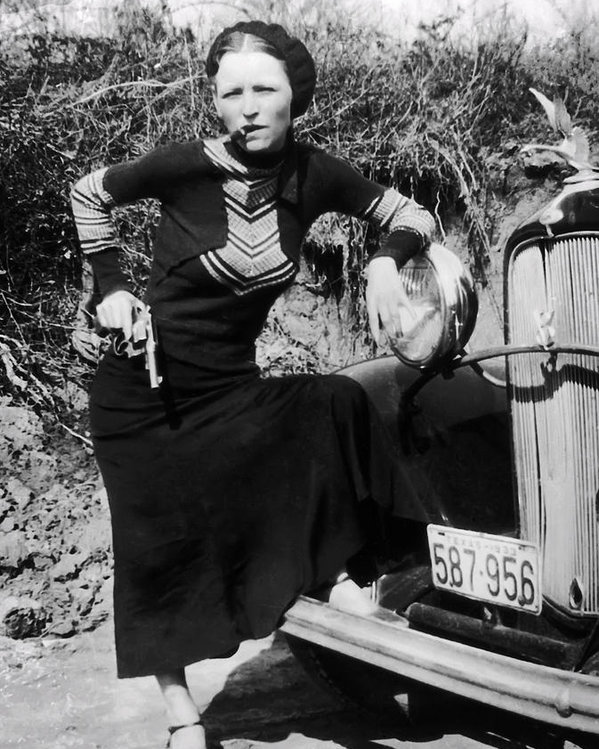
Bonnie Elizabeth Parker, a pivotal figure among American female criminals, captured the public's attention as part of the infamous duo Bonnie and Clyde. Their crime spree during the Great Depression positioned them as both feared outlaws and pop culture icons. Bonnie, born in 1910 in Rowena, Texas, joined forces with Clyde Barrow in the early 1930s, embarking on a notorious journey that included bank robberies and violent confrontations with law enforcement. The duo's criminal activities culminated in their death in 1934 in Bienville Parish, Louisiana, where they were ambushed and killed by police in their well-known Bonnie and Clyde car. The bullet-riddled vehicle and their dramatic demise are emblematic of their violent lifestyle. Bonnie and Clyde's funeral drew significant attention, reflecting their infamy. Their story remains a fascinating study of crime and desperation during one of America's most challenging eras, with Bonnie Parker at the heart of this enduring narrative.
Convicted: Pearl Hart
Pearl Hart, a Canadian-born outlaw of the American Old West, was known for committing one of the last recorded stagecoach robberies in the United States. Her crime gained notoriety primarily because of her gender, with many details about her life remaining uncertain due to varied and often contradictory reports.
Convicted: Kathleen Mary Josephine Leigh
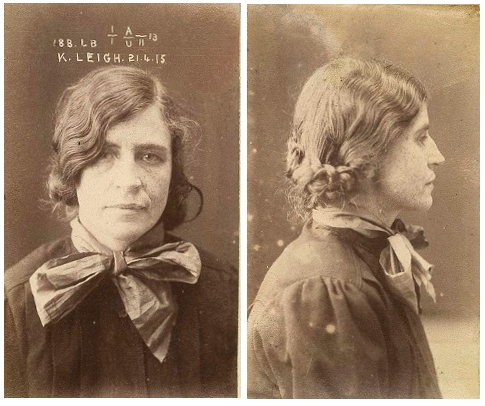
Kathleen Mary Josephine Leigh, better known as Kate Leigh, was an infamous Australian criminal who dominated the underworld scene in Sydney during the first half of the 20th century. She rose to prominence as a madam, an illegal trader of alcohol and cocaine, and for running betting syndicates from her home in Surry Hills. Known as the 'Queen of Surry Hills’ and the 'Snow Queen', Leigh was also a sly groger and fence for stolen property, becoming the largest supplier of cocaine in Sydney.
Accused: Opal Margaret "Peggy" Holder Lowe
The man who walked into Peggy Lowe's bank branch that September morning in 1981 had a new name, a government-issued identity, and $800 in his pocket, courtesy of the United States Federal Witness Protection Program. He had earned that protection by testifying about a prison murder. What federal prosecutors did not yet know, what they could not have imagined, was that he had committed that murder himself. Marion Albert Pruett was a liar so accomplished he fooled the government, and Peggy Lowe, a 43-year-old branch manager and grandmother who had spent her career helping ordinary people manage their savings, was the one who paid for that failure with her life. He chose her branch specifically because no men were on staff, believing women would resist less. He robbed the register of roughly $7,000, and when her phone rang mid-robbery — her son calling, an ordinary moment in an ordinary day — Pruett made a decision that sealed her fate. He took her instead. The full horror of what followed, from a dirt road in Sumter County, Alabama, to a death row press conference in which Pruett boasted about his crimes and tried to sell victim information to television producers, is a story about institutional failure, ordinary evil, and one woman whose name deserves far more than a footnote.