Vera Renczi
Case Summary
Thirty-two men lay in zinc-lined coffins in the wine cellar beneath a Romanian chateau, each one poisoned with arsenic by the woman who had loved them. Or so the story goes.
Vera Renczi, dubbed the 'Black Widow' and 'Chatelaine of Berkerekul,' is one of history's most notorious female serial killers: a wealthy beauty who allegedly confessed to murdering 35 people during the 1920s, including two husbands, dozens of lovers, and her own son. According to the legend, she laced their wine when she feared they might leave her, then kept their bodies in the cellar so they never could. Police reportedly found her sitting peacefully among the coffins.
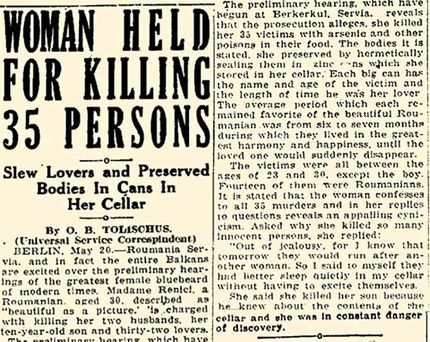
But here is where the story fractures. When the Guinness Book of World Records investigated in 1972, researchers found nothing verifiable: no arrest records, no trial transcripts, no regional newspapers, no prison files. Every account traces back to a single 1925 dispatch by an American journalist who cited no primary sources. Photographs circulated as Renczi's have been identified as a Russian actress dead since 1910. The Daily Mirror once published a photo of a living Spanish fashion model and called it Renczi, later apologizing unreservedly.
Was Vera Renczi a monster, or a myth? The answer, it turns out, is more unsettling than either option alone.
January 1, 1903, Bucharest, Romania (per most accounts; Hungarian family origins)(Age: 57)
January 1, 1960, Prison (location unspecified) (Cerebral hemorrhage (per Find a Grave; unverified primary source))
Related Cases

Convicted
Connection tags:

Convicted
Connection tags:

Convicted
Connection tags:
Alleged
Connection tags:

Convicted
Connection tags:
Convicted
Connection tags:
Case Details
The two police inspectors descended the cellar stairs with lanterns. What they found at the bottom stopped them cold.
Thirty-two coffins, lined in zinc, arranged in rows on the stone floor. Inside each one lay a man in varying stages of decomposition. The smell was immense. The room was otherwise orderly, almost ceremonial. And the woman of the house, when asked to explain, confessed without apparent distress.
This is the story of Vera Renczi as it has been told for nearly a century: a tale of jealousy, arsenic, and a wine cellar full of the men who had loved her. It is also, depending on who you ask, a story that may never have happened at all.
She was born in Bucharest, Romania, around 1903, though historians note that a late-nineteenth-century birth date would fit the timeline of her alleged crimes more coherently. Her family was of Hungarian origin, wealthy and well-positioned. When her mother died and Vera was around thirteen years old, her father relocated the household to Nagybecskerek, a city then part of the Kingdom of Hungary (known today as Zrenjanin, in Serbia). She attended boarding school there, where she was described, almost immediately, as unmanageable.
By fifteen, she was running away with older men. Friends from those years recalled a girl with an almost magnetic pull toward male companionship, coupled with a suspicion so intense it curdled into jealousy at the slightest provocation. She was beautiful, reportedly, in the severe and arresting way that commands a room. She was also, by most accounts, constitutionally unable to tolerate the idea of being left.
She married for the first time shortly before age twenty. Her husband was Karl Schick, a wealthy Austrian banker considerably older than herself. Together they had a son, Lorenzo. The marriage, by her own later account, became intolerable when she grew convinced Schick was being unfaithful. She poisoned his wine with arsenic. When he died, she told the neighbors he had abandoned her; later she amended this to a car accident. Nobody investigated.
Widowhood did not last long. Her second husband, Joseph Renczi, whose surname she kept, was closer to her own age. He disappeared within months of the wedding. She explained his absence the way she explained everything: he had been unfaithful, she said, and he had left. She even produced, eventually, a letter in which he declared he was gone forever. It was her last marriage.
What followed was a decade of affairs. Renczi took lovers from across social classes: businessmen, laborers, civil servants, married men, single men. Each one entered her world and then, within days or weeks or months, vanished. She always had a ready explanation. He had cheated on her. He had grown cold. He had moved on. She received no sympathy; people in town regarded her romantic misfortunes as a pattern of poor judgment, nothing more. In an era before systematic missing-persons tracking, in a region where borders were shifting and populations were unsettled in the aftermath of the First World War, men who disappeared did not always prompt formal inquiry.
Her method, she would later confess, was simple: arsenic in their wine. She had a cellar full of evidence and she had never once been asked to open it.
The reckoning came, as it so often does, because of a wife.
A bank officer named Milorad had been missing for some time when his wife went to the police. They were unimpressed. Women whose husbands had left them often came to police stations; this was not unusual. The wife, unconvinced, conducted her own investigation and determined that Renczi had been her husband's mistress. She returned to the police with this information. This time, two inspectors were dispatched to the chateau.
They found the thirty-two coffins. Autopsies confirmed arsenic in the kidneys of the bodies. And Vera Renczi, faced with the evidence, confessed to everything.
She had killed thirty-two lovers, she said. She had killed both her husbands. She had killed her son Lorenzo, who had discovered the cellar and threatened to expose her. She had used arsenic each time, administered in wine. And she admitted something that the newspapers, when they got hold of it, could not print fast enough: she liked to sit in her armchair among the coffins. She spoke to the men there. Dead, they could not betray her. Dead, they would never leave.
She was convicted of thirty-five murders and sentenced to life in prison. Secondary sources, including Find a Grave, record her death in 1960 from a cerebral hemorrhage, though no primary documentation has been produced to confirm this.
And here is where the story of Vera Renczi becomes something stranger and more troubling than any crime drama.
In 1972, editors at the Guinness Book of World Records attempted to verify the case for inclusion. They found nothing. No arrest records. No court transcripts. No prison intake logs. No regional newspaper coverage from Zrenjanin or anywhere in the former Kingdom of Serbs, Croats and Slovenes. No files from Romania. Researchers who specialized in Balkan history and in the specific region of Berkerekul found no trace of Renczi in any archive.
Every single published account of the case, in every language, traces back to one source: a dispatch filed in May 1925 by Otto Tolischus, an American journalist, published in a U.S. newspaper. Tolischus named no primary sources. He cited no local coverage. He provided no documentation. The story spread from that single article the way a rumor spreads, each retelling treating the previous one as confirmation.
The archival silence is not entirely without explanation. The Berkerekul region passed from Austro-Hungarian to Yugoslavian to Serbian administration across the early twentieth century, and the Second World War brought significant destruction of regional records. Gaps exist in the documentary history of many events from this period. But historians who have looked specifically for Renczi, including a British professor specializing in Yugoslavia and Balkans history and researchers based in Zrenjanin itself, have found nothing. Not a fragment.
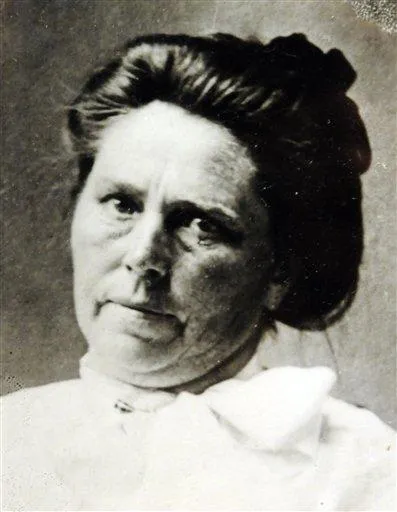
The photographs are perhaps the most revealing detail. For decades, a striking dark-haired woman stared out from newspaper supplements, true crime paperbacks, and eventually the internet, identified as Vera Renczi. She was not. The image was of Vera Fyodorovna Komissarzhevskaya, a celebrated Russian stage actress who had died in 1910, thirteen years before Renczi's alleged first murder. In 2012, the Daily Mirror published a story about female killers and included a photograph labeled as Renczi; it was actually a 2004 image of Patricia Belda Martinez, a Spanish fashion model known professionally as Lady Morgana, who was very much alive. The paper apologized.
No authenticated photograph of Vera Renczi has ever been produced.
None of this has slowed the story's cultural momentum. Discovery Channel's "Deadly Women" featured Renczi in 2005, with criminal profiler Candice DeLong offering psychological analysis of her behavior. In 2024, a peer-reviewed paper in the journal Psychiatria Danubina applied what the authors called the Schahriar Syndrome Model to her case, identifying five psychological mechanisms: omnipotence, sadistic fantasy, ritualized performance, dehumanization, and what they termed symbiotic merger with her victims. The paper, to its credit, explicitly acknowledged the uncertain historicity of its subject while proceeding with analysis anyway. Dozens of podcasts, YouTube documentaries, and true crime websites covered the case in 2024 as though the question of her existence were settled.
It is worth pausing on what this means. The Renczi case exists in a peculiar category: a story with the texture of historical fact, the specificity of journalism, and the emotional architecture of myth. The details are almost too perfectly calibrated to horror. The zinc-lined coffins. The armchair in the cellar. The dead men who could not leave her. These are the images that lodge in memory precisely because they externalize something psychologically coherent: a terror of abandonment taken to its absolute, irreversible conclusion. Whether or not Vera Renczi ever lived, the story she inhabits is not random. Someone shaped it.
Otto Tolischus, the journalist who filed that 1925 dispatch, went on to have a distinguished career. He won a Pulitzer Prize in 1940 for his reporting from Nazi Germany. He was not, by any measure, a tabloid sensationalist throughout his career. Whether the Renczi piece was a fabrication he originated, a story he received from an unverified local source and filed in good faith, or something in between, is unknown. He left no notes on it. He never returned to it.
The region itself, now the Serbian city of Zrenjanin, has no local tradition of the Renczi story. It did not enter Serbian cultural memory as a local scandal; it entered global cultural memory as an American newspaper report about somewhere else.
For the true crime reader, the Renczi case presents an uncomfortable question. We consume these stories, in part, because they are real; the horror is anchored to actual suffering, actual lives ended. When that anchor is missing, when the case is revealed as possibly a century-old confabulation with borrowed photographs and untraceable sourcing, what remains? The story does not become less disturbing. If anything, it becomes more so: thirty-five people who may never have existed, mourned and analyzed and dramatized by millions, while the region where they supposedly died has no memory of them at all.
Vera Renczi sits in her cellar armchair, in the imagination of everyone who has ever read about her, speaking to men who cannot leave. Whether she was real or invented, she has been extraordinarily difficult to get rid of.
Timeline
Birth in Bucharest
Vera Renczi was born into a wealthy Hungarian-origin family in Bucharest, Romania, though historians note a late-19th-century birth date would be more chronologically consistent with her alleged crimes. Her early childhood was marked by privilege, but her mother's death when she was approximately 13 years old would prove a pivotal disruption. Following her mother's death, she relocated with her father to Nagybecskerek (modern-day Zrenjanin, Serbia), where she attended boarding school.
Establishes Renczi's origins and the formative disruptions — loss of her mother, relocation — that early accounts cite as shaping her reportedly obsessive and jealous personality.
Adolescent Instability and Early Runaway Behavior
By approximately age 15, Renczi was described by contemporaries as 'increasingly unmanageable,' repeatedly running away from home with older boyfriends. Childhood acquaintances characterized her as possessing an almost pathological craving for male companionship alongside a deeply jealous and suspicious nature. This pattern of compulsive attachment to men — and terror of abandonment — would become the psychological engine of her alleged crimes.
Documents the earliest observable behavioral warning signs, including the abandonment anxiety and obsessive jealousy that reportedly motivated her later poisonings.
First Marriage to Karl Schick and Birth of Son Lorenzo
Shortly before age 20, Renczi married Karl Schick, a wealthy Austrian banker considerably older than herself, and the couple had a son named Lorenzo. Renczi soon grew convinced that Schick was being unfaithful, and she allegedly poisoned his dinner wine with arsenic. She told neighbors he had abandoned her, later revising her story to claim he had died in a car accident — establishing the deceptive template she would reuse for subsequent victims.
Represents the alleged first use of arsenic poisoning by Renczi and the establishment of her signature cover story — the 'abandonment' narrative — that would shield her from suspicion for years.
Second Marriage to Joseph Renczi and His Disappearance
Renczi entered a second marriage with a man named Joseph Renczi, from whom she took her enduring surname, and who was reportedly closer to her own age. Within months, he too vanished; she claimed he had abandoned her, and later produced what she described as a letter from him declaring he was leaving forever. This was her final marriage, and Joseph Renczi became the second confirmed victim in her alleged series of arsenic poisonings.
Marks the end of Renczi's marital history and the consolidation of her method — arsenic administered to a partner perceived as straying, followed by a fabricated abandonment narrative.
Years of Serial Poisonings of Lovers
Over the course of the early-to-mid 1920s, Renczi allegedly conducted a series of affairs with men from diverse social backgrounds — married and unmarried — all of whom disappeared within days, weeks, or months of becoming involved with her. She consistently told acquaintances that each man had proven unfaithful and abandoned her. The bodies of these men — ultimately numbering 32 — were placed in zinc-lined coffins and stored in her wine cellar beneath the chateau at Berkerekul.
Represents the bulk of Renczi's alleged criminal activity and the accumulation of evidence that would eventually be discovered by police, making her one of the most prolific alleged female serial killers of the 20th century.
Murder of Son Lorenzo
Renczi's son Lorenzo, having grown old enough to access the wine cellar, allegedly discovered the rows of zinc-lined coffins containing his mother's victims. Rather than risk exposure, Renczi poisoned Lorenzo as well, adding him to the count of her victims and eliminating the only family member who could have betrayed her secret. This act — killing her own child — was among the most disturbing elements of her later confession.
The murder of Lorenzo extended Renczi's alleged crimes beyond romantic obsession into the elimination of any witness, and it underscored the calculated ruthlessness attributed to her in confessional accounts.
Disappearance of Final Victim Milorad Triggers Investigation
Renczi's last known lover, a bank officer named Milorad, disappeared after becoming involved with her. His wife, suspicious of the circumstances, reported the disappearance to police, who initially dismissed her concerns. Undeterred, the wife conducted her own investigation, identified Renczi as her husband's mistress, and returned to authorities with enough information to compel two inspectors to visit Renczi's chateau — the act that would unravel her entire operation.
The persistence of Milorad's wife in the face of police indifference was the direct catalyst for the investigation, illustrating how close Renczi came to escaping detection entirely.
Discovery of 32 Coffins in the Wine Cellar
When police inspectors searched Renczi's wine cellar at the Berkerekul chateau, they discovered 32 zinc-lined coffins containing the corpses of men in varying states of decomposition. Forensic examination of the bodies revealed arsenic in the kidneys of the victims, confirming the cause of death. The grim tableau — coffins arranged in a cellar where Renczi reportedly sat in an armchair to 'converse' with the dead — shocked investigators and would become the defining image of the case.
The discovery of the coffins constituted the central physical evidence of the case and transformed a missing-persons inquiry into one of the largest alleged serial murder investigations in interwar Eastern Europe.
Confession and Arrest
Confronted with the evidence in her cellar, Renczi reportedly confessed in full, admitting to poisoning 32 lovers with arsenic whenever she suspected their interest was waning or feared they would be unfaithful. She also confessed to the murders of her two husbands and her son Lorenzo. In one of the most disturbing elements of her confession, she acknowledged sitting among the coffins in her cellar armchair, 'conversing' with the corpses — reasoning that dead men could never leave or betray her.
Renczi's confession, if authentic, provided a rare and psychologically detailed self-account of a serial killer's motivations, centering on abandonment terror and a grotesque form of possessive control extending beyond death.
Conviction, Life Sentence, and Death in Prison
Renczi was convicted of 35 murders — encompassing her two husbands, 32 lovers, and her son Lorenzo — and sentenced to life imprisonment. Secondary sources, including Find a Grave, record that she died in prison of a cerebral hemorrhage, with 1960 most commonly cited as the year of her death, though no verified primary documentation of the trial, conviction, or her death has ever been produced. The entire case has been disputed by historians, with investigators finding no arrest records, trial transcripts, or contemporary local newspaper accounts to corroborate the story, which traces to a single 1925 article by U.S. journalist Otto Tolischus.
The conviction represents the official judicial endpoint of the case as reported, but the absence of any verifiable primary sources has led many historians to classify the Renczi case as likely yellow journalism or an outright hoax, making it as much a cautionary tale about media fabrication as a true crime narrative.
Crime Location
Photos
Article about Vera Renczi
Sources
- Vera Renczi – Wikipedia
- Otto Tolischus article on Vera Renczi
- Deadly Women – Season 1, Episode 'Obsession'
- Guinness Book of World Records – Investigation of Renczi Case
- Psychobiography of Vera Renczi: Schahriar Syndrome Model
- Daily Mirror 'Women Who Kill' Supplement – Photo Correction
- Vera Fyodorovna Komissarzhevskaya – Wikimedia Commons
Frequently Asked Questions
Table of Contents
Case Summary
Thirty-two men lay in zinc-lined coffins in the wine cellar beneath a Romanian chateau, each one poisoned with arsenic by the woman who had loved them. Or so the story goes.
Vera Renczi, dubbed the 'Black Widow' and 'Chatelaine of Berkerekul,' is one of history's most notorious female serial killers: a wealthy beauty who allegedly confessed to murdering 35 people during the 1920s, including two husbands, dozens of lovers, and her own son. According to the legend, she laced their wine when she feared they might leave her, then kept their bodies in the cellar so they never could. Police reportedly found her sitting peacefully among the coffins.
But here is where the story fractures. When the Guinness Book of World Records investigated in 1972, researchers found nothing verifiable: no arrest records, no trial transcripts, no regional newspapers, no prison files. Every account traces back to a single 1925 dispatch by an American journalist who cited no primary sources. Photographs circulated as Renczi's have been identified as a Russian actress dead since 1910. The Daily Mirror once published a photo of a living Spanish fashion model and called it Renczi, later apologizing unreservedly.
Was Vera Renczi a monster, or a myth? The answer, it turns out, is more unsettling than either option alone.
January 1, 1903, Bucharest, Romania (per most accounts; Hungarian family origins)(Age: 57)
January 1, 1960, Prison (location unspecified) (Cerebral hemorrhage (per Find a Grave; unverified primary source))
Case Details
The two police inspectors descended the cellar stairs with lanterns. What they found at the bottom stopped them cold.
Thirty-two coffins, lined in zinc, arranged in rows on the stone floor. Inside each one lay a man in varying stages of decomposition. The smell was immense. The room was otherwise orderly, almost ceremonial. And the woman of the house, when asked to explain, confessed without apparent distress.
This is the story of Vera Renczi as it has been told for nearly a century: a tale of jealousy, arsenic, and a wine cellar full of the men who had loved her. It is also, depending on who you ask, a story that may never have happened at all.
She was born in Bucharest, Romania, around 1903, though historians note that a late-nineteenth-century birth date would fit the timeline of her alleged crimes more coherently. Her family was of Hungarian origin, wealthy and well-positioned. When her mother died and Vera was around thirteen years old, her father relocated the household to Nagybecskerek, a city then part of the Kingdom of Hungary (known today as Zrenjanin, in Serbia). She attended boarding school there, where she was described, almost immediately, as unmanageable.
By fifteen, she was running away with older men. Friends from those years recalled a girl with an almost magnetic pull toward male companionship, coupled with a suspicion so intense it curdled into jealousy at the slightest provocation. She was beautiful, reportedly, in the severe and arresting way that commands a room. She was also, by most accounts, constitutionally unable to tolerate the idea of being left.
She married for the first time shortly before age twenty. Her husband was Karl Schick, a wealthy Austrian banker considerably older than herself. Together they had a son, Lorenzo. The marriage, by her own later account, became intolerable when she grew convinced Schick was being unfaithful. She poisoned his wine with arsenic. When he died, she told the neighbors he had abandoned her; later she amended this to a car accident. Nobody investigated.
Widowhood did not last long. Her second husband, Joseph Renczi, whose surname she kept, was closer to her own age. He disappeared within months of the wedding. She explained his absence the way she explained everything: he had been unfaithful, she said, and he had left. She even produced, eventually, a letter in which he declared he was gone forever. It was her last marriage.
What followed was a decade of affairs. Renczi took lovers from across social classes: businessmen, laborers, civil servants, married men, single men. Each one entered her world and then, within days or weeks or months, vanished. She always had a ready explanation. He had cheated on her. He had grown cold. He had moved on. She received no sympathy; people in town regarded her romantic misfortunes as a pattern of poor judgment, nothing more. In an era before systematic missing-persons tracking, in a region where borders were shifting and populations were unsettled in the aftermath of the First World War, men who disappeared did not always prompt formal inquiry.
Her method, she would later confess, was simple: arsenic in their wine. She had a cellar full of evidence and she had never once been asked to open it.
The reckoning came, as it so often does, because of a wife.
A bank officer named Milorad had been missing for some time when his wife went to the police. They were unimpressed. Women whose husbands had left them often came to police stations; this was not unusual. The wife, unconvinced, conducted her own investigation and determined that Renczi had been her husband's mistress. She returned to the police with this information. This time, two inspectors were dispatched to the chateau.
They found the thirty-two coffins. Autopsies confirmed arsenic in the kidneys of the bodies. And Vera Renczi, faced with the evidence, confessed to everything.
She had killed thirty-two lovers, she said. She had killed both her husbands. She had killed her son Lorenzo, who had discovered the cellar and threatened to expose her. She had used arsenic each time, administered in wine. And she admitted something that the newspapers, when they got hold of it, could not print fast enough: she liked to sit in her armchair among the coffins. She spoke to the men there. Dead, they could not betray her. Dead, they would never leave.
She was convicted of thirty-five murders and sentenced to life in prison. Secondary sources, including Find a Grave, record her death in 1960 from a cerebral hemorrhage, though no primary documentation has been produced to confirm this.
And here is where the story of Vera Renczi becomes something stranger and more troubling than any crime drama.
In 1972, editors at the Guinness Book of World Records attempted to verify the case for inclusion. They found nothing. No arrest records. No court transcripts. No prison intake logs. No regional newspaper coverage from Zrenjanin or anywhere in the former Kingdom of Serbs, Croats and Slovenes. No files from Romania. Researchers who specialized in Balkan history and in the specific region of Berkerekul found no trace of Renczi in any archive.
Every single published account of the case, in every language, traces back to one source: a dispatch filed in May 1925 by Otto Tolischus, an American journalist, published in a U.S. newspaper. Tolischus named no primary sources. He cited no local coverage. He provided no documentation. The story spread from that single article the way a rumor spreads, each retelling treating the previous one as confirmation.
The archival silence is not entirely without explanation. The Berkerekul region passed from Austro-Hungarian to Yugoslavian to Serbian administration across the early twentieth century, and the Second World War brought significant destruction of regional records. Gaps exist in the documentary history of many events from this period. But historians who have looked specifically for Renczi, including a British professor specializing in Yugoslavia and Balkans history and researchers based in Zrenjanin itself, have found nothing. Not a fragment.
The photographs are perhaps the most revealing detail. For decades, a striking dark-haired woman stared out from newspaper supplements, true crime paperbacks, and eventually the internet, identified as Vera Renczi. She was not. The image was of Vera Fyodorovna Komissarzhevskaya, a celebrated Russian stage actress who had died in 1910, thirteen years before Renczi's alleged first murder. In 2012, the Daily Mirror published a story about female killers and included a photograph labeled as Renczi; it was actually a 2004 image of Patricia Belda Martinez, a Spanish fashion model known professionally as Lady Morgana, who was very much alive. The paper apologized.
No authenticated photograph of Vera Renczi has ever been produced.
None of this has slowed the story's cultural momentum. Discovery Channel's "Deadly Women" featured Renczi in 2005, with criminal profiler Candice DeLong offering psychological analysis of her behavior. In 2024, a peer-reviewed paper in the journal Psychiatria Danubina applied what the authors called the Schahriar Syndrome Model to her case, identifying five psychological mechanisms: omnipotence, sadistic fantasy, ritualized performance, dehumanization, and what they termed symbiotic merger with her victims. The paper, to its credit, explicitly acknowledged the uncertain historicity of its subject while proceeding with analysis anyway. Dozens of podcasts, YouTube documentaries, and true crime websites covered the case in 2024 as though the question of her existence were settled.
It is worth pausing on what this means. The Renczi case exists in a peculiar category: a story with the texture of historical fact, the specificity of journalism, and the emotional architecture of myth. The details are almost too perfectly calibrated to horror. The zinc-lined coffins. The armchair in the cellar. The dead men who could not leave her. These are the images that lodge in memory precisely because they externalize something psychologically coherent: a terror of abandonment taken to its absolute, irreversible conclusion. Whether or not Vera Renczi ever lived, the story she inhabits is not random. Someone shaped it.
Otto Tolischus, the journalist who filed that 1925 dispatch, went on to have a distinguished career. He won a Pulitzer Prize in 1940 for his reporting from Nazi Germany. He was not, by any measure, a tabloid sensationalist throughout his career. Whether the Renczi piece was a fabrication he originated, a story he received from an unverified local source and filed in good faith, or something in between, is unknown. He left no notes on it. He never returned to it.
The region itself, now the Serbian city of Zrenjanin, has no local tradition of the Renczi story. It did not enter Serbian cultural memory as a local scandal; it entered global cultural memory as an American newspaper report about somewhere else.
For the true crime reader, the Renczi case presents an uncomfortable question. We consume these stories, in part, because they are real; the horror is anchored to actual suffering, actual lives ended. When that anchor is missing, when the case is revealed as possibly a century-old confabulation with borrowed photographs and untraceable sourcing, what remains? The story does not become less disturbing. If anything, it becomes more so: thirty-five people who may never have existed, mourned and analyzed and dramatized by millions, while the region where they supposedly died has no memory of them at all.
Vera Renczi sits in her cellar armchair, in the imagination of everyone who has ever read about her, speaking to men who cannot leave. Whether she was real or invented, she has been extraordinarily difficult to get rid of.
Timeline
Birth in Bucharest
Vera Renczi was born into a wealthy Hungarian-origin family in Bucharest, Romania, though historians note a late-19th-century birth date would be more chronologically consistent with her alleged crimes. Her early childhood was marked by privilege, but her mother's death when she was approximately 13 years old would prove a pivotal disruption. Following her mother's death, she relocated with her father to Nagybecskerek (modern-day Zrenjanin, Serbia), where she attended boarding school.
Establishes Renczi's origins and the formative disruptions — loss of her mother, relocation — that early accounts cite as shaping her reportedly obsessive and jealous personality.
Adolescent Instability and Early Runaway Behavior
By approximately age 15, Renczi was described by contemporaries as 'increasingly unmanageable,' repeatedly running away from home with older boyfriends. Childhood acquaintances characterized her as possessing an almost pathological craving for male companionship alongside a deeply jealous and suspicious nature. This pattern of compulsive attachment to men — and terror of abandonment — would become the psychological engine of her alleged crimes.
Documents the earliest observable behavioral warning signs, including the abandonment anxiety and obsessive jealousy that reportedly motivated her later poisonings.
First Marriage to Karl Schick and Birth of Son Lorenzo
Shortly before age 20, Renczi married Karl Schick, a wealthy Austrian banker considerably older than herself, and the couple had a son named Lorenzo. Renczi soon grew convinced that Schick was being unfaithful, and she allegedly poisoned his dinner wine with arsenic. She told neighbors he had abandoned her, later revising her story to claim he had died in a car accident — establishing the deceptive template she would reuse for subsequent victims.
Represents the alleged first use of arsenic poisoning by Renczi and the establishment of her signature cover story — the 'abandonment' narrative — that would shield her from suspicion for years.
Second Marriage to Joseph Renczi and His Disappearance
Renczi entered a second marriage with a man named Joseph Renczi, from whom she took her enduring surname, and who was reportedly closer to her own age. Within months, he too vanished; she claimed he had abandoned her, and later produced what she described as a letter from him declaring he was leaving forever. This was her final marriage, and Joseph Renczi became the second confirmed victim in her alleged series of arsenic poisonings.
Marks the end of Renczi's marital history and the consolidation of her method — arsenic administered to a partner perceived as straying, followed by a fabricated abandonment narrative.
Years of Serial Poisonings of Lovers
Over the course of the early-to-mid 1920s, Renczi allegedly conducted a series of affairs with men from diverse social backgrounds — married and unmarried — all of whom disappeared within days, weeks, or months of becoming involved with her. She consistently told acquaintances that each man had proven unfaithful and abandoned her. The bodies of these men — ultimately numbering 32 — were placed in zinc-lined coffins and stored in her wine cellar beneath the chateau at Berkerekul.
Represents the bulk of Renczi's alleged criminal activity and the accumulation of evidence that would eventually be discovered by police, making her one of the most prolific alleged female serial killers of the 20th century.
Murder of Son Lorenzo
Renczi's son Lorenzo, having grown old enough to access the wine cellar, allegedly discovered the rows of zinc-lined coffins containing his mother's victims. Rather than risk exposure, Renczi poisoned Lorenzo as well, adding him to the count of her victims and eliminating the only family member who could have betrayed her secret. This act — killing her own child — was among the most disturbing elements of her later confession.
The murder of Lorenzo extended Renczi's alleged crimes beyond romantic obsession into the elimination of any witness, and it underscored the calculated ruthlessness attributed to her in confessional accounts.
Disappearance of Final Victim Milorad Triggers Investigation
Renczi's last known lover, a bank officer named Milorad, disappeared after becoming involved with her. His wife, suspicious of the circumstances, reported the disappearance to police, who initially dismissed her concerns. Undeterred, the wife conducted her own investigation, identified Renczi as her husband's mistress, and returned to authorities with enough information to compel two inspectors to visit Renczi's chateau — the act that would unravel her entire operation.
The persistence of Milorad's wife in the face of police indifference was the direct catalyst for the investigation, illustrating how close Renczi came to escaping detection entirely.
Discovery of 32 Coffins in the Wine Cellar
When police inspectors searched Renczi's wine cellar at the Berkerekul chateau, they discovered 32 zinc-lined coffins containing the corpses of men in varying states of decomposition. Forensic examination of the bodies revealed arsenic in the kidneys of the victims, confirming the cause of death. The grim tableau — coffins arranged in a cellar where Renczi reportedly sat in an armchair to 'converse' with the dead — shocked investigators and would become the defining image of the case.
The discovery of the coffins constituted the central physical evidence of the case and transformed a missing-persons inquiry into one of the largest alleged serial murder investigations in interwar Eastern Europe.
Confession and Arrest
Confronted with the evidence in her cellar, Renczi reportedly confessed in full, admitting to poisoning 32 lovers with arsenic whenever she suspected their interest was waning or feared they would be unfaithful. She also confessed to the murders of her two husbands and her son Lorenzo. In one of the most disturbing elements of her confession, she acknowledged sitting among the coffins in her cellar armchair, 'conversing' with the corpses — reasoning that dead men could never leave or betray her.
Renczi's confession, if authentic, provided a rare and psychologically detailed self-account of a serial killer's motivations, centering on abandonment terror and a grotesque form of possessive control extending beyond death.
Conviction, Life Sentence, and Death in Prison
Renczi was convicted of 35 murders — encompassing her two husbands, 32 lovers, and her son Lorenzo — and sentenced to life imprisonment. Secondary sources, including Find a Grave, record that she died in prison of a cerebral hemorrhage, with 1960 most commonly cited as the year of her death, though no verified primary documentation of the trial, conviction, or her death has ever been produced. The entire case has been disputed by historians, with investigators finding no arrest records, trial transcripts, or contemporary local newspaper accounts to corroborate the story, which traces to a single 1925 article by U.S. journalist Otto Tolischus.
The conviction represents the official judicial endpoint of the case as reported, but the absence of any verifiable primary sources has led many historians to classify the Renczi case as likely yellow journalism or an outright hoax, making it as much a cautionary tale about media fabrication as a true crime narrative.
Crime Location
Photos
Article about Vera Renczi
Sources
- Vera Renczi – Wikipedia
- Otto Tolischus article on Vera Renczi
- Deadly Women – Season 1, Episode 'Obsession'
- Guinness Book of World Records – Investigation of Renczi Case
- Psychobiography of Vera Renczi: Schahriar Syndrome Model
- Daily Mirror 'Women Who Kill' Supplement – Photo Correction
- Vera Fyodorovna Komissarzhevskaya – Wikimedia Commons
Frequently Asked Questions
Related Cases
Convicted
Connection tags:
Convicted
Connection tags:
Convicted
Connection tags:
Alleged
Connection tags:
Convicted
Connection tags:
Convicted
Connection tags:
Tags
Popular Culture
TV (2005)
Discovery Channel episode featuring a dramatized account of Vera Renczi's alleged poisoning spree, with analysis from criminal profiler Candice DeLong and a forensic pathologist.
book (2024)
Peer-reviewed academic psychobiography analyzing Renczi's alleged psychological profile using the Schahriar Syndrome Model, even while acknowledging disputed historicity.