3 cases tagged “cold case”
Convicted: Myra Hindley
On the morning of October 7, 1965, eighteen-year-old David Smith walked to a public telephone box in Hattersley, Greater Manchester, hands shaking, and dialed 999. The night before, he had watched his brother-in-law bludgeon a seventeen-year-old to death with an axe. The brother-in-law was Ian Brady. The woman who had invited him to witness it was Myra Hindley. What that phone call exposed would redefine evil in the British imagination for generations. Between 1963 and 1965, Brady and Hindley abducted five children and teenagers from the streets of Greater Manchester, sexually assaulted them, and buried four in shallow graves on the desolate expanse of Saddleworth Moor. The fifth was killed in Hindley's living room. The evidence police found inside that house was staggering in its horror: photographs of a ten-year-old girl bound and gagged in Hindley's bedroom, and sixteen minutes of audio tape capturing that same child's final, agonized moments. A luggage ticket for the suitcase containing these materials was found hidden inside the spine of Hindley's Catholic prayer book. Myra Hindley would spend thirty-six years in prison, applying repeatedly for parole, insisting she had changed. The British public never believed her. One of her victims, Keith Bennett, has never been found. His mother died in 2012, still waiting. This is the story of how an ordinary girl from Gorton became the most reviled woman in British criminal history.
Convicted: Valerie Jean Solanas
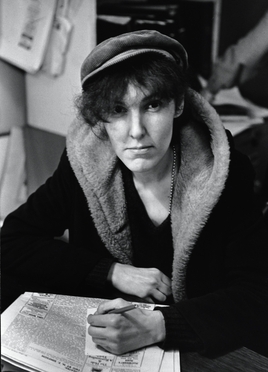
On the afternoon of June 3, 1968, Valerie Jean Solanas rode an elevator to Andy Warhol's Manhattan studio, pulled two firearms from a paper bag, and opened fire. She shot Warhol three times, hit art critic Mario Amaya in the hip, and attempted to execute Warhol's manager before her gun jammed. Then she walked out, hailed a cab, and waited. That evening, she surrendered to a Times Square patrolman, handed him both weapons, and offered nine words of explanation: 'He had too much control over my life.' Warhol survived, barely, after five hours of surgery during which he was briefly declared dead. He never fully recovered. Solanas, a woman with an IQ of 131 who authored one of the most provocative feminist texts of the twentieth century and held a psychology degree with honors, spent the rest of her life cycling through psychiatric wards and welfare hotels. She died alone in a San Francisco flophouse in 1988, her body undiscovered for days. What drove her to The Factory that afternoon, and what her life reveals about genius, mental illness, and the violence that festers at society's margins, remains as unsettling now as it was then.
Convicted: Vera Renczi
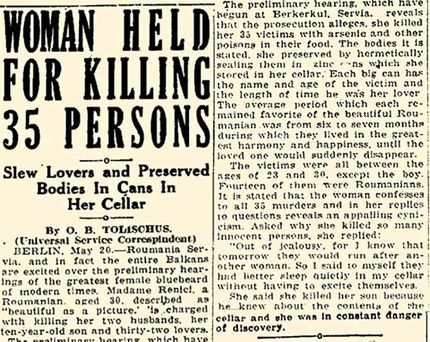
Thirty-two men lay in zinc-lined coffins in the wine cellar beneath a Romanian chateau, each one poisoned with arsenic by the woman who had loved them. Or so the story goes. Vera Renczi, dubbed the 'Black Widow' and 'Chatelaine of Berkerekul,' is one of history's most notorious female serial killers: a wealthy beauty who allegedly confessed to murdering 35 people during the 1920s, including two husbands, dozens of lovers, and her own son. According to the legend, she laced their wine when she feared they might leave her, then kept their bodies in the cellar so they never could. Police reportedly found her sitting peacefully among the coffins. But here is where the story fractures. When the Guinness Book of World Records investigated in 1972, researchers found nothing verifiable: no arrest records, no trial transcripts, no regional newspapers, no prison files. Every account traces back to a single 1925 dispatch by an American journalist who cited no primary sources. Photographs circulated as Renczi's have been identified as a Russian actress dead since 1910. The Daily Mirror once published a photo of a living Spanish fashion model and called it Renczi, later apologizing unreservedly. Was Vera Renczi a monster, or a myth? The answer, it turns out, is more unsettling than either option alone.