Enriqueta Martí Ripollés

Case Summary
On the morning of February 10, 1912, Barcelona police broke down the door of a ground-floor apartment on Carrer de Ponent and found something that would haunt the city for generations. Behind a locked interior door sat roughly fifty jars and basins arranged with terrible precision: congealed human blood, rendered fat, hand skeletons, bone dust, and small glass vials of finished elixirs, each one labeled in elegant calligraphy. Cowering in the front room were two children, one of them a five-year-old girl named Teresita who had been missing from the streets of El Raval for only days.
The apartment's tenant was a woman named Enriqueta Martí Ripollés. By day, neighbors knew her as a ragged beggar who shuffled through Barcelona's poorest quarters with a child at her side. By night, she was something else entirely: wigged, jeweled, and dressed in silk, moving through the parlors of the city's wealthiest families and selling them preparations she claimed could cure tuberculosis, reverse aging, and treat venereal disease. Preparations made, authorities alleged, from the bodies of the city's most vulnerable children.
She became known across Spain as "The Vampire of Barcelona." She was never convicted. She never stood trial. And the full truth of what happened inside that locked room may have been buried, deliberately and permanently, by the very people she served.
February 2, 1868, Sant Feliu de Llobregat, Catalonia, Spain(Age: 45)
May 12, 1913, Reina Amàlia Prison, Barcelona, Spain (Disputed: officially listed as uterine cancer on death certificate; most accounts indicate she was lynched/beaten to death by fellow inmates, possibly coordinated by wealthy clients to silence her before trial)
Related Cases
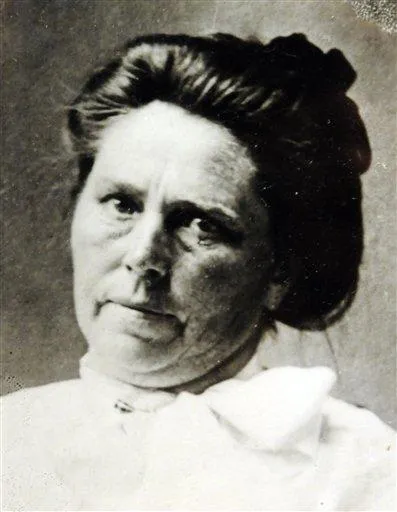
Alleged
Connection tags:

Convicted
Connection tags:

Convicted
Connection tags:
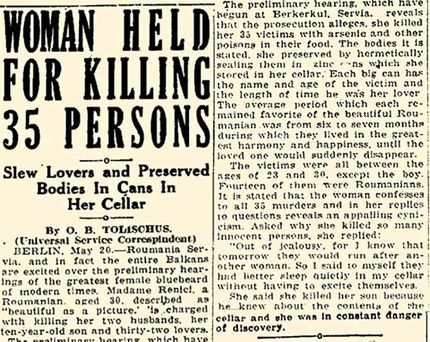
Convicted
Connection tags:

Convicted
Connection tags:

Convicted
Connection tags:
Case Details
The child had been missing for only a few days when Inspector Ribot's men climbed the steps at No. 29 Carrer de Ponent. It was February 10, 1912, a cold winter morning in Barcelona's Raval quarter, and the building was the kind of place the city preferred not to think about: crumbling plaster, dim corridors, the smell of mold and coal smoke. A neighbor had reported seeing a small girl enter the ground-floor flat and not come out. The police knocked. Then they broke the door down.
What they found inside would consume Barcelona for the next year and echo through Catalan culture for more than a century after.
In the front room, huddled and malnourished, were two children: five-year-old Teresita Guitart Congost, who had been snatched from the streets of El Raval days earlier, and a second girl named Angelita, whose condition suggested she had been there considerably longer. The apartment's tenant was absent. But behind a locked interior door, the police found her work.
Approximately fifty jars and basins, arranged with a kind of awful deliberateness, lined the surfaces of the back room. Inside them: congealed human blood, rendered human fat, fragments of bone, skeletal hands, fine bone dust, braids of human hair, and finished preparations in small glass vials, some sealed with wax and labeled in a careful, elegant hand. On a shelf sat an ancient book bound in parchment, and beside it a notebook filled with recipes and instructions for potions, written in the same meticulous calligraphy. There were coded letters. There was a list of names.
The list of names would become one of the most incendiary documents in the city's modern history.
The woman who lived in that apartment was Enriqueta Martí Ripollés, born February 2, 1868, in Sant Feliu de Llobregat, a modest town southwest of Barcelona. She had grown up in a peasant family, knowing poverty the way certain people know the weather: as something constant, something that shapes the body and narrows the possible futures. She moved to Barcelona as a young woman and found work as a servant, then as a nanny. Both were respectable enough trades. Neither paid well. She drifted, as desperate women in that era often did, toward prostitution.
She had married, briefly and badly, in 1895. Her husband was a painter named Juan Pujaló. The union collapsed when he found he could not live with whatever he discovered about her other life. They separated. They had no children.
By the turn of the century, Martí had settled into a double life of extraordinary audacity. In the daylight hours she dressed in rags and haunted the poorest districts of Barcelona, begging with a child beside her, blending seamlessly into the landscape of urban misery. The children who accompanied her on those rounds were not her own. After dark, she transformed: wigs, jewelry, expensive gowns. She moved through the drawing rooms and private clinics of Barcelona's upper classes, carrying her preparations in their elegant little vials and collecting significant sums of money.
Her sales pitch rested on a belief that was not entirely fringe for the era. Certain folk remedies and pseudo-medical treatments of the time held that substances derived from the bodies of children, particularly young, unbaptized, or otherwise "pure" children, held curative and even mystical properties. Martí allegedly told her clients that her elixirs could treat tuberculosis, one of the great killers of the age; that her ointments could halt the visible aging of the skin; that her preparations could address the symptoms of venereal disease. Her clients, if the whispers were accurate, included doctors, politicians, bankers, and businessmen. People with everything to lose.
The children she used to make these preparations came from El Raval and similar neighborhoods, places where poverty was dense enough that a child could vanish and the disappearance might be attributed to any number of causes. Authorities later estimated she had been operating for roughly a decade, possibly from around 1900, though the true timeline was never established in court. The estimated victim count ranges from ten to twelve or more, with figures varying by source. None of it was ever proven at trial.
This was not, it turned out, her first encounter with law enforcement. During Barcelona's Semana Trágica, the Tragic Week of 1909, police had reportedly discovered a child brothel she was operating and taken her into custody. She was released. The prevailing explanation, accepted by most historians, is that her clients intervened. Men with sufficient standing to make a problem disappear had every incentive to make this particular problem disappear quickly.
She walked free and returned to her work.
Teresita Guitart Congost changed that. The girl's kidnapping was recent enough, and the neighborhood alarmed enough, that the police moved before Martí could slip the net. She was not in the apartment when Ribot's men arrived on February 10. She was arrested seventeen days later, on February 27, 1912, and taken to Reina Amàlia Prison.
Barcelona's reaction was not calm. The city had been living for years with the low-grade dread of children who vanished and never returned. Now, with the details of that locked room circulating through the press, the dread curdled into fury. Crowds gathered outside the prison. Newspapers ran composite illustrations of Martí surrounded by her alleged victims' faces, under headlines that named her "The Vampire of Carrer de Ponent" and, more enduringly, "The Vampire of Barcelona." Parents who had spent years wondering what had happened to their children began to wonder if they now knew.
Inside the prison, Martí gave the investigators very little. She confessed to running a small brothel on Carrer Sabadell, where a seventeen-year-old girl had been prostituted, and she admitted to performing abortions. These were serious crimes in 1912 Spain. But she would not confess to murder. She would not account for the contents of those jars. When the interrogation pressed her too hard, she attempted suicide with a wooden knife she had somehow fashioned or obtained; she slashed her wrists and survived.
The notebook of recipes, the coded letters, the ancient parchment book: investigators worked through all of it. The document that fascinated and frightened the city most, though, was the list of names found in the apartment. The public, and much of the press, concluded immediately that it was a client list, a registry of the prominent Barcelonians who had purchased Martí's preparations, knowing or at least suspecting what went into them. The authorities looked at the same list and announced, with a composure that struck many as convenient, that it was merely a record of households where Martí had begged. Nothing to see. No further inquiry warranted.
The suppression of that list, whether it was a genuine client registry or not, became one of the case's defining controversies. Barcelona in 1912 was still raw from the Tragic Week of 1909, a period of street fighting and church burnings that had exposed the city's class tensions in the most violent possible way. A public trial that named wealthy clients in connection with the torture and killing of poor children could have torn the city apart. The incentive to bury it was enormous.
Bury it they did. Enriqueta Martí Ripollés died in Reina Amàlia Prison on May 12, 1913, approximately fifteen months after her arrest. She had never been tried. The case was still in its investigative phase.
Her death certificate lists uterine cancer as the cause of death. Most accounts, including those drawn from contemporary reports and prisoner testimony, tell a different story: that she was beaten to death by fellow inmates in a prison courtyard, in a coordinated assault that some historians believe was arranged by the clients whose names she carried in her memory, the ones the list had failed to fully reveal. Whether the cancer was real, whether it was a cover story, or whether it was a convenient coincidence, no one has ever definitively established.
She was buried in secret, in a common grave at the Cementerio del Sudoeste on the slopes of Montjuïc. The authorities chose a quiet interment deliberately; a public funeral procession might have drawn the kind of crowd that ends in riot.
The Reina Amàlia prison was eventually demolished. Carrer de Ponent was renamed Carrer de Joaquín Costa. The physical traces of Enriqueta Martí's story were steadily erased from the city's surface. The story itself proved far harder to erase.
For generations of Catalan children, her name functioned as a bogeyman, the figure parents invoked when children wandered too far or stayed out too late: be careful, or the Vampire will find you. The oral tradition kept her alive in the culture long after the official record had gone cold.
In more recent decades, scholars have returned to the case with fresh skepticism. Barcelona writer Jordi Corominas, whose 2014 book "Barcelona 1912" examined the evidence in detail, argued that the serial killer narrative was substantially constructed by a sensation-hungry press in a city still shaking from the traumas of 1909. Corominas and other revisionist historians have pointed out that Martí's guilt for murder was never established in court, that the physical evidence was interpreted through a lens of moral panic, and that her apparent uterine cancer might explain some of the biological material found in the apartment. They have raised the possibility that mental illness played a significant role, that the woman in that apartment was not a calculating predator so much as someone deeply sick, operating at the margins of a society that had failed her comprehensively.
The counterargument is equally straightforward: two living children were found in that apartment. Fifty jars of human remains were found in that locked room. Children had been disappearing from those streets for years.
No trial ever weighed those facts in open court. No verdict was ever reached. The list of names was suppressed, the suspect died in custody under disputed circumstances, and the evidence was interpreted by institutions that had powerful reasons to limit what the public learned.
What remains is a case shaped more by silence than by testimony, more by what was hidden than by what was revealed. The cultural works it has inspired, including a 2011 musical by Albert Guinovart that won Spain's Max Award for Performing Arts and Lluís Danés's 2020 film "La Vampira de Barcelona," which won the Audience Award at the Sitges International Fantastic Film Festival, keep returning to the same unanswered question at the story's core: not just what Enriqueta Martí did, but who helped her do it, who protected her in 1909, who arranged to have her silenced in 1913, and whose names were really on that list.
Barcelona has never fully answered. Perhaps it never will.
Timeline
Birth in Sant Feliu de Llobregat
Enriqueta Martí Ripollés was born on February 2, 1868, in Sant Feliu de Llobregat, a small town near Barcelona, Catalonia, Spain, into a rural peasant family. Her humble origins would stand in stark contrast to the wealthy elite she would later serve as an adult. Little is documented about her childhood, but poverty shaped the trajectory of her life.
Establishes her origins and the socioeconomic backdrop that would define her double life decades later.
Move to Barcelona and Early Working Life
As a young woman, Enriqueta migrated to Barcelona, where she initially worked as a domestic servant and nanny in the homes of wealthier families. Unable to sustain herself through legitimate work, she eventually turned to prostitution, gaining intimate knowledge of Barcelona's underworld as well as its upper-class social circles. This period gave her access to both the city's poorest neighborhoods and its most privileged households.
Her early exposure to both extremes of Barcelona society laid the groundwork for the predatory double life she would later lead.
Marriage to Painter Juan Pujaló
Enriqueta married Barcelona painter Juan Pujaló in 1895, in what appeared to be an attempt to establish a respectable life. The marriage quickly deteriorated when Pujaló refused to accept her criminal double life, and the couple separated without having any children together. The failed marriage left her operating entirely outside the bounds of conventional society.
The collapse of her marriage marked the point at which Martí fully committed to a clandestine criminal existence with no domestic anchor.
Decade of Child Kidnappings Begins
Around the turn of the century, Martí began systematically kidnapping children — reportedly aged newborn to twelve years — from the impoverished El Raval neighborhood and other poor districts of Barcelona. She disguised herself in rags and begged in the streets, often with kidnapped children in tow to elicit sympathy and charitable donations. At night she transformed, donning wigs, jewellery, and luxurious clothing to move among Barcelona's wealthy elite as a supplier of 'miraculous' preparations.
This marks the beginning of an estimated decade of predatory crimes that would eventually claim an unknown number of child victims.
First Police Discovery During Tragic Week
During the violent social uprising known as La Setmana Tràgica (the Tragic Week) of 1909, Barcelona police reportedly first uncovered evidence of Martí's child brothel operation and detained her briefly. She was released from custody without charge, allegedly through the direct intervention of powerful and wealthy clients whose names appeared in her possession. This early escape from justice allowed her crimes to continue for nearly three more years.
Her release under apparent elite protection demonstrated the dangerous reach of her client network and foreshadowed the later suppression of her client list.
Apartment Raid and Discovery of Teresita Guitart
On February 10, 1912, Barcelona police led by Inspector Ribot raided Martí's apartment at No. 29 Carrer de Ponent (later renamed Carrer de Joaquín Costa) after a neighbor reported hearing a child crying. Officers discovered two living children: five-year-old Teresita Guitart Congost, recently kidnapped, and another severely malnourished child named Angelita. A locked room yielded approximately fifty jars and basins containing preserved human remains — congealed blood, human fat, bone fragments, hand skeletons, bone dust, hair, and finished potions ready for sale.
The raid produced the physical evidence that broke the case open and shocked Barcelona, exposing the full horror of Martí's alleged crimes to the public and press.
Discovery of the Controversial Client List
Among the items seized during the apartment raid were an ancient parchment-covered book, a notebook of potion recipes written in elegant calligraphy, coded letters, and a highly controversial list of names belonging to prominent Barcelona families — widely believed by the public to be a client list of doctors, politicians, businessmen, and bankers who had purchased her preparations. Authorities publicly dismissed the list as a beggar's record of charitable donors, but suppressed its full contents, fearing riots in the aftermath of the Tragic Week. The list's existence fueled enduring speculation that powerful figures orchestrated her eventual silencing.
The suppressed client list became the most politically explosive element of the case and may have sealed Martí's fate by making her a dangerous liability to influential people.
Formal Arrest and Imprisonment
Enriqueta Martí was formally arrested on February 27, 1912, and transferred to Reina Amàlia Prison in Barcelona, where public outrage was so intense that crowds demanded she be executed by garrote. During interrogation she confessed to prostituting a seventeen-year-old girl at a brothel on Carrer Sabadell and to performing abortions, but she never confessed to murdering anyone. She subsequently attempted suicide in prison by slashing her wrists with a sharpened wooden implement.
Her arrest formally initiated legal proceedings, though the case would never reach trial — making her imprisonment the final act of her judicial story.
Pre-Trial Investigation and Public Indignation
Throughout 1912 and into 1913, Martí's case remained in the pre-trial investigative phase as magistrates attempted to build a formal prosecution while managing an increasingly volatile public atmosphere. Barcelona's press, feeding a sensation-hungry readership, dubbed her 'La Vampira del Raval' and published lurid accounts of her alleged crimes, cementing her status as a monster in the public imagination. The investigation was complicated by the suppression of the client list and the murky circumstances surrounding her 1909 release, which suggested institutional obstruction.
The prolonged pre-trial period — during which she was never formally charged or tried — left the full scope of her crimes permanently unresolved.
Death in Prison Under Disputed Circumstances
Enriqueta Martí died on May 12, 1913, approximately fifteen months after her arrest, in Reina Amàlia Prison. Her official death certificate listed uterine cancer as the cause of death, but the overwhelming consensus among contemporaries and later historians is that she was beaten or lynched to death by fellow inmates in the prison courtyard — possibly coordinated by her wealthy clients to prevent a public trial from exposing them. She was buried secretly in a common grave at the Cementerio del Sudoeste on Montjuïc mountain, with authorities keeping the burial location confidential to avoid public disorder.
Her death before trial ensured that the full truth of her crimes, her client network, and the extent of institutional complicity would never be established in a court of law — a silence that has persisted for over a century.
Crime Location
Photos
Historical photograph of Enriqueta Martí i Ripollés, Spanish child serial killer, kidnapper, and procuress, known as 'The Vampire of Barcelona'

Enriqueta Martí
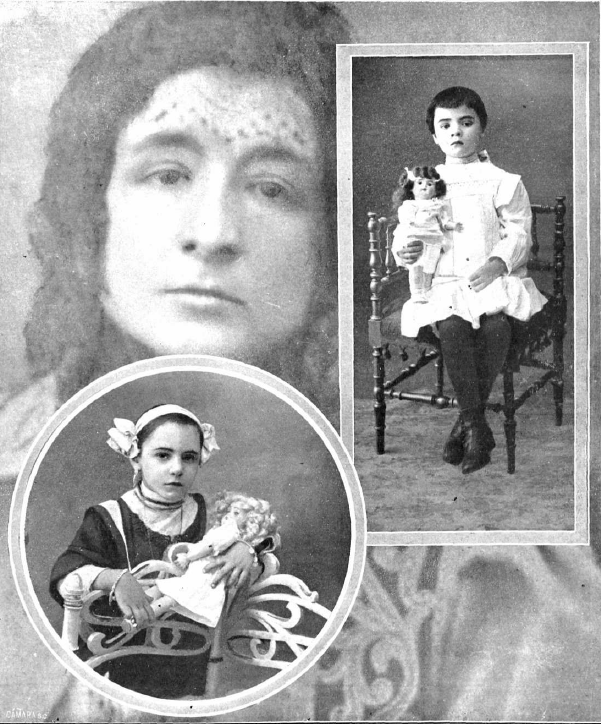
Enriqueta Martí y sus víctimas
Sources
Frequently Asked Questions
Table of Contents
Case Summary
On the morning of February 10, 1912, Barcelona police broke down the door of a ground-floor apartment on Carrer de Ponent and found something that would haunt the city for generations. Behind a locked interior door sat roughly fifty jars and basins arranged with terrible precision: congealed human blood, rendered fat, hand skeletons, bone dust, and small glass vials of finished elixirs, each one labeled in elegant calligraphy. Cowering in the front room were two children, one of them a five-year-old girl named Teresita who had been missing from the streets of El Raval for only days.
The apartment's tenant was a woman named Enriqueta Martí Ripollés. By day, neighbors knew her as a ragged beggar who shuffled through Barcelona's poorest quarters with a child at her side. By night, she was something else entirely: wigged, jeweled, and dressed in silk, moving through the parlors of the city's wealthiest families and selling them preparations she claimed could cure tuberculosis, reverse aging, and treat venereal disease. Preparations made, authorities alleged, from the bodies of the city's most vulnerable children.
She became known across Spain as "The Vampire of Barcelona." She was never convicted. She never stood trial. And the full truth of what happened inside that locked room may have been buried, deliberately and permanently, by the very people she served.
February 2, 1868, Sant Feliu de Llobregat, Catalonia, Spain(Age: 45)
May 12, 1913, Reina Amàlia Prison, Barcelona, Spain (Disputed: officially listed as uterine cancer on death certificate; most accounts indicate she was lynched/beaten to death by fellow inmates, possibly coordinated by wealthy clients to silence her before trial)
Case Details
The child had been missing for only a few days when Inspector Ribot's men climbed the steps at No. 29 Carrer de Ponent. It was February 10, 1912, a cold winter morning in Barcelona's Raval quarter, and the building was the kind of place the city preferred not to think about: crumbling plaster, dim corridors, the smell of mold and coal smoke. A neighbor had reported seeing a small girl enter the ground-floor flat and not come out. The police knocked. Then they broke the door down.
What they found inside would consume Barcelona for the next year and echo through Catalan culture for more than a century after.
In the front room, huddled and malnourished, were two children: five-year-old Teresita Guitart Congost, who had been snatched from the streets of El Raval days earlier, and a second girl named Angelita, whose condition suggested she had been there considerably longer. The apartment's tenant was absent. But behind a locked interior door, the police found her work.
Approximately fifty jars and basins, arranged with a kind of awful deliberateness, lined the surfaces of the back room. Inside them: congealed human blood, rendered human fat, fragments of bone, skeletal hands, fine bone dust, braids of human hair, and finished preparations in small glass vials, some sealed with wax and labeled in a careful, elegant hand. On a shelf sat an ancient book bound in parchment, and beside it a notebook filled with recipes and instructions for potions, written in the same meticulous calligraphy. There were coded letters. There was a list of names.
The list of names would become one of the most incendiary documents in the city's modern history.
The woman who lived in that apartment was Enriqueta Martí Ripollés, born February 2, 1868, in Sant Feliu de Llobregat, a modest town southwest of Barcelona. She had grown up in a peasant family, knowing poverty the way certain people know the weather: as something constant, something that shapes the body and narrows the possible futures. She moved to Barcelona as a young woman and found work as a servant, then as a nanny. Both were respectable enough trades. Neither paid well. She drifted, as desperate women in that era often did, toward prostitution.
She had married, briefly and badly, in 1895. Her husband was a painter named Juan Pujaló. The union collapsed when he found he could not live with whatever he discovered about her other life. They separated. They had no children.
By the turn of the century, Martí had settled into a double life of extraordinary audacity. In the daylight hours she dressed in rags and haunted the poorest districts of Barcelona, begging with a child beside her, blending seamlessly into the landscape of urban misery. The children who accompanied her on those rounds were not her own. After dark, she transformed: wigs, jewelry, expensive gowns. She moved through the drawing rooms and private clinics of Barcelona's upper classes, carrying her preparations in their elegant little vials and collecting significant sums of money.
Her sales pitch rested on a belief that was not entirely fringe for the era. Certain folk remedies and pseudo-medical treatments of the time held that substances derived from the bodies of children, particularly young, unbaptized, or otherwise "pure" children, held curative and even mystical properties. Martí allegedly told her clients that her elixirs could treat tuberculosis, one of the great killers of the age; that her ointments could halt the visible aging of the skin; that her preparations could address the symptoms of venereal disease. Her clients, if the whispers were accurate, included doctors, politicians, bankers, and businessmen. People with everything to lose.
The children she used to make these preparations came from El Raval and similar neighborhoods, places where poverty was dense enough that a child could vanish and the disappearance might be attributed to any number of causes. Authorities later estimated she had been operating for roughly a decade, possibly from around 1900, though the true timeline was never established in court. The estimated victim count ranges from ten to twelve or more, with figures varying by source. None of it was ever proven at trial.
This was not, it turned out, her first encounter with law enforcement. During Barcelona's Semana Trágica, the Tragic Week of 1909, police had reportedly discovered a child brothel she was operating and taken her into custody. She was released. The prevailing explanation, accepted by most historians, is that her clients intervened. Men with sufficient standing to make a problem disappear had every incentive to make this particular problem disappear quickly.
She walked free and returned to her work.
Teresita Guitart Congost changed that. The girl's kidnapping was recent enough, and the neighborhood alarmed enough, that the police moved before Martí could slip the net. She was not in the apartment when Ribot's men arrived on February 10. She was arrested seventeen days later, on February 27, 1912, and taken to Reina Amàlia Prison.
Barcelona's reaction was not calm. The city had been living for years with the low-grade dread of children who vanished and never returned. Now, with the details of that locked room circulating through the press, the dread curdled into fury. Crowds gathered outside the prison. Newspapers ran composite illustrations of Martí surrounded by her alleged victims' faces, under headlines that named her "The Vampire of Carrer de Ponent" and, more enduringly, "The Vampire of Barcelona." Parents who had spent years wondering what had happened to their children began to wonder if they now knew.
Inside the prison, Martí gave the investigators very little. She confessed to running a small brothel on Carrer Sabadell, where a seventeen-year-old girl had been prostituted, and she admitted to performing abortions. These were serious crimes in 1912 Spain. But she would not confess to murder. She would not account for the contents of those jars. When the interrogation pressed her too hard, she attempted suicide with a wooden knife she had somehow fashioned or obtained; she slashed her wrists and survived.
The notebook of recipes, the coded letters, the ancient parchment book: investigators worked through all of it. The document that fascinated and frightened the city most, though, was the list of names found in the apartment. The public, and much of the press, concluded immediately that it was a client list, a registry of the prominent Barcelonians who had purchased Martí's preparations, knowing or at least suspecting what went into them. The authorities looked at the same list and announced, with a composure that struck many as convenient, that it was merely a record of households where Martí had begged. Nothing to see. No further inquiry warranted.
The suppression of that list, whether it was a genuine client registry or not, became one of the case's defining controversies. Barcelona in 1912 was still raw from the Tragic Week of 1909, a period of street fighting and church burnings that had exposed the city's class tensions in the most violent possible way. A public trial that named wealthy clients in connection with the torture and killing of poor children could have torn the city apart. The incentive to bury it was enormous.
Bury it they did. Enriqueta Martí Ripollés died in Reina Amàlia Prison on May 12, 1913, approximately fifteen months after her arrest. She had never been tried. The case was still in its investigative phase.
Her death certificate lists uterine cancer as the cause of death. Most accounts, including those drawn from contemporary reports and prisoner testimony, tell a different story: that she was beaten to death by fellow inmates in a prison courtyard, in a coordinated assault that some historians believe was arranged by the clients whose names she carried in her memory, the ones the list had failed to fully reveal. Whether the cancer was real, whether it was a cover story, or whether it was a convenient coincidence, no one has ever definitively established.
She was buried in secret, in a common grave at the Cementerio del Sudoeste on the slopes of Montjuïc. The authorities chose a quiet interment deliberately; a public funeral procession might have drawn the kind of crowd that ends in riot.
The Reina Amàlia prison was eventually demolished. Carrer de Ponent was renamed Carrer de Joaquín Costa. The physical traces of Enriqueta Martí's story were steadily erased from the city's surface. The story itself proved far harder to erase.
For generations of Catalan children, her name functioned as a bogeyman, the figure parents invoked when children wandered too far or stayed out too late: be careful, or the Vampire will find you. The oral tradition kept her alive in the culture long after the official record had gone cold.
In more recent decades, scholars have returned to the case with fresh skepticism. Barcelona writer Jordi Corominas, whose 2014 book "Barcelona 1912" examined the evidence in detail, argued that the serial killer narrative was substantially constructed by a sensation-hungry press in a city still shaking from the traumas of 1909. Corominas and other revisionist historians have pointed out that Martí's guilt for murder was never established in court, that the physical evidence was interpreted through a lens of moral panic, and that her apparent uterine cancer might explain some of the biological material found in the apartment. They have raised the possibility that mental illness played a significant role, that the woman in that apartment was not a calculating predator so much as someone deeply sick, operating at the margins of a society that had failed her comprehensively.
The counterargument is equally straightforward: two living children were found in that apartment. Fifty jars of human remains were found in that locked room. Children had been disappearing from those streets for years.
No trial ever weighed those facts in open court. No verdict was ever reached. The list of names was suppressed, the suspect died in custody under disputed circumstances, and the evidence was interpreted by institutions that had powerful reasons to limit what the public learned.
What remains is a case shaped more by silence than by testimony, more by what was hidden than by what was revealed. The cultural works it has inspired, including a 2011 musical by Albert Guinovart that won Spain's Max Award for Performing Arts and Lluís Danés's 2020 film "La Vampira de Barcelona," which won the Audience Award at the Sitges International Fantastic Film Festival, keep returning to the same unanswered question at the story's core: not just what Enriqueta Martí did, but who helped her do it, who protected her in 1909, who arranged to have her silenced in 1913, and whose names were really on that list.
Barcelona has never fully answered. Perhaps it never will.
Timeline
Birth in Sant Feliu de Llobregat
Enriqueta Martí Ripollés was born on February 2, 1868, in Sant Feliu de Llobregat, a small town near Barcelona, Catalonia, Spain, into a rural peasant family. Her humble origins would stand in stark contrast to the wealthy elite she would later serve as an adult. Little is documented about her childhood, but poverty shaped the trajectory of her life.
Establishes her origins and the socioeconomic backdrop that would define her double life decades later.
Move to Barcelona and Early Working Life
As a young woman, Enriqueta migrated to Barcelona, where she initially worked as a domestic servant and nanny in the homes of wealthier families. Unable to sustain herself through legitimate work, she eventually turned to prostitution, gaining intimate knowledge of Barcelona's underworld as well as its upper-class social circles. This period gave her access to both the city's poorest neighborhoods and its most privileged households.
Her early exposure to both extremes of Barcelona society laid the groundwork for the predatory double life she would later lead.
Marriage to Painter Juan Pujaló
Enriqueta married Barcelona painter Juan Pujaló in 1895, in what appeared to be an attempt to establish a respectable life. The marriage quickly deteriorated when Pujaló refused to accept her criminal double life, and the couple separated without having any children together. The failed marriage left her operating entirely outside the bounds of conventional society.
The collapse of her marriage marked the point at which Martí fully committed to a clandestine criminal existence with no domestic anchor.
Decade of Child Kidnappings Begins
Around the turn of the century, Martí began systematically kidnapping children — reportedly aged newborn to twelve years — from the impoverished El Raval neighborhood and other poor districts of Barcelona. She disguised herself in rags and begged in the streets, often with kidnapped children in tow to elicit sympathy and charitable donations. At night she transformed, donning wigs, jewellery, and luxurious clothing to move among Barcelona's wealthy elite as a supplier of 'miraculous' preparations.
This marks the beginning of an estimated decade of predatory crimes that would eventually claim an unknown number of child victims.
First Police Discovery During Tragic Week
During the violent social uprising known as La Setmana Tràgica (the Tragic Week) of 1909, Barcelona police reportedly first uncovered evidence of Martí's child brothel operation and detained her briefly. She was released from custody without charge, allegedly through the direct intervention of powerful and wealthy clients whose names appeared in her possession. This early escape from justice allowed her crimes to continue for nearly three more years.
Her release under apparent elite protection demonstrated the dangerous reach of her client network and foreshadowed the later suppression of her client list.
Apartment Raid and Discovery of Teresita Guitart
On February 10, 1912, Barcelona police led by Inspector Ribot raided Martí's apartment at No. 29 Carrer de Ponent (later renamed Carrer de Joaquín Costa) after a neighbor reported hearing a child crying. Officers discovered two living children: five-year-old Teresita Guitart Congost, recently kidnapped, and another severely malnourished child named Angelita. A locked room yielded approximately fifty jars and basins containing preserved human remains — congealed blood, human fat, bone fragments, hand skeletons, bone dust, hair, and finished potions ready for sale.
The raid produced the physical evidence that broke the case open and shocked Barcelona, exposing the full horror of Martí's alleged crimes to the public and press.
Discovery of the Controversial Client List
Among the items seized during the apartment raid were an ancient parchment-covered book, a notebook of potion recipes written in elegant calligraphy, coded letters, and a highly controversial list of names belonging to prominent Barcelona families — widely believed by the public to be a client list of doctors, politicians, businessmen, and bankers who had purchased her preparations. Authorities publicly dismissed the list as a beggar's record of charitable donors, but suppressed its full contents, fearing riots in the aftermath of the Tragic Week. The list's existence fueled enduring speculation that powerful figures orchestrated her eventual silencing.
The suppressed client list became the most politically explosive element of the case and may have sealed Martí's fate by making her a dangerous liability to influential people.
Formal Arrest and Imprisonment
Enriqueta Martí was formally arrested on February 27, 1912, and transferred to Reina Amàlia Prison in Barcelona, where public outrage was so intense that crowds demanded she be executed by garrote. During interrogation she confessed to prostituting a seventeen-year-old girl at a brothel on Carrer Sabadell and to performing abortions, but she never confessed to murdering anyone. She subsequently attempted suicide in prison by slashing her wrists with a sharpened wooden implement.
Her arrest formally initiated legal proceedings, though the case would never reach trial — making her imprisonment the final act of her judicial story.
Pre-Trial Investigation and Public Indignation
Throughout 1912 and into 1913, Martí's case remained in the pre-trial investigative phase as magistrates attempted to build a formal prosecution while managing an increasingly volatile public atmosphere. Barcelona's press, feeding a sensation-hungry readership, dubbed her 'La Vampira del Raval' and published lurid accounts of her alleged crimes, cementing her status as a monster in the public imagination. The investigation was complicated by the suppression of the client list and the murky circumstances surrounding her 1909 release, which suggested institutional obstruction.
The prolonged pre-trial period — during which she was never formally charged or tried — left the full scope of her crimes permanently unresolved.
Death in Prison Under Disputed Circumstances
Enriqueta Martí died on May 12, 1913, approximately fifteen months after her arrest, in Reina Amàlia Prison. Her official death certificate listed uterine cancer as the cause of death, but the overwhelming consensus among contemporaries and later historians is that she was beaten or lynched to death by fellow inmates in the prison courtyard — possibly coordinated by her wealthy clients to prevent a public trial from exposing them. She was buried secretly in a common grave at the Cementerio del Sudoeste on Montjuïc mountain, with authorities keeping the burial location confidential to avoid public disorder.
Her death before trial ensured that the full truth of her crimes, her client network, and the extent of institutional complicity would never be established in a court of law — a silence that has persisted for over a century.
Crime Location
Photos
Historical photograph of Enriqueta Martí i Ripollés, Spanish child serial killer, kidnapper, and procuress, known as 'The Vampire of Barcelona'
Enriqueta Martí
Enriqueta Martí y sus víctimas
Sources
Frequently Asked Questions
Related Cases
Alleged
Connection tags:
Convicted
Connection tags:
Convicted
Connection tags:
Convicted
Connection tags:
Convicted
Connection tags:
Convicted
Connection tags:
Tags
Popular Culture
movie (2020)
Spanish-language feature film directed by Lluís Danés dramatizing the life and crimes of Enriqueta Martí; won the Audience Award at the Sitges International Fantastic Film Festival.
movie (2011)
Spanish film directed by Carlos Vermut that draws inspiration from the Enriqueta Martí case and the mythology surrounding the Vampire of Barcelona.
TV (2011)
Stage musical composed by Albert Guinovart based on the Enriqueta Martí case; won the Max Award for Performing Arts in Spain.
movie (2011)
Stop-motion animated short film retelling the story of Enriqueta Martí, produced as part of the wave of 21st-century cultural works inspired by her case.
book (2014)
Revisionist non-fiction book by Jordi Corominas re-examining the Enriqueta Martí case, arguing the serial killer narrative was exaggerated by sensationalist press coverage of the era.