Poisoning

17 cases · Violent Crime

Mary Ann Cotton (née Robson)
closedConvictedHistorical

Mary Ann Cotton (née Robson)

Convicted: Mary Ann Cotton (née Robson)

'I won't be troubled long. He'll go like all the rest of the Cottons.' That was Mary Ann Cotton's assessment of her seven-year-old stepson Charles Edward, delivered to a parish official in West Auckland, County Durham, in the spring of 1872. Five days later, the boy was dead. It was the statement that finally brought her down. By the time investigators began pulling at the thread, they found two decades of bodies behind it: eleven of her thirteen children, three of her four husbands, her own mother, and a string of lodgers and stepchildren, each one dead of 'gastric fever,' each one insured, each one mourned briefly and then forgotten. The death toll, historians estimate, may have reached twenty-one. Mary Ann Cotton was a nurse, a mother, a wife. She was trusted by the sick she nursed and by the physicians who signed off on her victims' deaths. She understood, precisely, that Victorian medicine would not look twice at a working-class child dying of gastroenteritis. She killed for insurance money: modest sums, accumulated over years, in exchange for the lives of nearly everyone who had ever depended on her. She was only ever convicted of one murder. She was hanged in Durham County Gaol on March 24, 1873, in a botched execution that left her strangling at the end of a too-short rope. She was forty years old. The full story of what she did is both a portrait of individual evil and an indictment of a system that made it catastrophically easy.

serial killerVictorian era
GT
closedAllegedHistorical

Giulia Tofana (also spelled Toffana, Tophana, Tophania; possible true surname: Mangiardi, per modern scholarship)

Alleged Offender: Giulia Tofana (also spelled Toffana, Tophana, Tophania; possible true surname: Mangiardi, per modern scholarship)

A woman stands over a pot of soup, a small vial in her hand. The liquid she has just tipped into the broth is colorless, odorless, invisible. Then something breaks inside her. She pulls the bowl away from her husband and confesses everything. That single moment of conscience, recorded in court testimony from the 1659 Roman poison investigation, may have unraveled one of the most elaborate criminal networks in early modern history. At its center, at least according to legend, stood a Sicilian woman named Giulia Tofana, creator of a poison so perfectly engineered it mimicked natural illness, so cleverly packaged it passed as a devotional product bearing the image of a saint. Traditional accounts credit her with over 600 deaths, mostly husbands of women with nowhere else to turn. But modern scholarship tells a different story entirely: the woman behind the myth may have died quietly in her sleep around 1651, years before the trial that made her famous. Her real surname may not have been Tofana at all. And the network eventually prosecuted by Roman authorities may have been run by someone else. This is the true story of Giulia Tofana: part documented history, part deliberate mythology, and wholly extraordinary.

Giulia TofanaAqua Tofana
Ranavalona I (born Rabodonandrianampoinimerina; also known as Ramavo, Ranavalo-Manjaka I, and Ranavalona reniny)
closedAccusedHistorical

Ranavalona I (born Rabodonandrianampoinimerina; also known as Ramavo, Ranavalo-Manjaka I, and Ranavalona reniny)

Accused: Ranavalona I (born Rabodonandrianampoinimerina; also known as Ramavo, Ranavalo-Manjaka I, and Ranavalona reniny)

In a single year, 1838, an estimated 100,000 people died by her command, forced to swallow poison from the tangena nut and then prove their innocence by vomiting chicken skin. She ruled Madagascar for thirty-three years, expelled every Christian missionary on the island, mounted the skulls of approximately twenty-one Europeans on pikes along her coastline, and oversaw a population collapse that cut her island's people nearly in half. Her name was Ranavalona I, and for three decades she was the most feared sovereign in the Indian Ocean world. Western contemporaries called her the 'Mad Monarch of Madagascar,' the 'Bloody Mary of Madagascar,' the 'Female Caligula.' Revisionist historians see something else entirely: a pragmatic anti-colonial strategist who kept her island free from European domination at any cost. Both portraits carry weight. Born a commoner around 1778, she seized absolute power through a palace coup, eliminated the legitimate royal heir and his entire family, and never looked back. She died quietly, in her own bed, in her own palace, at approximately eighty-three years of age. France did not colonize Madagascar until 1896, thirty-five years after her death. The full story of her reign is one of blood, genius, and the terrible arithmetic of survival at the height of empire.

Ranavalona IMadagascar
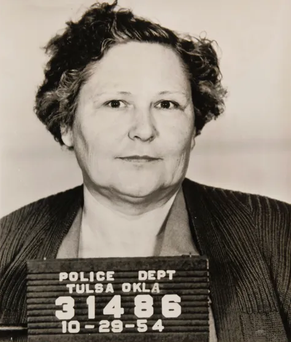
Nancy Agnes Hazel Doss
closedConvictedHistorical

Nancy Agnes Hazel Doss

Convicted: Nancy Agnes Hazel Doss

She sat across from Tulsa police Captain Harry Stege in November 1954 and giggled. She giggled when she described stirring rat poison into her husband's coffee. She giggled when she confirmed she had poisoned four of her five husbands. She giggled when the officers pressed her about the grandchildren, the sisters, the mother. The laughter never quite left her face. Nannie Doss was 49 years old, soft-featured, grandmotherly, and by the time she was arraigned on November 29, 1954, the prime suspect in at least eleven deaths spanning four states and nearly three decades. Her weapons were domestic and unremarkable: stewed prunes, corn whiskey, a slice of prune cake, a cup of morning coffee laced with arsenic. Her victims were the people closest to her, the ones who ate at her table and slept in her bed. Investigators called her 'The Giggling Granny.' The press added 'The Black Widow,' 'Lady Bluebeard,' and 'The Lonely Hearts Killer.' Each nickname captured a piece of her; none captured all of her. Because behind the laughter sat something more complicated and more chilling: a woman who had dreamed her whole life of storybook romance, and who killed, methodically and repeatedly, every time reality fell short of the fantasy. This is the story of Nancy Agnes Hazel Doss, born in rural Alabama in 1905 and buried in a prison cemetery in Oklahoma in 1965. In between, she made sure a great many people never made it out alive.

female serial killerblack widow killer
Laren Renee Sims (alias: Elisa McNabney, also known as Elisa Redelsperger, Elisa Barasch, Shane Ivaroni, and 34+ other aliases — total 38 documented aliases)
closedAccusedHistorical

Laren Renee Sims (alias: Elisa McNabney, also known as Elisa Redelsperger, Elisa Barasch, Shane Ivaroni, and 34+ other aliases — total 38 documented aliases)

Accused: Laren Renee Sims (alias: Elisa McNabney, also known as Elisa Redelsperger, Elisa Barasch, Shane Ivaroni, and 34+ other aliases — total 38 documented aliases)

On Easter Sunday 2002, a jail officer in Brooksville, Florida found a woman dead in her cell. She had braided strips from her pillowcase into a rope and fastened it to an air duct in the ceiling. She was thirty-six years old, and she had been, at various points in her life, at least thirty-eight different people. Her FBI criminal rap sheet ran to one hundred and thirteen pages. Her real name was Laren Renee Sims. Most people knew her as Elisa McNabney, the glamorous, horse-loving wife of Sacramento trial attorney Larry McNabney. In the fall of 2001, she and her twenty-one-year-old legal secretary administered horse tranquilizer to Larry at a show in Los Angeles County, stored his body in a garage refrigerator for three months, buried him in a vineyard, liquidated over $500,000 in assets, and fled across the country in a red Jaguar. She was a former straight-A student with a reported IQ of 140. She was a mother who kept her teenage daughter by her side through the whole gruesome flight. She was a con artist, a forger, and a fugitive. When detectives finally traced her to a Florida beach, she looked up and said simply: "I'm the one you're looking for." This is the story of Laren Renee Sims: a woman who spent thirty years constructing false identities, fell into a marriage that may have saved her and ultimately destroyed her, and chose suicide over a courtroom. It is one of the most bizarre, cold-blooded, and strangely human cases in California criminal history.

poisoninghorse tranquilizer