33 cases from Europe
Convicted: Ghislaine Maxwell
Ghislaine Maxwell, once a high-profile British socialite, became globally notorious following her association and subsequent legal trial with financier Jeffrey Epstein. Her life transformed dramatically from attending elite social gatherings to facing charges in a New York trial for sex trafficking and child abuse. Maxwell's case captured international attention due to its depth of criminal activities intertwined with the lifestyles of the influential. Convicted in 2021, Maxwell was handed a 20-year prison sentence, underscoring her pivotal role in facilitating Epstein's network of sexual exploitation. This outcome not only secured a measure of justice for the victims but also highlighted the severe implications of power misuse in elite circles. Currently, Maxwell remains incarcerated, her previous affluent lifestyle starkly contrasted by her life behind bars, continually making headlines and prompting discussions about accountability and the social elite.
Convicted: Anna Vadimovna Sorokin
When Rachel DeLoache Williams returned from a luxury week at the Surf Club in Marrakech in the spring of 2017, she was $62,000 poorer. Her friend had promised the wire transfer was coming. It never came. The friend was Anna Sorokin, the 26-year-old daughter of a Russian truck driver who had spent four years convincing Manhattan's elite that she controlled a 60-million-euro European trust fund. Operating under the alias Anna Delvey, she defrauded banks, luxury hotels, and private individuals of approximately $275,000, forged financial documents, bounced checks, and nearly secured a $22 million bank loan using fabricated paperwork. When she was arrested, tried, and convicted in 2019, she hired a courtroom stylist and showed up in Saint Laurent and Victoria Beckham, making international headlines for her courtroom looks as much as her crimes. Netflix paid $320,000 for her story. The state took most of it under the Son of Sam law. She was released from prison, immediately detained by ICE, held for nineteen months, then released to house arrest in a 470-square-foot East Village apartment. She started selling art and made $340,000. She appeared on Dancing With the Stars wearing a bedazzled ankle monitor. Her deportation case remains unresolved. Anna Delvey, it turns out, is very hard to get rid of.
Convicted: Myra Hindley
On the morning of October 7, 1965, eighteen-year-old David Smith walked to a public telephone box in Hattersley, Greater Manchester, hands shaking, and dialed 999. The night before, he had watched his brother-in-law bludgeon a seventeen-year-old to death with an axe. The brother-in-law was Ian Brady. The woman who had invited him to witness it was Myra Hindley. What that phone call exposed would redefine evil in the British imagination for generations. Between 1963 and 1965, Brady and Hindley abducted five children and teenagers from the streets of Greater Manchester, sexually assaulted them, and buried four in shallow graves on the desolate expanse of Saddleworth Moor. The fifth was killed in Hindley's living room. The evidence police found inside that house was staggering in its horror: photographs of a ten-year-old girl bound and gagged in Hindley's bedroom, and sixteen minutes of audio tape capturing that same child's final, agonized moments. A luggage ticket for the suitcase containing these materials was found hidden inside the spine of Hindley's Catholic prayer book. Myra Hindley would spend thirty-six years in prison, applying repeatedly for parole, insisting she had changed. The British public never believed her. One of her victims, Keith Bennett, has never been found. His mother died in 2012, still waiting. This is the story of how an ordinary girl from Gorton became the most reviled woman in British criminal history.
Convicted: Maria Licciardi
When Italian police raided what they believed was Maria Licciardi's hideout in June 2001, they expected a spartan fugitive's den. Instead, they found marble floors, a grand piano, and an outsize Jacuzzi — all tucked inside an attic bristling with surveillance cameras. The most powerful woman in the Neapolitan underworld had vanished again, as she always did, slipping back into the maze of streets where she had been born fifty years earlier. A fellow mafioso once told investigators that Maria Licciardi was more dangerous than Sicily's most-wanted fugitive, Matteo Messina Denaro. Italy's Interior Ministry called her the 'strategic head' of a criminal confederation controlling twenty rival Camorra clans. She brokered peace between warring gangsters, dispatched kill orders through a pentito who later testified that 'talking with Maria was the same as talking with Gennaro, the boss,' and in 1999 recalled an entire heroin shipment on quality-control grounds — a decision the Lo Russo clan defied, triggering at least eleven overdose deaths in a single month. She earned three nicknames: La Madrina, La Piccolina, and La Principessa. She earned each of them. This is the story of the woman who ran Naples.
Convicted: Mary Frith
Mary Frith, also known as Moll Cutpurse, was a notorious English pickpocket and fence operating in the London underworld during the late 16th and early 17th centuries. Her criminal activities primarily involved theft, fencing stolen goods, and occasional highway robbery. She was a well-known figure in London, recognized for her unconventional behavior, including wearing male attire and smoking, both of which were highly unusual for women during the period.
Convicted: Ruth Ellis (née Neilson)
"It is obvious when I shot him I intended to kill him." With those eleven words, spoken calmly before a packed courtroom at the Old Bailey, Ruth Ellis handed the jury everything they needed. They deliberated for less than twenty-five minutes. Six weeks later, at nine o'clock on the morning of 13 July 1955, she walked to the gallows at Holloway Prison and became the last woman ever executed in the United Kingdom. She was twenty-eight years old. But the story of how a Welsh-born nightclub manageress came to fire four bullets into her racing-driver lover outside a Hampstead pub on Easter Sunday is not a simple story of jealousy and rage. It is a story of sustained beatings, a miscarriage caused by a punch to the stomach, a secret weapon supplier who was never charged with a crime, and a justice system that hanged a deeply traumatized woman without once telling the jury what she had endured. Seven decades later, her grandchildren are still fighting to clear her name. The question hanging over the case has never been whether Ruth Ellis pulled the trigger. It has always been whether Britain should have pulled the lever.
Convicted: Dagmar Johanne Amalie Overbye
When Copenhagen police sifted through the cold ashes of a masonry stove in a Vesterbro apartment in the autumn of 1920, they found what they had feared most: charred bone fragments and a small, unmistakable human skull. The apartment belonged to Dagmar Johanne Amalie Overbye, a soft-spoken woman who had built a quiet business promising desperate, unmarried mothers a better life for their newborns. She charged them roughly 200 kroner, shook their hands, and took their babies. Then she burned them alive, drowned them, smothered them, or strangled them, disposing of the remains in her stove, her garden, or the building's loft. Between 1913 and 1920, she confessed to killing 16 infants. Police could physically confirm only 9. She is Denmark's most prolific known serial killer, the first woman sentenced to death in the country since 1861, and the architect, however grotesquely, of the child welfare laws that Denmark passed in 1923. Her nickname, whispered across Copenhagen for a century since, is 'Englemagersken': The Angel Maker. This is her story.
Convicted: Fusako Shigenobu
On May 28, 2022, a 76-year-old woman in a black hat and gray suit walked out of a Tokyo prison and let her daughter drape a Palestinian keffiyeh around her shoulders. Cameras clicked. Supporters waved Palestinian flags. And Fusako Shigenobu, the woman Western media had dubbed 'the Empress of Terror,' blinked into the daylight after two decades behind bars. For thirty years before her arrest, she had been one of the world's most wanted fugitives: the founder of the Japanese Red Army, a group linked to bombings, hijackings, and one of the deadliest airport massacres in history. On May 30, 1972, three JRA militants opened fire with automatic weapons at Lod Airport near Tel Aviv, killing 26 people and wounding approximately 80 more in a crowded arrival hall. Shigenobu was never charged for that attack. Born in postwar Tokyo to a disgraced ultranationalist father, she transformed herself from a Kikkoman soy sauce office worker into a global revolutionary, building an armed network from the refugee camps of Beirut while raising a stateless daughter in the shadows. This is the story of how she got there, what she built, and what remains unanswered.
Convicted: Maria Mandl
She held orphaned children from Soviet transports in her arms, sang to them, gave them cookies and chocolate. Then, after a few days, she personally escorted some of them to the gas chambers. This was Maria Mandl: Lagerführerin of Auschwitz II-Birkenau's women's camp, the highest-ranking woman in the entire Nazi concentration camp system, and the figure prisoners knew only as 'The Beast.' Death lists bearing her signature implicate her in approximately 500,000 murders. She organized a prisoner orchestra that played during selections and executions. She rode a bicycle along prisoner lines and struck faces as she passed. And yet, on the morning of her hanging in January 1948, she knelt on a prison floor before a woman she had once held power over, wept, and begged for forgiveness. Her last words were spoken in Polish, a language not her own, in a country she had helped to destroy. Her execution received almost no coverage in the Austrian press. Her death certificate was not amended to reflect her Holocaust role until 2017. The first biography of her life was not published until 2023. This is the story of how a shoemaker's daughter from a small Catholic village in Upper Austria became one of history's most prolific female killers, and how the world spent eighty years looking away.
Convicted: Irma Ilse Ida Grese
Irma Ilse Ida Grese, widely known as the 'Hyena of Auschwitz' and the 'Beast of Belsen', was a Nazi concentration camp Helferin at Ravensbrück, Auschwitz II-Birkenau, and Bergen-Belsen. Her atrocities committed in Birkenau during the Holocaust period made her one of the most notorious female Nazi war criminals. Grese was convicted for crimes against humanity at the Belsen Trial in 1945 and was sentenced to death.
Convicted: Biljana Plavšić
Biljana Plavšić is a former Bosnian Serb politician, university professor, and scientist who notably served as President of Republika Srpska, a region within Bosnia and Herzegovina. During the Bosnian War, she was accused of participating in the planning, instigation, ordering, and execution of crimes against humanity, including genocide, extermination, murder, and other severe violations of international law. In 2003, Plavšić pleaded guilty to crimes against humanity and was sentenced to 11 years in prison by the International Criminal Tribunal for the former Yugoslavia. She was released in 2009 after serving two-thirds of her sentence.
Convicted: Gudrun Ensslin
Gudrun Ensslin was a German far-left militant and founder of the Red Army Faction, a West German terrorist group. She was involved in several bombings, robberies, and other violent actions against the West German government and capitalist institutions. She was arrested in 1972 and was imprisoned until her death in 1977, which was ruled a suicide.
Defendant: Leila Khaled
Leila Khaled, born in 1944, is a Palestinian former militant and activist. She was a member of the Popular Front for the Liberation of Palestine (PFLP). Khaled is known for being the first woman to hijack an airplane. Her first hijacking was in 1969 on a flight from Rome to Athens, which was diverted to Damascus. A year later, she attempted another hijack on a flight from Amsterdam to New York, but this was thwarted by the air marshals on board.
Alleged Offender: Catherine de' Medici
Catherine de' Medici, though not officially convicted or charged, is often implicated in a series of political machinations and alleged crimes during her reign as Queen of France. She is notably associated with the St. Bartholomew's Day Massacre in 1572, where thousands of Huguenots (French Protestants) were slaughtered by Catholic mobs. While her role in the massacre is still debated among historians, she is often portrayed as a perpetrator or instigator.
Alleged Offender: Claudia Berenice Ochoa Félix
In May 2014, a young woman named Yuriana Castillo Torres was kidnapped off the streets of Culiacán, Sinaloa, and murdered. The men who took her believed she was someone else: a glamorous social media star whose physical resemblance to Kim Kardashian had made her the most-talked-about woman in the narco underworld. The intended target, Claudia Ochoa Félix, was alive. For now. She had been born into the capital of Mexico's deadliest cartel territory, married a Sinaloa Cartel lieutenant, survived a car crash that killed her boyfriend, and allegedly fallen in love with the man who commanded the cartel's most feared assassination squad. By 2014, her Instagram account was a fever dream of gold-plated rifles, stacks of cash, and designer everything, and the world had decided she was the 'Empress of the Ántrax.' She said it was all lies. Mexican authorities said she was never under investigation. A respected journalist who knew the cartel better than almost anyone agreed she showed no signs of actual membership. Then, on a September morning in 2019, she was found dead in a private residence in her hometown. She was 32. The cause was accidental. Some people never believed it.
Convicted: Rosemary Pauline West (née Letts; also known as Jennifer Jones since 2020)
In February 1994, police arrived at 25 Cromwell Street, Gloucester, looking for a missing teenage girl. What they found instead would stop Britain cold: nine sets of human remains buried beneath the floorboards and garden of a nondescript terraced house — and that was only the beginning. Rosemary West, a 40-year-old mother of eight, sat at the center of it all. She had helped lure young women and girls to that house. She had participated in their torture, their sexual abuse, their deaths. She had then gone on living there — cooking meals, watching television, raising children — while the bodies of ten victims, including her own stepdaughter and her own teenage daughter, rotted in the earth beneath her feet. On 22 November 1995, a jury took less than two days to convict her on all ten counts of murder. The judge said she should never be freed. He was right. Thirty years later, Rose West — now calling herself Jennifer Jones — remains in a prison cell, in declining health, largely alone, still insisting she is innocent. This is the story of how ordinary evil hides in plain sight.
Convicted: Doris Marie Payne
She was 86 years old, wearing an electronic ankle monitor from her previous arrest, and she was shoplifting $86 worth of merchandise from a Walmart near Atlanta. That is the last chapter, so far, in the seven-decade criminal career of Doris Marie Payne, a woman who once walked out of a Monte Carlo Cartier boutique with a half-million-dollar diamond hidden in the seam of her girdle. Born in the coal-scarred poverty of Slab Fork, West Virginia, in 1930, Payne became the most prolific jewel thief in American history: over $2 million stolen, 32 aliases, nine passports, ten Social Security numbers, and an FBI file reportedly six feet long. She wore designer clothes into the finest jewelry stores in Paris, Rome, Geneva, and Tokyo, charmed the clerks with a smile, and walked out richer. Judges called her "the Terminator." Interpol tracked her for decades. She expressed no remorse, ever. Now approaching 95, she lives as a free woman in Atlanta. A documentary about her life won an Audience Award at Tribeca. Halle Berry is reportedly attached to play her in a biopic. And through it all, Doris Payne has remained exactly what she always was: the best-dressed thief in the room.
Convicted: Mary Ann Cotton (née Robson)
'I won't be troubled long. He'll go like all the rest of the Cottons.' That was Mary Ann Cotton's assessment of her seven-year-old stepson Charles Edward, delivered to a parish official in West Auckland, County Durham, in the spring of 1872. Five days later, the boy was dead. It was the statement that finally brought her down. By the time investigators began pulling at the thread, they found two decades of bodies behind it: eleven of her thirteen children, three of her four husbands, her own mother, and a string of lodgers and stepchildren, each one dead of 'gastric fever,' each one insured, each one mourned briefly and then forgotten. The death toll, historians estimate, may have reached twenty-one. Mary Ann Cotton was a nurse, a mother, a wife. She was trusted by the sick she nursed and by the physicians who signed off on her victims' deaths. She understood, precisely, that Victorian medicine would not look twice at a working-class child dying of gastroenteritis. She killed for insurance money: modest sums, accumulated over years, in exchange for the lives of nearly everyone who had ever depended on her. She was only ever convicted of one murder. She was hanged in Durham County Gaol on March 24, 1873, in a botched execution that left her strangling at the end of a too-short rope. She was forty years old. The full story of what she did is both a portrait of individual evil and an indictment of a system that made it catastrophically easy.
Convicted: Vera Renczi
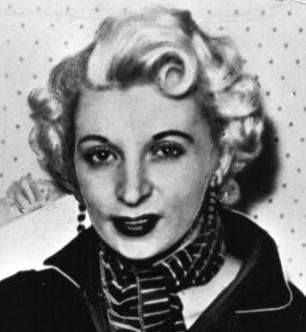
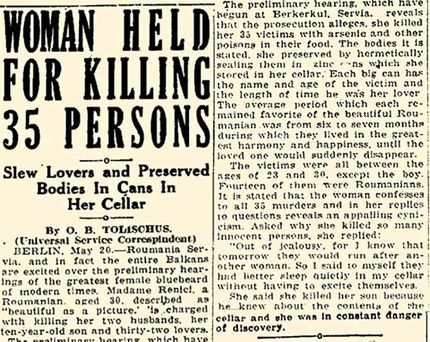
Thirty-two men lay in zinc-lined coffins in the wine cellar beneath a Romanian chateau, each one poisoned with arsenic by the woman who had loved them. Or so the story goes. Vera Renczi, dubbed the 'Black Widow' and 'Chatelaine of Berkerekul,' is one of history's most notorious female serial killers: a wealthy beauty who allegedly confessed to murdering 35 people during the 1920s, including two husbands, dozens of lovers, and her own son. According to the legend, she laced their wine when she feared they might leave her, then kept their bodies in the cellar so they never could. Police reportedly found her sitting peacefully among the coffins. But here is where the story fractures. When the Guinness Book of World Records investigated in 1972, researchers found nothing verifiable: no arrest records, no trial transcripts, no regional newspapers, no prison files. Every account traces back to a single 1925 dispatch by an American journalist who cited no primary sources. Photographs circulated as Renczi's have been identified as a Russian actress dead since 1910. The Daily Mirror once published a photo of a living Spanish fashion model and called it Renczi, later apologizing unreservedly. Was Vera Renczi a monster, or a myth? The answer, it turns out, is more unsettling than either option alone.
Convicted: Elizabeth Báthory
Elizabeth Báthory, a Hungarian noblewoman from the powerful House of Báthory, is notorious for her alleged crimes as a serial killer. Between 1590 and 1610, she and her four accomplices were accused of torturing and killing hundreds of girls and women. The victims were predominantly from the lower classes, and the crimes were purportedly committed in her estates across the Kingdom of Hungary. Báthory's trial resulted in the execution of her servants, while she herself was imprisoned in the Castle of Csejte where she eventually died in 1614.
Convicted: Ilse Koch
Ilse Koch, a German war criminal, committed horrific acts during World War II while her husband Karl-Otto Koch was the commandant at Buchenwald concentration camp. Though she had no official position in the Nazi state, she became one of the most infamous figures after the war due to her involvement in atrocities. She was known as the 'Kommandeuse of Buchenwald' and was accused of taking souvenirs from the skin of murdered inmates.
Accused: Enriqueta Martí Ripollés
On the morning of February 10, 1912, Barcelona police broke down the door of a ground-floor apartment on Carrer de Ponent and found something that would haunt the city for generations. Behind a locked interior door sat roughly fifty jars and basins arranged with terrible precision: congealed human blood, rendered fat, hand skeletons, bone dust, and small glass vials of finished elixirs, each one labeled in elegant calligraphy. Cowering in the front room were two children, one of them a five-year-old girl named Teresita who had been missing from the streets of El Raval for only days. The apartment's tenant was a woman named Enriqueta Martí Ripollés. By day, neighbors knew her as a ragged beggar who shuffled through Barcelona's poorest quarters with a child at her side. By night, she was something else entirely: wigged, jeweled, and dressed in silk, moving through the parlors of the city's wealthiest families and selling them preparations she claimed could cure tuberculosis, reverse aging, and treat venereal disease. Preparations made, authorities alleged, from the bodies of the city's most vulnerable children. She became known across Spain as "The Vampire of Barcelona." She was never convicted. She never stood trial. And the full truth of what happened inside that locked room may have been buried, deliberately and permanently, by the very people she served.
Convicted: Jacqueline Sauvage
At 7:27 PM on September 10, 2012, Jacqueline Sauvage called emergency services in rural central France to report that her husband was on the terrace of their home, shot three times in the back. He was dead. The night before, their only son Pascal had hanged himself. Jacqueline was 64 years old, married for 47 years, and had allegedly spent nearly five decades absorbing the fists, boots, and violations of the man now cooling on the terrace flagstones. She would later say she fired the shots with her eyes closed. The case that followed split France down the middle, drew nearly 436,000 petition signatures, forced a sitting president to act twice, and dragged into the open a question French law had never been designed to answer: what does self-defense mean for a woman who has been taught by decades of violence that by the time the threat feels immediate, it is already too late? This is the story of Jacqueline Sauvage, a woman the courts convicted of murder, the public embraced as a martyr, and history will not easily categorize.
Alleged Offender: Giulia Tofana (also spelled Toffana, Tophana, Tophania; possible true surname: Mangiardi, per modern scholarship)
A woman stands over a pot of soup, a small vial in her hand. The liquid she has just tipped into the broth is colorless, odorless, invisible. Then something breaks inside her. She pulls the bowl away from her husband and confesses everything. That single moment of conscience, recorded in court testimony from the 1659 Roman poison investigation, may have unraveled one of the most elaborate criminal networks in early modern history. At its center, at least according to legend, stood a Sicilian woman named Giulia Tofana, creator of a poison so perfectly engineered it mimicked natural illness, so cleverly packaged it passed as a devotional product bearing the image of a saint. Traditional accounts credit her with over 600 deaths, mostly husbands of women with nowhere else to turn. But modern scholarship tells a different story entirely: the woman behind the myth may have died quietly in her sleep around 1651, years before the trial that made her famous. Her real surname may not have been Tofana at all. And the network eventually prosecuted by Roman authorities may have been run by someone else. This is the true story of Giulia Tofana: part documented history, part deliberate mythology, and wholly extraordinary.
Accused: Onie Virginia Hill
On the evening of June 20, 1947, a .30-caliber carbine was pressed against the window of a Beverly Hills mansion and fired nine times. Benjamin "Bugsy" Siegel, reading the newspaper on the sofa inside, was dead before he hit the floor. His right eye was found fifteen feet away. His girlfriend, Virginia Hill, had flown to Paris four days earlier. She described it as a spontaneous vacation. Nobody believed her. Not the investigators. Not the mob. Not the men who had watched her move money across state lines, carry intelligence between crime families, and charm her way through two decades in the highest ranks of American organized crime. Born dirt-poor in rural Alabama in 1916, Hill had transformed herself from a seventeen-year-old shimmy dancer at a World's Fair restaurant into the only woman ever officially identified as a Mafia associate. The United States Senate called her a "central clearing house" for organized crime intelligence. Everyone else called her the Queen of the Mob. When her body was found beside an Austrian brook in March 1966, authorities ruled it a suicide. Bruises on her neck, an unidentified substance in her blood, and a diary full of mob secrets suggested the real story was considerably more complicated. It almost always was, with Virginia Hill.
Subject: Amanda Marie Knox
In a Florence courtroom on June 5, 2024, Amanda Knox wept. She had crossed the Atlantic for the first time in over a decade to stand before Italian judges on a slander charge she had carried like a stone since the night police interrogated her without a lawyer for fifty-three hours and she signed a statement accusing an innocent man. The court re-convicted her. She had already served the time. Seven months later, Italy's highest court upheld that conviction. It was the final word in a legal saga that had consumed nearly eighteen years of her life, begun when her British roommate Meredith Kercher was found stabbed to death in their shared Perugia apartment in November 2007. Knox was twenty years old. She would be tried four times, convicted twice for murder, acquitted twice, convicted again for slander, and acquitted of murder a final time by a court that cited "stunning flaws" in the original prosecution. Meredith Kercher's actual killer, Rudy Guede, served thirteen years and walked free in 2021. The question the world has argued about ever since is not simply whether Amanda Knox killed anyone. It is about what happens when a justice system, an international media frenzy, and a culture hungry for a villain fix their gaze on a young woman and refuse to look away.
Convicted: Amelia Elizabeth Dyer (née Hobley)
'You'll know all mine by the tape around their necks.' When Amelia Dyer spoke those words to Reading police in the spring of 1896, she did so with the calm of a woman who had been getting away with murder — quite literally — for two decades. On March 30, 1896, a bargeman pulled a brown paper parcel from the River Thames near Caversham. Inside was a baby girl, strangled with white dressmaker's tape. She would not be the last. By the time detectives closed in on the mild-mannered, churchgoing widow operating out of a modest terrace on Kensington Road, seven infant bodies had been recovered from the river. Experts now estimate that Amelia Dyer — the 'Ogress of Reading,' a trained nurse turned baby farmer — murdered between 200 and 400 children over twenty years, making her one of the most prolific killers in British history. The jury took four and a half minutes to convict her. The tape never lied. This is her story.
Convicted: Mary Flora Bell
The morning after Mary Bell strangled four-year-old Martin Brown to death, she broke into a nursery school and left four handwritten notes claiming responsibility for the killing. Police dismissed them as a prank. The author was ten years old. What followed over the summer of 1968 in Scotswood, Newcastle, was one of the most disturbing chapters in British criminal history: a child killer operating in plain sight, in broad daylight, returning to mutilate a victim's body with broken scissors, and sitting with the grieving families of her victims as though nothing had happened. Mary Flora Bell was not a monster who emerged from nowhere. She was a product of almost incomprehensible abuse, a girl whose own mother allegedly tried to poison her with sleeping pills and drop her from a first-floor window. That context explains nothing and excuses nothing, but it haunts everything. She would become Britain's youngest female killer on record, a title she still holds. This is her story.
Convicted: Christine Léa Papin
Christine Léa Papin and her sister Léa Papin were both live-in maids who were convicted for the murder of their employer's wife and daughter in Le Mans, France on February 2, 1933. The crime, which was a shocking and brutal attack, stunned the country and has been the subject of numerous books, films, and studies. The sisters were found guilty and sentenced to prison, with Christine's sentence being commuted to life imprisonment after a retrial.
Convicted: Locusta
Locusta, also known as Lucusta, was a notorious poison maker in the 1st-century Roman Empire. She was active during the final two reigns of the Julio-Claudian dynasty and is believed to have been involved in the assassinations of Claudius and Britannicus. Emperor Nero favored her and had her train other poisoners in his service. After Nero's death, Locusta was executed by his successor, Galba.
Accused: Ruja Plamenova Ignatova
Ruja Plamenova Ignatova is a Bulgarian and German entrepreneur known for being one of the FBI's Ten Most Wanted Fugitives. She is best known as the founder of OneCoin, a fraudulent cryptocurrency scheme described by The Times as 'one of the biggest scams in history.' In 2017, Ignatova boarded a flight to Athens and has not been seen since. Despite her disappearance, she remains a figure of interest in ongoing investigations into her fraudulent activities.
Convicted: Darya Nikolayevna Saltykova
Darya Nikolayevna Saltykova, also known as Saltychikha, was a Russian noblewoman, sadist, and serial killer from the Saltykov family in Moscow. She was notorious for her brutal treatment and murder of many of her serfs, especially women. Her crimes have often been compared to those of the Hungarian 'Blood Countess,' Elizabeth Báthory, who allegedly committed similar atrocities against servant girls and local serfs in her home, Čachtice Castle. The charges against Saltykova, however, are better documented and less disputed by historians.
Convicted: Clara Hamilton Harris (later Clara Hamilton Harris Rathbone)
She survived the night Abraham Lincoln was shot. She held her fiancé's arm together with her bare hands while his blood soaked her white dress from collar to hem. She stayed until dawn with a screaming, inconsolable Mary Todd Lincoln, absorbing the widow's grief alongside her own. Clara Harris endured all of that — and still, eighteen years later, she never saw her death coming. On the night of December 23, 1883, in a consular residence in Hanover, Germany, her husband Henry Rathbone shot and stabbed her to death in their bedroom while their three children slept nearby. He then turned the knife on himself five or six times. He survived. She did not. A German court found Henry guilty but criminally insane. He was committed to an asylum, where he lived another twenty-seven years, apparently never fully comprehending what he had done. The children were shipped back across the Atlantic. Clara was buried in a foreign city cemetery and eventually disinterred when no family came to tend her grave. This is the story of a woman who sat two feet from history's most famous assassination, and lived to describe it — only to become the victim of a quieter, more intimate one. It is also the story of what trauma does to the people left alive in its wake: how it metastasizes, quietly, over years, until it destroys everything it touches.